California Government Branches — Reading Comprehension
Rate this
Premium Resource
Present
Present in classroom. No work saved
Assign
Classroom with student accounts, Track progress
Quick Play
No student accounts, assign with a link
Grades
3
4
5
Standards
D2.CIV.1.3-5
D2.CIV.2.3-5
RI.4.3
RI.4.4
W.4.2
PRINT+DIGITAL RESOURCE
This learning resource is available in interactive and printable formats. The interactive worksheet can be played online and assigned to students. The Printable PDF version can be downloaded and printed for completion by hand.
This engaging history reading passage introduces students to the three branches of California government: the Legislative, Executive, and Judicial branches. Students will learn how these branches work together to create, enforce, and interpret laws, and why this system is important for fairness and democracy. The passage includes clear examples, grade-appropriate vocabulary, and a cause-and-effect structure to support literacy skills. Activities include a multiple-choice quiz, a writing prompt, and a graphic organizer to deepen understanding. The passage is aligned to C3 Framework and Common Core standards, making it perfect for classroom use. A Spanish translation and read aloud audio are included, supporting language learners and diverse classrooms. Key vocabulary terms are highlighted and defined to enhance comprehension. This resource helps students build foundational knowledge about government and citizenship, preparing them for future civic understanding.
CONTENT PREVIEW
Expand content preview
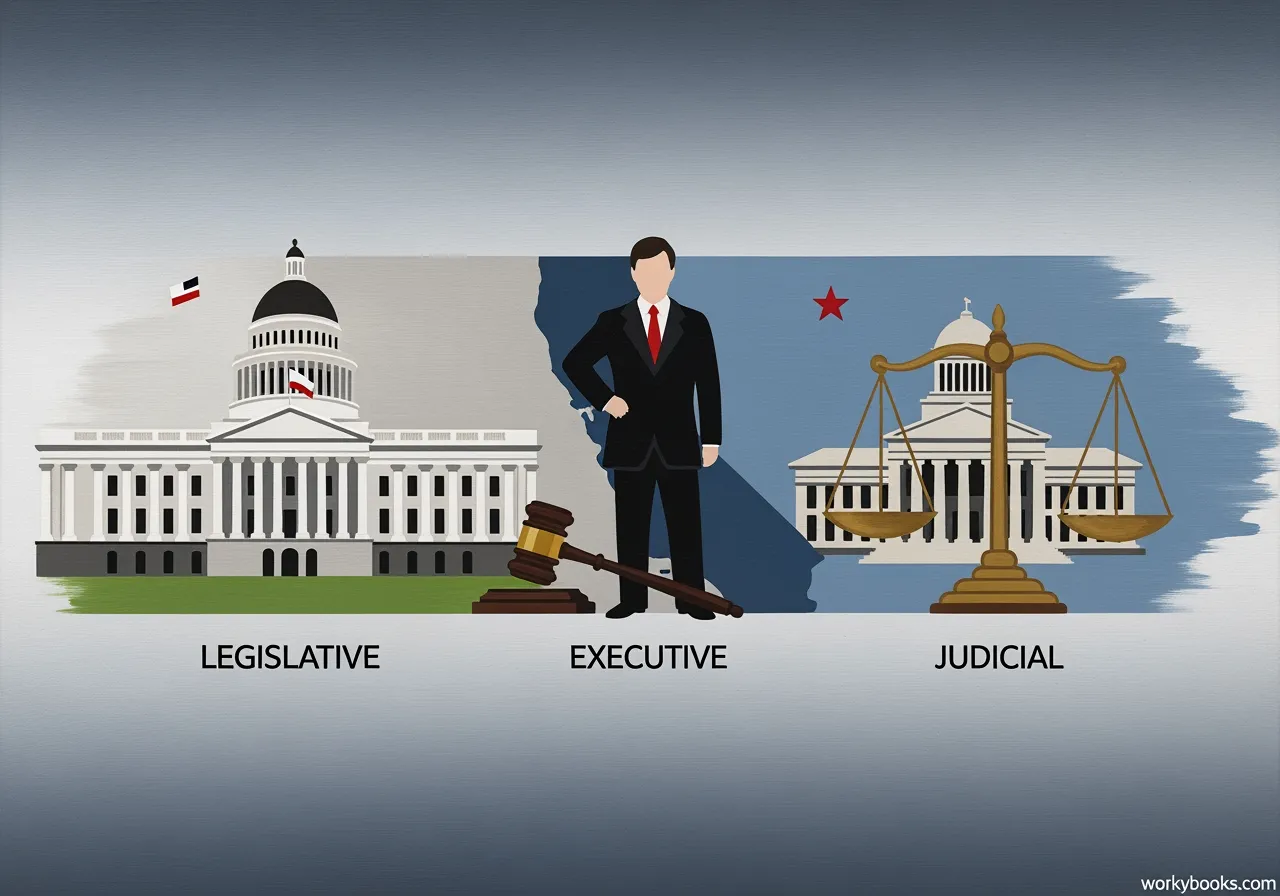
Artistic Representation of the Legislative, Executive, and Judicial branches ensure California's government remains fair.
California’s government is divided into three main branches. These branches are called the executive branch, the legislative branch, and the judicial branch. This system is based on the idea of separation of powers. Each branch has different jobs. No branch can have all the power. This keeps the government fair and balanced.
The executive branch is led by the governor. The governor is elected by the people of California. The executive branch carries out state laws. It makes sure laws are followed. The governor can also suggest new laws. The governor can sign bills into law or veto them, which means to reject a bill. The executive branch also manages state agencies, such as schools and public safety.
The legislative branch makes the laws. It is made up of two groups: the State Assembly and the State Senate. Together, they are called the California State Legislature. The legislature writes bills and debates them. If both groups agree, the bill goes to the governor. The legislative branch also decides how the state spends its money, called the budget.
The judicial branch includes the state courts and judges. The highest court in California is the California Supreme Court. The judicial branch makes sure laws are fair and follow the state constitution. Judges can decide if a law is unconstitutional, which means it goes against the state’s rules. Courts also solve problems between people, groups, or the government.
The three branches use a system called checks and balances. This means each branch can limit the power of the others. For example, the governor can veto a bill, but the legislature can override the veto if enough members agree. Courts can stop laws that are unfair. This system helps protect the rights of all Californians.
The separation of powers and checks and balances are important because they prevent any one branch from becoming too strong. This helps make sure the government works for everyone and follows the rules.
Interesting Fact: The California State Capitol building in Sacramento is where the governor, legislature, and courts all meet to do their important work.
Who leads the executive branch?
The governorThe judgeThe mayorThe president
What does the legislative branch do?
Makes lawsCarries out lawsRuns courtsTeaches students
What is the highest court in California?
California Supreme CourtLos Angeles CourtFederal CourtState Assembly
What is separation of powers?
Each branch has its own jobAll power in one branchNo laws are madeOnly the governor rules
Why are checks and balances important?
To limit branch powerTo spend moneyTo elect judgesTo write new laws
What happens if a law is unconstitutional?
Courts can stop itGovernor signs itAssembly votes againBudget is changed
The governor can veto bills. True or false?
TrueFalse
What does 'veto' mean?
To reject a billTo create a lawTo spend moneyTo debate a law
Perfect For:
👩🏫 Teachers
• Reading comprehension practice
• Auto-graded assessments
• Literacy skill development
👨👩👧👦 Parents
• Reading practice at home
• Comprehension improvement
• Educational reading time
🏠 Homeschoolers
• Reading curriculum support
• Independent reading practice
• Progress monitoring
Reading Features:
📖
Reading Passage
Engaging fiction or nonfiction text
❓
Comprehension Quiz
Auto-graded questions
📊
Instant Feedback
Immediate results and scoring
📄
Printable Version
Download for offline reading
🔊
Read Aloud
Voice-over with word highlighting
Reviews & Ratings
No reviews yet. Be the first to share your experience!
Related Content
The Three Branches of Government
This engaging history reading passage introduces students to the three branches of government in the United States: the ...
D2.CIV.1.3-5D2.CIV.4.3-5RI.4.1RI.4.3RI.4.4
The Governor’s Job: Leading the State
This reading passage introduces students to the important job of the governor in California. Students will learn how the...
D2.CIV.1.3-5D2.CIV.2.3-5RI.4.3RI.4.4
California Local Government
This engaging U.S. History reading passage introduces students to the roles of city and county governments in California...
D2.CIV.1.3-5D2.CIV.2.3-5RI.4.3RI.4.4
Local Leaders and How They Help Us
This engaging U.S. history passage explores the important roles that local leaders play in communities, with a focus on ...
D2.CIV.1.3-5D2.CIV.2.3-5RI.4.3RI.4.4
The Constitution and Bill of Rights
This passage explores the creation of the United States Constitution and the Bill of Rights. Students will learn about t...
D2.CIV.2.3-5D2.CIV.12.3-5RI.4.1RI.4.3
California Citizen Participation
This engaging U.S. history reading passage explores the important role citizens play in shaping modern America, focusing...
D2.HIS.5.3-5D2.CIV.2.3-5RI.4.3RI.4.4
Town Meetings: How Colonists Made Decisions
This passage explores the role of town meetings in the New England Colonies and how colonists worked together to make im...
D2.HIS.6.3-5D2.CIV.2.3-5RI.4.3RI.4.4
Informational Text —Healthy Teeth and Gums
RI.4.10RI.4.3RF.4.4RF.4.4.A
Informational Text —Migratory Birds
Engage young minds with this worksheet that delves into the wonders of migratory birds. Learn about their extraordinary ...
RI.4.10RI.4.3RF.4.4RF.4.4.A
Informational Text —All About Dentists
Students read an informational text explaining what dentists do and how they are trained. Aligned to RI.4.3-2
RI.4.10RI.4.3RF.4.4RF.4.4.A
Pollination: A Crucial Ecosystem Service
Explore the vital role of pollination beyond plant reproduction, as it sustains ecosystems by ensuring food security, pr...
RI.4.2RI.4.3RI.4.4RI.5.1
The States of Matter: Solid
Discover the differences between solids, liquids and gases by exploring how their particles are arranged and move. This ...
RI.4.2RI.4.3RI.4.4RI.5.1
What is a Simple Machine
Discover the power of simple machines! This informational text explores how basic tools like levers, pulleys and incline...
RI.4.2RI.4.3RI.4.4RI.5.1
The Role of Pollinators in Nature
Learn about the fascinating world of pollinators and discover their crucial role in the reproductive process of flowerin...
RI.4.2RI.4.3RI.4.4RI.5.1
Seed Dispersal: How Plants Travel
Plants may seem stationary, but their seeds have amazing ways to travel! Explore the fascinating world of seed dispersal...
RI.4.2RI.4.3RI.4.4RI.5.1
What is Milky Way
This engaging passage introduces Grade 4-5 students to the Milky Way, our home galaxy. Students will learn that the Milk...
5-ESS1-15-ESS1-2RI.3.1RI.3.4
Andromeda Galaxy
This engaging science passage introduces Grade 4-5 students to the Andromeda Galaxy, our closest large galactic neighbor...
5-ESS1-15-ESS1-2RI.3.1RI.3.4
Bats in the Night
This informative first-grade reading passage delves into the intriguing world of bats, highlighting their nocturnal natu...
RI.3.1RI.4.4RI.4.3
Malala Yousafzai
This Grade 4-5 science reading passage introduces students to Malala Yousafzai, a courageous young woman from Pakistan w...