This passage guides students through the step-by-step process of how a bill becomes a law in California, from the first idea to the governor’s signature. Students will explore the roles of lawmakers, committees, and the governor, building understanding of democracy and the legislative process. The passage uses clear language and grade-appropriate vocabulary to support literacy and social studies skills, and includes a Spanish translation for accessibility. Activities include a reading comprehension quiz, writing prompts, and graphic organizers to deepen learning. A timeline helps students visualize the sequence of events. This U.S. history reading passage is aligned with HSS 4.5.3 and RH.6-8.2, and is designed to meet literacy and history standards. The resource also features read aloud audio and is suitable for classroom use or independent study.
Written by Workybooks TeamPublished by Workybooks
Preview
Sample passage and quiz content
CONTENT PREVIEW
Expand content preview
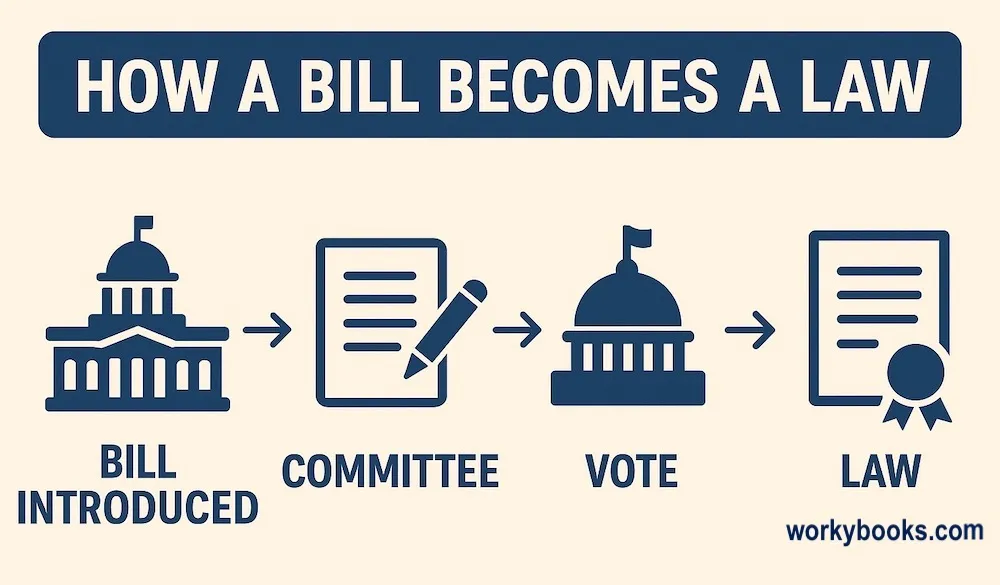
Every law in California starts as an idea. Sometimes, these ideas come from lawmakers, but they can also come from regular people. When someone wants to change a rule or add a new one, they write down their idea. This written idea is called a bill.
The first step is for a lawmaker, called a legislator, to introduce the bill. The bill is read out loud in front of either the California State Assembly or the California State Senate. The Assembly and Senate are the two parts of California’s legislature. The legislator explains why the new law is needed and how it will help people.
Next, the bill goes to a committee. A committee is a small group of lawmakers who study the bill carefully. They decide if the bill is a good idea. Sometimes, they make changes to make it better. The committee can vote to pass the bill, change it, or stop it.
If the committee says yes, the bill moves to the whole Assembly or Senate. All the lawmakers debate and vote. If most lawmakers vote yes, the bill goes to the other house—the Senate if it started in the Assembly, or the Assembly if it started in the Senate. The bill goes through another committee and another vote. Both houses must agree for the bill to move on.
The last step is the governor. The governor is the leader of the state. The governor reads the bill and decides if it should become a law. If the governor signs the bill, it becomes a law. If the governor says no, or vetoes it, the bill does not become a law—unless most lawmakers vote to pass it anyway.
This process helps make sure every new law is carefully considered. It gives many people a chance to share their ideas. This is part of democracy in California. It shows how people work together to solve problems and improve their state.
Interesting Fact: California lawmakers introduce more than 2,000 bills each year, but only some of them become laws.
What is the first step to make a law?
Someone has an ideaThe governor signs itThe committee votesThe Assembly debates
Who introduces the bill?
A legislatorThe governorA judgeA teacher
What is a committee?
A small groupA big buildingA type of lawA school
Why does the bill go to both houses?
To get more votesTo make it longerTo make it a ruleTo teach students
What happens if the governor vetoes a bill?
It might not become lawIt is signedIt is read againIt starts over
Why is committee work important?
To study the billTo clean the buildingTo write new booksTo call the governor
A bill becomes law after the governor signs it. True or false?
TrueFalse
What does 'vetoes' mean?
Says no to a billSigns a billChanges a lawWrites a rule
Who it's for
Perfect for the way you teach
Teachers
Build comprehension skills
Auto-graded quiz
Differentiated reading
Parents
Read together at home
Improve fluency
Quiet reading time
Homeschoolers
Reading curriculum support
Independent practice
Track Lexile growth
Topics
California lawmakingbill processlegislaturegovernordemocracyhistory readingUS government
Reviews & Ratings
No reviews yet. Be the first to share your experience!
More reading you might love
18 more
Juan Bautista de Anza's Expedition
This reading passage explores the remarkable journey of Juan Bautista de Anza and his expedition from Mexico to Californ...
HSS 4.2.3RH.6-8.2
How Explorers Changed California
This engaging U.S. History reading passage explores how explorers from Europe transformed California through the Columbi...
HSS 4.2.2RH.6-8.2
California Gold Discovery
This passage explores the discovery of gold in California at Sutter's Mill by James Marshall in January 1848 and its imp...
HSS 4.4.1RH.6-8.2
California Mining Camps
This engaging history reading passage explores the world of California mining camps during the Gold Rush, aligning with ...
HSS 4.4.2RH.6-8.2
San Francisco Growth
This comprehensive U.S. history passage explores the rapid growth of San Francisco during the California Gold Rush. Stud...
HSS 4.4.3RH.6-8.2
Transcontinental Railroad
This reading passage explores the history and importance of the Transcontinental Railroad, which was completed in 1869. ...
HSS 4.4.1RH.6-8.2
California Agriculture Growth
This passage explores the remarkable growth of California's agriculture during the Progressive Era, focusing on how the ...
HSS 4.4.6RH.6-8.2
The 1879 California Constitution
This reading passage explores the significance of the 1879 California Constitution, explaining why California adopted a ...
HSS 4.5.1RH.6-8.2
California Progressive Era
This engaging reading passage explores the California Progressive Era, a crucial period in U.S. history when reformers l...
HSS 4.5.2RH.6-8.2
Civic Participation in California
This engaging U.S. History reading passage explores California citizen participation, focusing on how ordinary people he...
HSS 4.5.5RH.6-8.2
Meroë: Capital of Kush
This passage explores the rise and significance of Meroë, once the capital of the Kingdom of Kush in ancient Africa. Loc...
CA HSS 6.2.6RH.6-8.1RH.6-8.2WHST.6-8.2
New Kingdom Egypt
This engaging history reading passage explores the rise of Ancient Egypt during the New Kingdom, when Egypt became a pow...
CA HSS 6.2RH.6-8.2WHST.6-8.2
First Humans
This engaging history reading passage explores the evolution of early humans, tracing the journey from the earliest homi...
CA HSS 6.1RH.6-8.1RH.6-8.2W.6.2
Han Dynasty: Wheelbarrow
This passage explores the invention and historical significance of the wheelbarrow during the Han dynasty in ancient Chi...
CA HSS 6.6CCSS RH.6-8.1RH.6-8.2RH.6-8.4
Han Dynasty: Seismograph
Discover the groundbreaking invention of the seismograph during the Han dynasty in ancient China in this engaging histor...
HSS 6.6.7RH.6-8.1RH.6-8.2WHST.6-8.2
Early Human Migration
This comprehensive history reading passage explores the Out of Africa movement and how early humans migrated across cont...
CA HSS 6.1.1CCSS RH.6-8.1RH.6-8.2RH.6-8.4
Paleolithic Migration by Land and Sea
This passage explores the migration of Paleolithic humans from Africa to the rest of the world, focusing on the routes t...
6.1RH.6-8.1RH.6-8.2RH.6-8.4
Origins of Social Classes
This engaging history reading passage explores how the rise of farming and the spread of pastoral nomads across the Eura...