

How Animals Sense and Respond
A bundle of 6 resources — buy once and get every item to download and assign, individually or all together.
By completing this purchase you agree to our Terms of Use and Privacy Policy. Your subscription renews automatically until you cancel. You can cancel anytime from your account settings. All sales are final and non-refundable. Digital content is available for download in your account immediately upon purchase.
Items included in this bundle
6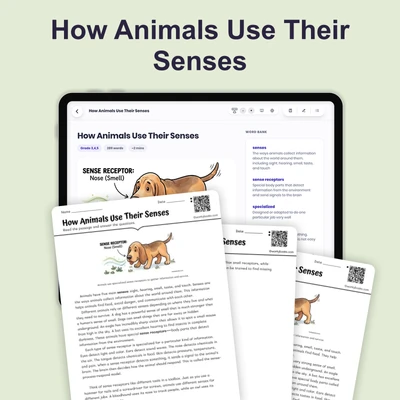
About this bundle
Help your 4th graders understand how animals gather and use information to survive with this NGSS-aligned reading passage packet!
This comprehensive resource includes original nonfiction texts covering specialized sense receptors, unique eye and ear structures, and the complex ways animals learn from experience.
What's Included:
- 5 Original Reading Passages: Written specifically at a 4th-grade level, covering animal senses, vision, hearing, smell/touch, and response to danger.
- Differentiated Learning: Each topic includes two leveled versions (Simplified and Detailed) to support all readers in your classroom.
- Bilingual Support: All passages are available in both English and Spanish.
- Comprehension Quizzes: Multiple-choice questions for every passage to check for understanding.
- Writing Activities: Open-ended questions that encourage students to explain complex biological processes.
- Graphic Organizers: Tables and charts to help students compare animal features and map out sensory functions.
- Glossaries: Key vocabulary definitions provided for each section.
- Answer Keys: Full answer keys included for all quizzes, writing prompts, and organizers.
- Phygital Access: QR codes provide instant access to interactive digital versions, including read-aloud audio and auto-graded quizzes.
Topics Covered:
- How Animals Use Their Senses: Introduction to the five senses and the sense-process-respond model.
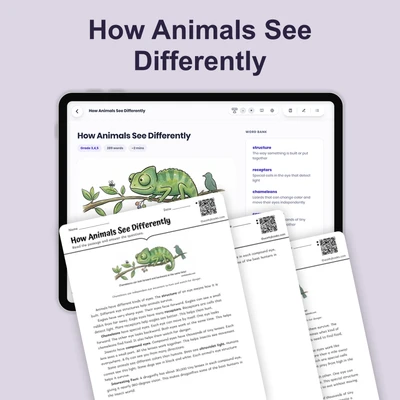
- How Animals See Differently: Exploration of receptors, compound eyes, and ultraviolet light.
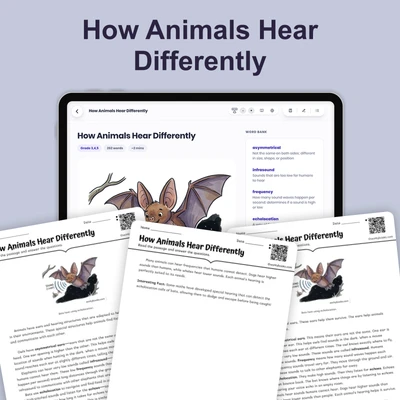
- How Animals Hear Differently: Detailed look at asymmetrical ears, infrasound, and echolocation.
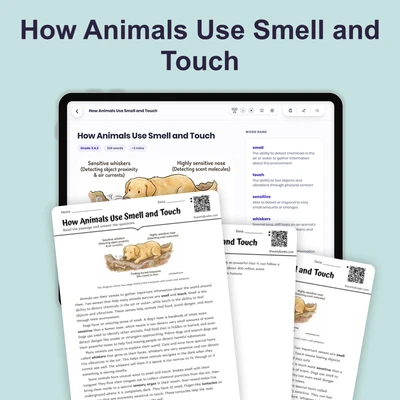
- How Animals Use Smell and Touch: Features on bloodhound scent receptors, whiskers, and star-nosed mole tentacles.
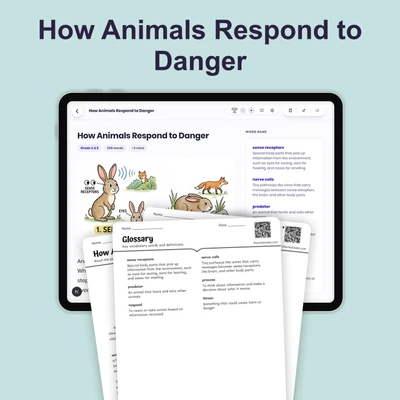
- How Animals Respond to Danger: Understanding predators, nerve cells, and defense behaviors.
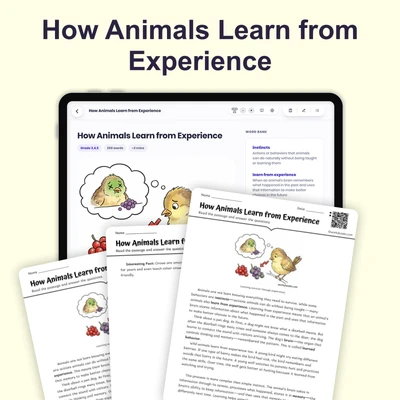
- How Animals Learn from Experience: Distinguishing between instincts and learned behaviors.
Key Vocabulary:
- Sense receptors
- Sense-process-respond model
- Echolocation
- Asymmetrical
- Compound eyes
- Learned behavior
- Nerve cells
Learning Objectives:
After completing these activities, students will be able to:
- Identify the five main senses and the specialized receptors animals use to gather environmental information.
- Explain the three-step "sense-process-respond" model and the role of the brain as a control center.
- Compare unique physical structures, such as compound eyes or asymmetrical ears, and describe how they aid in survival.
- Describe how nerve cells function like wires to carry messages between receptors and the brain.
- Differentiate between innate instincts and behaviors learned through past experience and memory.
- Analyze real-world examples of animal adaptations, such as bat echolocation and octopus camouflage.
Perfect for the way you teach
- Assign in one click
- Track progress per student
- Auto-graded results
- Practice at home
- Print or do on-screen
- Build skill mastery
- Standards-aligned
- Self-paced
- Ready-to-use today