How Animals Hear Differently — Reading Comprehension
Rate this
Premium Resource
Present
Present in classroom. No work saved
Assign
Classroom with student accounts, Track progress
Quick Play
No student accounts, assign with a link
Grades
3
4
5
Standards
NGSS 4-LS1-1
PRINT+DIGITAL RESOURCE
This learning resource is available in interactive and printable formats. The interactive worksheet can be played online and assigned to students. The Printable PDF version can be downloaded and printed for completion by hand.
This engaging Grade 4 science reading passage explores how different animals hear differently based on their unique ear structures and hearing adaptations. Students learn about owl ears that help pinpoint sounds in the dark, elephant hearing that detects low-frequency sounds over long distances, and bat echolocation for navigation and hunting. The passage introduces key vocabulary including frequency, echolocation, and asymmetrical ears while explaining how these adaptations help animals survive in their environments. Aligned to NGSS standard 4-LS1-1 (structures and functions in organisms), this audio-integrated passage helps students understand that animals have internal and external structures that function to support survival, growth, behavior, and reproduction. The passage includes simplified differentiated versions, Spanish translations, comprehension activities, writing prompts, and graphic organizers to support diverse learners in building foundational understanding of animal adaptations and sensory structures.
CONTENT PREVIEW
Expand content preview
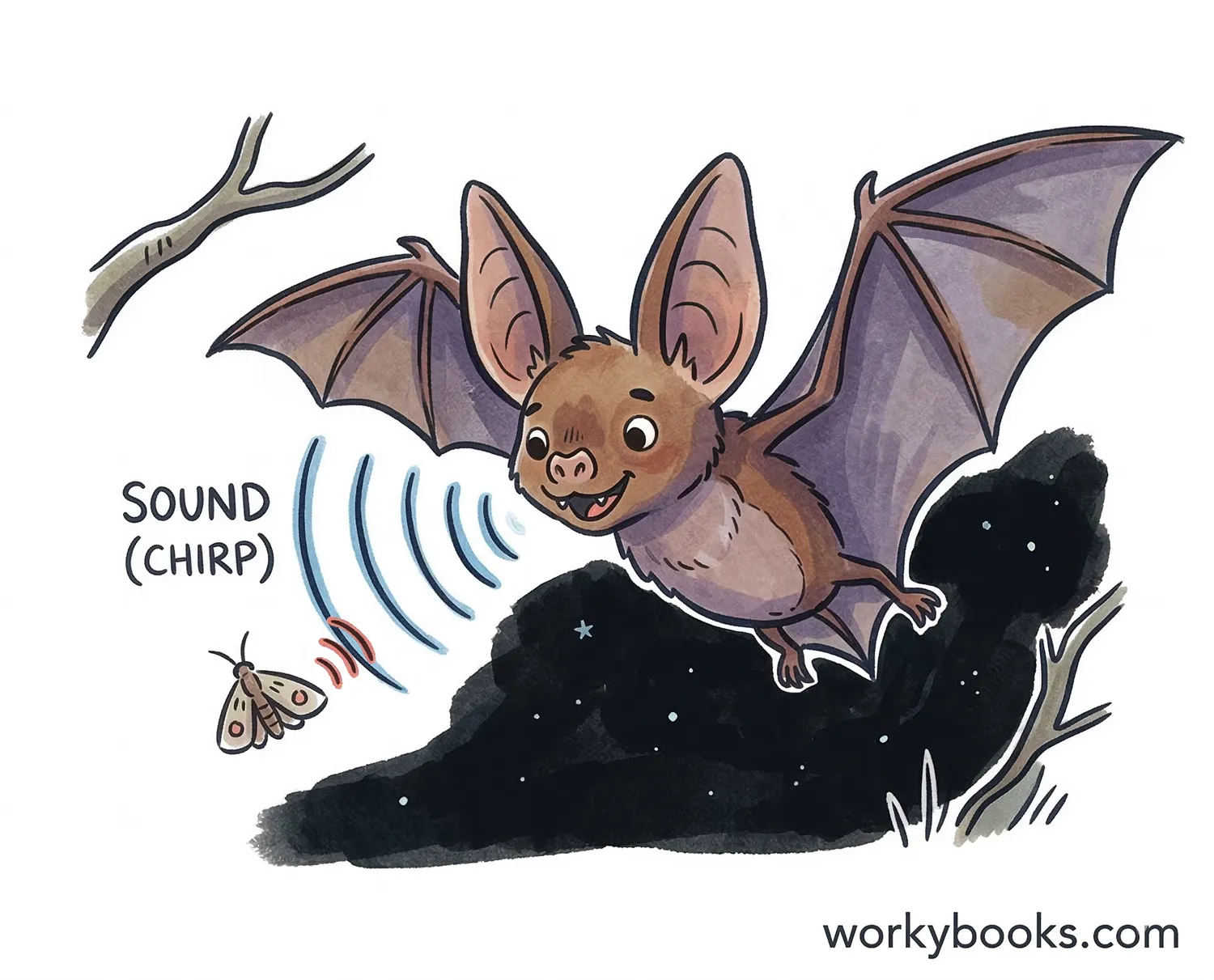
Bats hunt using echolocation.
Animals have ears and hearing structures that are adapted to help them survive in their environments. These special structures help animals find food, avoid danger, and communicate with each other.
Owls have asymmetrical ears—ears that are not the same on both sides of their head. One ear opening is higher than the other. This helps owls pinpoint the exact location of sounds when hunting in the dark. When a mouse moves on the ground, sound reaches each ear at slightly different times, telling the owl exactly where to fly.
Elephants can hear very low sounds called infrasound—sounds so low that humans cannot hear them. These low frequency sounds (how many sound waves happen per second) travel long distances through the ground and air. Elephants use infrasound to communicate with other elephants that are miles away.
Bats use echolocation to navigate and find food in complete darkness. They send out high-pitched sounds and listen for the echoes—sounds that bounce back from objects. By listening to how long it takes for echoes to return, bats can tell where objects are and how far away they are. This is similar to how you can tell a room is empty by how your voice echoes.
Many animals can hear frequencies that humans cannot detect. Dogs hear higher sounds than humans, while whales hear lower sounds. Each animal's hearing is perfectly suited to its needs.
Interesting Fact: Some moths have developed special hearing that can detect the echolocation calls of bats, allowing them to dodge and escape before being caught!
What are asymmetrical ears?
Ears that are very largeEars that are not the sameEars that hear low soundsEars inside the body
What can elephants hear that humans cannot?
Very high soundsEchoes from batsVery low sounds called infrasoundSounds from owls hunting
How do bats use echolocation?
They listen to other animalsThey make sounds and listen for echoesThey use their eyes in darknessThey feel vibrations in the ground
Why do owl ears help them hunt?
They can hear infrasoundThey make loud echoesThey pinpoint exact sound locationsThey hear sounds miles away
What does frequency measure in sound?
How loud a sound isHow many sound waves per secondHow far sound can travelHow long a sound lasts
How are animal hearing structures related to survival?
They help animals look betterThey help find food and avoid dangerThey make animals run fasterThey help animals see in darkness
All animals hear the same sound frequencies.
TrueFalse
What does 'adapted' mean in the passage?
Changed to fit the environment betterBecame larger over timeLearned from other animalsStarted making different sounds
Perfect For:
👩🏫 Teachers
• Reading comprehension practice
• Auto-graded assessments
• Literacy skill development
👨👩👧👦 Parents
• Reading practice at home
• Comprehension improvement
• Educational reading time
🏠 Homeschoolers
• Reading curriculum support
• Independent reading practice
• Progress monitoring
Reading Features:
📖
Reading Passage
Engaging fiction or nonfiction text
❓
Comprehension Quiz
Auto-graded questions
📊
Instant Feedback
Immediate results and scoring
📄
Printable Version
Download for offline reading
🔊
Read Aloud
Voice-over with word highlighting
Reviews & Ratings
No reviews yet. Be the first to share your experience!
Related Content
How Animals See Differently
This engaging 250-word reading passage introduces fourth-grade students to the fascinating world of animal vision and ey...
NGSS 4-LS1-1LS1.D
Animal Internal Structure
This engaging science passage for Grade 4-5 students explores animal internal structure and how organs work together to ...
NGSS 4-LS1-1
What Are Bones Made Of
This engaging 250-word reading passage introduces Grade 4 students to the structure and function of bones, aligned with ...
NGSS 4-LS1-1LS1.A
How Bones Protect Organs
This engaging 250-word reading passage helps Grade 4 students understand how bones protect organs, aligned with NGSS sta...
NGSS 4-LS1-1LS1.A
How Joints Connect Bones
This 250-word reading passage teaches fourth-grade students about joints and their role in the human skeletal system. Al...
NGSS 4-LS1-1LS1.A
How Muscles Move Bones
This comprehensive 250-word reading passage introduces fourth-grade students to the fundamental concept of how muscles a...
NGSS 4-LS1-1
Two Types of Muscles
This 250-word reading passage introduces fourth-grade students to the two main types of muscles in the human body: volun...
NGSS 4-LS1-1
What Are Muscles
This engaging 250-word reading passage introduces fourth-grade students to the essential concept of muscles and how they...
NGSS 4-LS1-1
How Skin Protects Body
This audio-integrated reading passage introduces fourth-grade students to the protective functions of skin, aligned with...
NGSS 4-LS1-1
Layers of the Skin
This engaging 250-word reading passage introduces fourth-grade students to the three layers of skin and their functions....
NGSS 4-LS1-1LS1.A
What Are Plant Structures
This engaging 250-word reading passage introduces fourth-grade students to the fundamental concept of plant structures a...
NGSS 4-LS1-1
Parts of Plant Stems
This engaging 250-word reading passage introduces fourth-grade students to the internal structure and function of plant ...
NGSS 4-LS1-1LS1.A
How Water Moves Inside Plants
This 250-word reading passage introduces fourth-grade students to the concept of water transport in plants, aligned with...
NGSS 4-LS1-1
Parts of a Flower
This comprehensive 250-word reading passage introduces fourth-grade students to the essential parts of a flower and thei...
NGSS 4-LS1-1LS1.A
How Fish Gills Work
This engaging 250-word reading passage introduces fourth-grade students to the concept of fish gills and how they functi...
NGSS 4-LS1-1
How Leaves Make Food
This engaging Grade 4 science reading passage explains how leaves make food through photosynthesis. Students discover th...
NGSS 4-LS1-1LS1.A
How Animal Hearts Work
This 250-word audio-integrated reading passage introduces fourth-grade students to the essential function of the heart a...
NGSS 4-LS1-1LS1.A
Animal Skeleton Structure
This 250-word reading passage introduces fourth grade students to animal skeleton structure, aligned with NGSS 4-LS1-1 a...
NGSS 4-LS1-1LS1.A
How Animal Lungs Work
This 250-word reading passage introduces fourth-grade students to how animal lungs work, aligned with NGSS standard 4-LS...
NGSS 4-LS1-1LS1.A
What Is Inside a Seed
This engaging 250-word reading passage helps Grade 4 students understand the internal structure of seeds, aligned with N...