How Animals Use Smell and Touch — Reading Comprehension
Rate this
Premium Resource
Present
Present in classroom. No work saved
Assign
Classroom with student accounts, Track progress
Quick Play
No student accounts, assign with a link
Grades
3
4
5
Standards
NGSS 4-LS1-2
LS1.D
PRINT+DIGITAL RESOURCE
This learning resource is available in interactive and printable formats. The interactive worksheet can be played online and assigned to students. The Printable PDF version can be downloaded and printed for completion by hand.
This engaging 250-word reading passage introduces fourth-grade students to how animals use smell and touch as critical senses for survival. Aligned with NGSS standard 4-LS1-2 and the Disciplinary Core Ideas for LS1.D, the passage explains how different animals have developed specialized sensory organs. Students learn that dogs possess noses hundreds of times more sensitive than humans, enabling them to identify other animals, locate food, and detect danger. The passage describes how whiskers on cats and mice detect vibrations to help these animals navigate in complete darkness. Students discover that snakes use their tongues to smell their environment, and star-nosed moles have touch-sensitive tentacles on their noses to find food underground. Written at an appropriate fourth-grade reading level, this audio-integrated passage uses simple vocabulary and real-world examples to build foundational understanding of animal sensory structures and their functions. The passage includes bolded key terms with immediate definitions, helping students develop science vocabulary. Accompanying activities include comprehension questions, writing prompts, and graphic organizers that reinforce learning objectives while encouraging critical thinking about how different animals have adapted their senses to meet survival needs in various environments.
CONTENT PREVIEW
Expand content preview
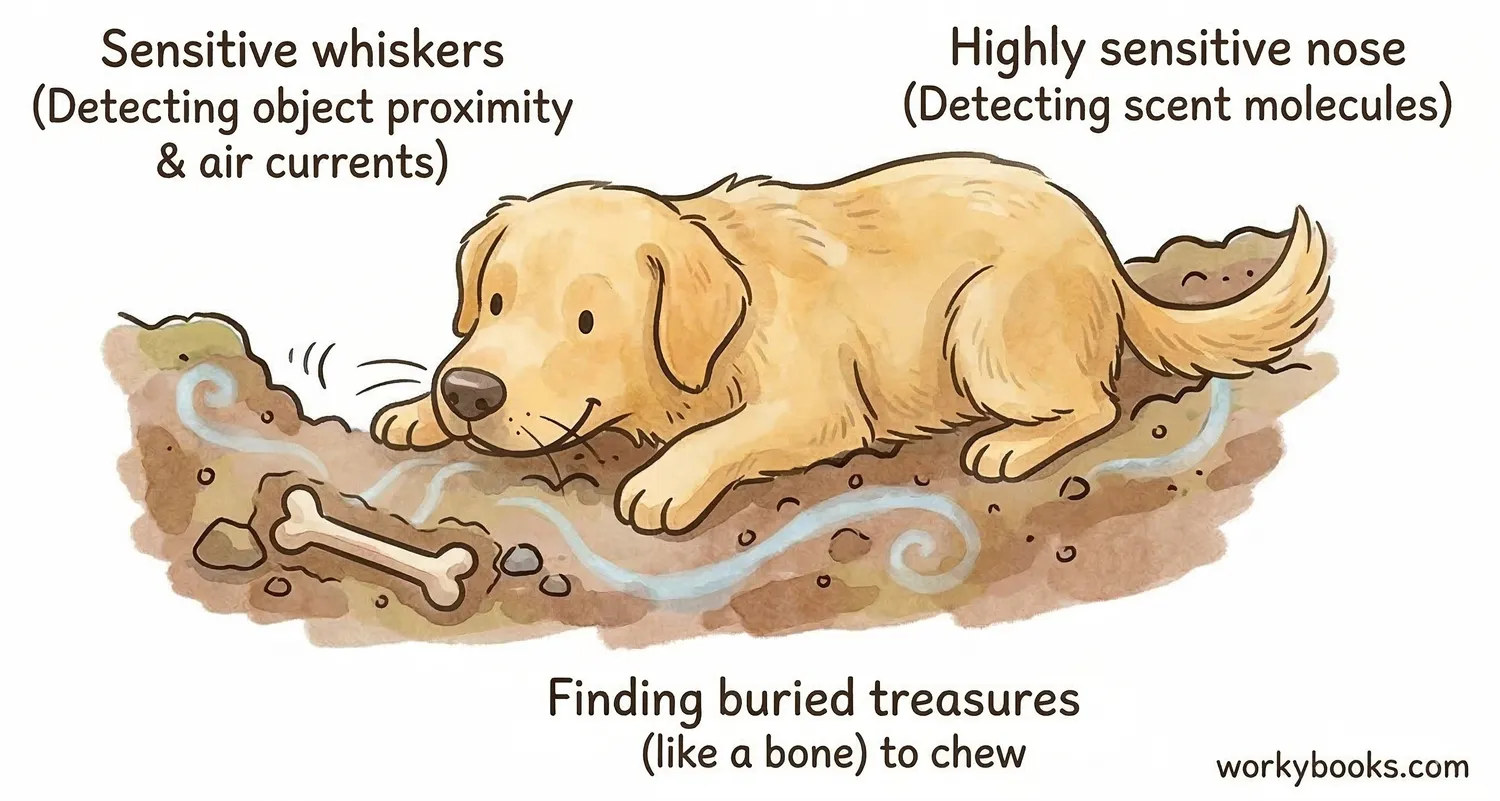
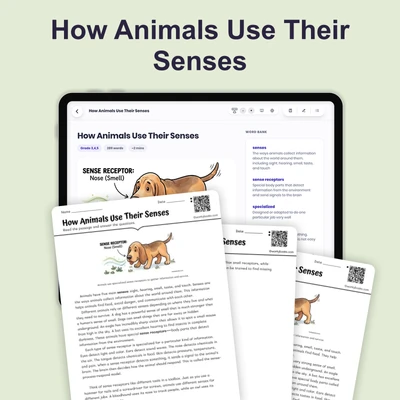
This diagram shows how dogs find buried treasures with scent and whiskers.
Animals use their senses to gather important information about the world around them. Two senses that help many animals survive are smell and touch. Smell is the ability to detect chemicals in the air or water, while touch is the ability to feel objects and vibrations. These senses help animals find food, avoid danger, and move through their environment.
Dogs have an amazing sense of smell. A dog's nose is hundreds of times more sensitive than a human nose, which means it can detect very small amounts of scent. Dogs use smell to identify other animals, find food that is hidden or buried, and even detect danger like smoke or strangers approaching. Police dogs and search dogs use their powerful noses to help find missing people or detect harmful substances.
Many animals use touch to explore their world. Cats and mice have special hairs called whiskers that grow on their faces. Whiskers are very sensitive and can detect tiny vibrations in the air. This helps these animals navigate in the dark when they cannot see well. The whiskers tell them if a space is too narrow to fit through or if something is moving nearby.
Some animals have unusual ways to smell and touch. Snakes smell with their tongues! They flick their tongues out to collect chemical particles from the air, then bring them inside to a special sensory organ in their mouth. Star-nosed moles live underground where it is completely dark. They have 22 small, finger-like tentacles on their nose that are extremely sensitive to touch. These tentacles help the mole quickly find worms and insects to eat in the soil.
Interesting Fact: A bloodhound's sense of smell is so powerful that it can follow a scent trail that is over 12 days old! These dogs have about 300 million scent receptors in their noses, compared to only 5 million in humans.
How sensitive is a dog's nose?
Ten times more than humansHundreds of times more than humansThe same as humansSlightly better than humans
What do whiskers help animals detect?
Temperature changesLight and colorsVibrations in the airSounds from far away
How many tentacles does a star-nosed mole have?
10 tentacles15 tentacles22 tentacles30 tentacles
Why do dogs use their sense of smell?
Only to find foodTo identify animals and detect dangerOnly to play gamesTo communicate with other dogs
How do whiskers help cats in darkness?
They light up the areaThey make sounds to find objectsThey detect vibrations to navigateThey change color in the dark
Why do star-nosed moles need sensitive tentacles?
To swim in waterTo find food in dark underground soilTo climb treesTo fly through caves
Snakes smell with their noses only.
TrueFalse
What does the word 'sensitive' mean?
Unable to detect anythingCan detect very small amountsOnly works in daylightRequires lots of energy
Perfect For:
👩🏫 Teachers
• Reading comprehension practice
• Auto-graded assessments
• Literacy skill development
👨👩👧👦 Parents
• Reading practice at home
• Comprehension improvement
• Educational reading time
🏠 Homeschoolers
• Reading curriculum support
• Independent reading practice
• Progress monitoring
Reading Features:
📖
Reading Passage
Engaging fiction or nonfiction text
❓
Comprehension Quiz
Auto-graded questions
📊
Instant Feedback
Immediate results and scoring
📄
Printable Version
Download for offline reading
🔊
Read Aloud
Voice-over with word highlighting
Reviews & Ratings
No reviews yet. Be the first to share your experience!
Related Content
How Animals See Differently
This engaging 250-word reading passage introduces fourth-grade students to the fascinating world of animal vision and ey...
NGSS 4-LS1-1LS1.D
What Is Spinal Cord
This engaging Grade 4 science reading passage introduces students to the spinal cord and its critical role in the human ...
NGSS 4-LS1-2LS1.ALS1.D
How We Smell, Taste, and Feel
This audio-integrated reading passage introduces fourth-grade students to the fundamental concept of how sensory organs ...
NGSS 4-LS1-2LS1.D
How the Body Responds
This 250-word reading passage introduces fourth-grade students to how the body responds to sensory information, aligned ...
NGSS 4-LS1-2LS1.D
How Animals Respond to Danger
This engaging 250-word reading passage introduces fourth-grade students to the sense-process-respond chain in animals, a...
NGSS 4-LS1-2LS1.D
How Animals Learn from Experience
This engaging 250-word reading passage introduces fourth-grade students to the concept of animal learning and behavioral...
NGSS 4-LS1-2LS1.D
What Is Nervous System
This Grade 4 science reading passage introduces students to the nervous system as the body's communication network align...
NGSS 4-LS1-2LS1.ALS1.D
Brain as Control Center
This engaging 250-word reading passage teaches fourth-grade students about the brain as the body's control center, align...
NGSS 4-LS1-2LS1.ALS1.D
How Nerves Carry Messages
This engaging 250-word reading passage introduces fourth-grade students to the nervous system and how nerves carry messa...
NGSS 4-LS1-2LS1.ALS1.D
How We Store Memories
How We Store Memories is an engaging Grade 4 science reading passage aligned with NGSS standard 4-LS1-2 (LS1.D). This 25...
NGSS 4-LS1-2LS1.D
How Animals Use Their Senses
This Grade 4 science reading passage introduces students to how animals use their senses to receive information about th...
NGSS 4-LS1-2
How Brain Processes Senses
This 250-word reading passage introduces fourth-grade students to the sense-process-respond model aligned with NGSS stan...
NGSS 4-LS1-2
How Our Eyes and Ears Work
This engaging 250-word reading passage introduces fourth-grade students to the specialized functions of sense organs, sp...