How Animals Respond to Danger — Reading Comprehension
Rate this
Premium Resource
Present
Present in classroom. No work saved
Assign
Classroom with student accounts, Track progress
Quick Play
No student accounts, assign with a link
Grades
3
4
5
Standards
NGSS 4-LS1-2
LS1.D
PRINT+DIGITAL RESOURCE
This learning resource is available in interactive and printable formats. The interactive worksheet can be played online and assigned to students. The Printable PDF version can be downloaded and printed for completion by hand.
This engaging 250-word reading passage introduces fourth-grade students to the sense-process-respond chain in animals, aligned with NGSS 4-LS1-2 and the Disciplinary Core Idea LS1.D. Students discover how animals detect threats through their senses—seeing predators, hearing loud noises, or smelling smoke. The passage explains how sense receptors respond to different inputs and transmit signals along nerve cells to the brain, which then directs the body's response. Through accessible examples like rabbits freezing, skunks releasing odor, and opossums playing dead, students understand that different animals have different responses to the same type of threat. The audio-integrated content uses simple sentences and everyday vocabulary appropriate for fourth-grade reading levels. Key terms like sense receptors, nerve cells, and predators are bolded and defined in context. Students engage with multiple-choice questions testing recall and comprehension, writing activities requiring explanation and application, and graphic organizers that help them visualize the input-process-output sequence of animal danger responses. This comprehensive resource builds foundational understanding of how sensory information travels through the nervous system to produce behavioral responses, preparing students for hands-on investigations and deeper discussions about animal adaptations and survival strategies.
CONTENT PREVIEW
Expand content preview
Animals protect themselves by sensing threats and responding quickly to danger.
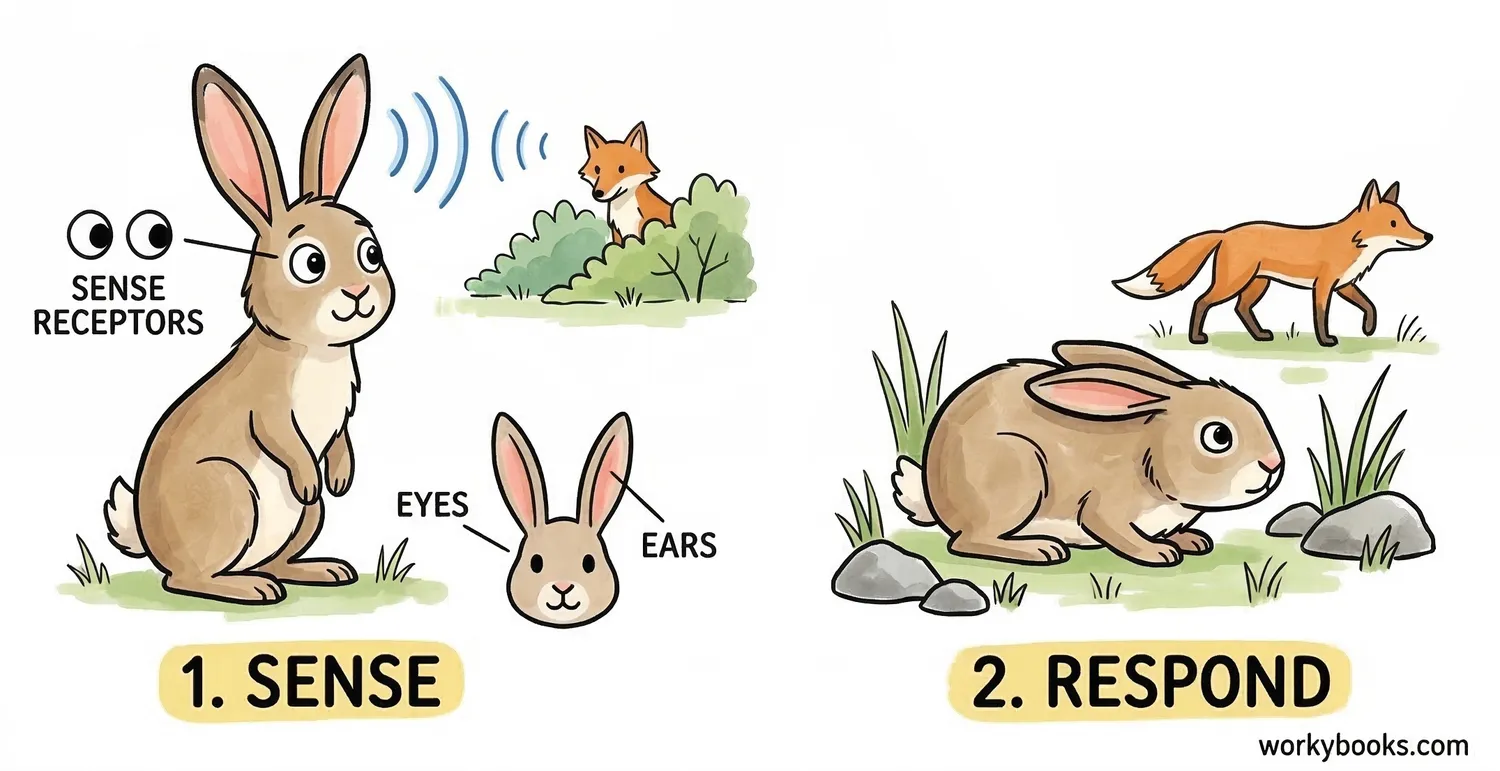
Animals must protect themselves from danger to survive. When an animal senses a threat, its body follows a three-step process: sense, process, and respond. This chain of events happens quickly and helps keep animals safe.
First, an animal detects danger through its senses. Special body parts called sense receptors pick up information from the environment. A rabbit's eyes might see a fox approaching. A deer's ears might hear a loud noise. A mouse's nose might smell smoke from a fire. Each sense receptor responds to a different type of input—light, sound, smell, touch, or taste.
Next, the sense receptors send signals along special pathways called nerve cells. These nerve cells are like tiny wires that carry messages. The signals travel from the sense receptors to the brain. The brain is like a control center that processes the information and decides if there is danger.
Finally, the brain sends commands back through nerve cells to tell the body how to respond. Different animals respond to danger in different ways. A rabbit might freeze and stay very still to hide. A skunk might spray a bad smell to scare away a predator—an animal that hunts other animals. An opossum might play dead by lying still and pretending to be dead. These responses help animals survive.
Interesting Fact: When an octopus senses danger, its brain can tell special cells in its skin to change color in less than one second, helping it blend in with rocks or sand!
What are sense receptors?
Body parts that pick up informationAnimals that hunt other animalsPathways that carry foodParts of the brain
What do nerve cells do?
They help animals see betterThey carry messages to the brainThey make animals run fasterThey detect smoke and fire
What is a predator?
An animal that plays deadAn animal that hunts other animalsAn animal that changes colorAn animal that freezes when scared
Why might a rabbit freeze?
To spray a bad smellTo change its skin colorTo hide from dangerTo hunt for food
How does the brain help animals?
It picks up smells from airIt decides if there is dangerIt makes animals play deadIt changes the animal's color
What happens after sense receptors detect danger?
The animal immediately runs awaySignals travel to the brainThe animal sprays bad smellThe predator leaves the area
All animals respond to danger the same way.
TrueFalse
Which word means to react to information?
SenseProcessRespondDetect
Perfect For:
👩🏫 Teachers
• Reading comprehension practice
• Auto-graded assessments
• Literacy skill development
👨👩👧👦 Parents
• Reading practice at home
• Comprehension improvement
• Educational reading time
🏠 Homeschoolers
• Reading curriculum support
• Independent reading practice
• Progress monitoring
Reading Features:
📖
Reading Passage
Engaging fiction or nonfiction text
❓
Comprehension Quiz
Auto-graded questions
📊
Instant Feedback
Immediate results and scoring
📄
Printable Version
Download for offline reading
🔊
Read Aloud
Voice-over with word highlighting
Reviews & Ratings
No reviews yet. Be the first to share your experience!
Related Content
How Animals See Differently
This engaging 250-word reading passage introduces fourth-grade students to the fascinating world of animal vision and ey...
NGSS 4-LS1-1LS1.D
What Is Spinal Cord
This engaging Grade 4 science reading passage introduces students to the spinal cord and its critical role in the human ...
NGSS 4-LS1-2LS1.ALS1.D
How We Smell, Taste, and Feel
This audio-integrated reading passage introduces fourth-grade students to the fundamental concept of how sensory organs ...
NGSS 4-LS1-2LS1.D
How the Body Responds
This 250-word reading passage introduces fourth-grade students to how the body responds to sensory information, aligned ...
NGSS 4-LS1-2LS1.D
How Animals Use Smell and Touch
This engaging 250-word reading passage introduces fourth-grade students to how animals use smell and touch as critical s...
NGSS 4-LS1-2LS1.D
How Animals Learn from Experience
This engaging 250-word reading passage introduces fourth-grade students to the concept of animal learning and behavioral...
NGSS 4-LS1-2LS1.D
What Is Nervous System
This Grade 4 science reading passage introduces students to the nervous system as the body's communication network align...
NGSS 4-LS1-2LS1.ALS1.D
Brain as Control Center
This engaging 250-word reading passage teaches fourth-grade students about the brain as the body's control center, align...
NGSS 4-LS1-2LS1.ALS1.D
How Nerves Carry Messages
This engaging 250-word reading passage introduces fourth-grade students to the nervous system and how nerves carry messa...
NGSS 4-LS1-2LS1.ALS1.D
How We Store Memories
How We Store Memories is an engaging Grade 4 science reading passage aligned with NGSS standard 4-LS1-2 (LS1.D). This 25...
NGSS 4-LS1-2LS1.D
How Animals Use Their Senses
This Grade 4 science reading passage introduces students to how animals use their senses to receive information about th...
NGSS 4-LS1-2
How Brain Processes Senses
This 250-word reading passage introduces fourth-grade students to the sense-process-respond model aligned with NGSS stan...
NGSS 4-LS1-2
How Our Eyes and Ears Work
This engaging 250-word reading passage introduces fourth-grade students to the specialized functions of sense organs, sp...