Reading Passage

Buddhism Spreads from India

Interactive passage with audio narration, comprehension questions, and printable PDF.

No ratings yet
Grades 5–8ReadingElaSocial-studiesHistoryEnglish · SpanishInteractive · Printable
Aligned toCA HSS 6.1.3RI.6.3RI.6.4W.6.2

What's included

Reading passage
Audio narration
Comprehension quiz
Writing activity
Glossary & flashcards
Differentiated version
Spanish translation

Buddhism Spreads from India preview and details

About this printable Buddhism Spreads from India reading passage (Grades 5-8)

This passage, suitable for middle school students, explores the journey of Buddhism from its origins in ancient India to its spread across China and Japan. Students will learn about the Silk Road, the role of missionaries and monks, and how Buddhism influenced art, society, and culture in East Asia. The reading includes key vocabulary, a timeline, Spanish translation, and aligned activities that build historical thinking and literacy skills. This history reading passage supports CA HSS 6.1.3 and CCSS RI.6.3, and offers read aloud audio and a Spanish translation for enhanced learning. Students will analyze cause and effect, trace changes over time, and use evidence to understand the significance of Buddhism's expansion.
Written by Workybooks TeamPublished by Workybooks
Preview

Sample passage and quiz from Buddhism Spreads from India

Reading passage and comprehension quiz preview

Buddhism Spreads from India
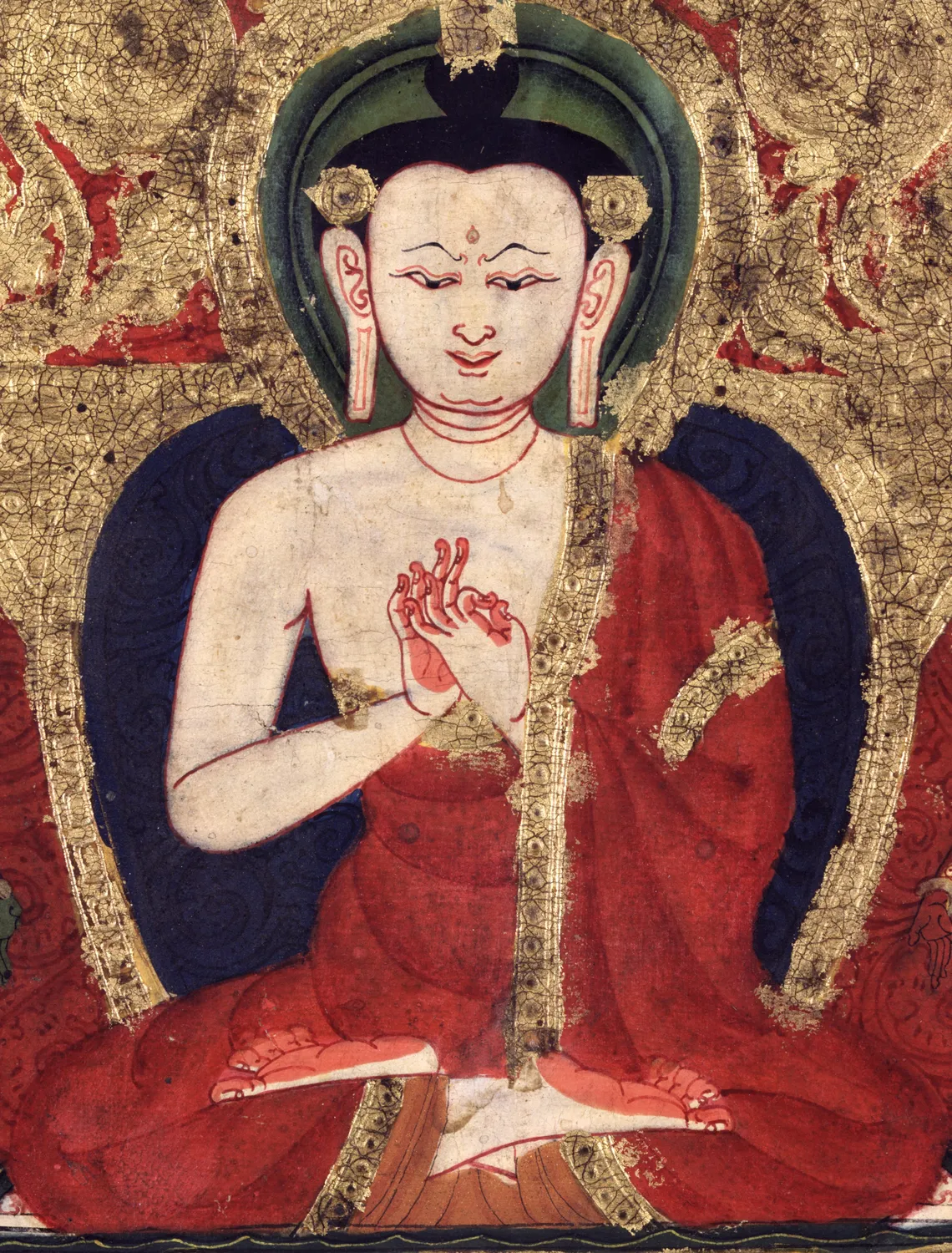
Buddha Vairocana from 14th century Tibet (cropped)

"Buddha Vairocana" / Wikimedia Commons (Public domain). 

Buddhism began in ancient India around the 5th century BCE with the teachings of Siddhartha Gautama, who became known as the Buddha. Over time, Buddhism became one of the world’s major religions. Its journey from India to China and Japan is a powerful example of cultural diffusion, the process by which beliefs and practices spread between societies.

The spread of Buddhism started as early as the 1st century CE, when traveling monks and traders carried Buddhist ideas along the Silk Road. The Silk Road was a network of trade routes that connected India, Central Asia, and China. Archaeological evidence, such as Buddhist statues and cave paintings found at Dunhuang in China, shows that Buddhist communities were active along these routes. Buddhist texts were translated into Chinese, and the first Chinese Buddhist temples were built during the Han Dynasty (206 BCE–220 CE). Emperors such as Ming of Han even sent envoys to India to learn more about Buddhist teachings, according to ancient sources.

As Buddhism established itself in China, it began to adapt to local beliefs like Confucianism and Daoism. Monasteries became centers of learning, art, and charity. Buddhist monks played key roles in translating texts, creating art, and advising rulers. The famous monk Xuanzang traveled to India in the 7th century to collect scriptures, a journey recorded in both historical texts and artwork. The religion’s influence reached society at many levels, from royal courts to common people. Some dynasties, such as the Tang (618–907 CE), supported large-scale construction of Buddhist temples and statues, like those at the Longmen Grottoes.

Buddhism arrived in Japan around the 6th century CE, brought by envoys and monks from Korea and China. The Japanese court adopted Buddhist rituals and sponsored temple building, such as the famous Hōryū-ji temple. Over time, Japanese Buddhism developed its own schools, like Zen and Pure Land, blending Indian, Chinese, and native traditions. Buddhist art, stories, and values became central to Japanese society, affecting everything from government to daily life.

The journey of Buddhism from India to China and Japan demonstrates the power of cultural exchange. The religion changed as it moved, adapting to local cultures and shaping new societies. This process not only transformed spiritual life but also influenced art, education, and social organization across East Asia.

This movement of ideas connects to the broader themes of ancient history, such as trade, cultural interaction, and the ways societies change over time.

Interesting Fact: The oldest wooden building in the world, Hōryū-ji in Japan, was originally built as a Buddhist temple in the 7th century CE.

Comprehension quiz (8 questions)

1. Who founded Buddhism?

Siddhartha Gautama
Confucius
Xuanzang
Emperor Ming

2. What is the Silk Road?

A trade route
A Buddhist temple
A government official
A Japanese school

3. Which dynasty built early Buddhist temples in China?

Han Dynasty
Tang Dynasty
Qin Dynasty
Song Dynasty

4. Why did Buddhism change in China?

It mixed with local beliefs
It stayed the same
It was banned
It lost followers

5. How did Buddhism arrive in Japan?

By envoys and monks
By sea pirates
By Roman traders
By native invention

6. What is one effect of Buddhism’s spread?

It influenced art and society
It stopped trade
It started wars
It replaced Daoism

7. Buddhism blended with local cultures. True or false?

True
False

8. What does 'dynasty' mean?

Family line of rulers
Religious text
Trade route
Traveling monk
Who it's for

Perfect for the way you teach

Teachers
  • Build comprehension skills
  • Auto-graded quiz
  • Differentiated reading
Parents
  • Read together at home
  • Improve fluency
  • Quiet reading time
Homeschoolers
  • Reading curriculum support
  • Independent practice
  • Track Lexile growth
Topics

Reviews & Ratings

No reviews yet. Be the first to share your experience!

More reading you might love

19 more
Passage
Surface Water Runoff - reading educational content
Grades 5–8

Surface Water Runoff

weather and climate · RI.5.3

$1.50
Passage
Mississippi River - reading educational content
Grades 5–8

Mississippi River

earth and space science · RI.5.3

$1.50
Passage
Mekong River - reading educational content
Grades 5–8

Mekong River

earth and space science · RI.5.3

Free
Passage
Freshwater Sources - reading educational content
Grades 5–8

Freshwater Sources

earth and space science · RI.5.3

Free
Passage
Precipitation Runoff - reading educational content
Grades 5–8

Precipitation Runoff

weather and climate · RI.5.3

$1.50
Passage
Large Streams of Moving Water - reading educational content
Grades 5–8

Large Streams of Moving Water

earth and space science · RI.5.3

Free
Passage
Cyclones and Anticyclones: A Comparison - reading educational content
Grades 5–8

Cyclones and Anticyclones: A Comparison

science · 7.RI.7.1

Free
Passage
Brahmaputra River - reading educational content
Grades 5–8

Brahmaputra River

earth and space science · RI.5.3

Free
Passage
The Amazon River Dolphin - reading educational content
Grades 5–8

The Amazon River Dolphin

life science · RI.5.3

Free
Passage
Rare Earth Minerals in Smartphones and Computers - reading educational content
Grades 5–8

Rare Earth Minerals in Smartphones and Computers

earth and space science · RI.5.3

Free
Passage
Transpiration - reading educational content
Grades 5–8

Transpiration

weather and climate · RI.5.3

Free
Passage
The Amazon River - reading educational content
Grades 5–8

The Amazon River

earth and space science · RI.5.3

$1.50
Passage
Vertical Farming - reading educational content
Grades 5–8

Vertical Farming

science · RI.5.3

Free
Passage
Do All Minerals Have Crystal Structures? - reading educational content
Grades 5–8

Do All Minerals Have Crystal Structures?

earth and space science · RI.5.3

Free
Passage
Why Are Pollinators Important? - reading educational content
Grades 5–8

Why Are Pollinators Important?

science · MS-LS2-4

$1.50
Passage
What Would Happen If Bees Went Extinct? - reading educational content
Grades 5–8

What Would Happen If Bees Went Extinct?

life science · MS-LS2-4

Free
Passage
Why Are Honeybees Important? - reading educational content
Grades 5–8

Why Are Honeybees Important?

science · MS-LS2-4

Free
Passage
Wolves of Yellowstone - reading educational content
Grades 5–8

Wolves of Yellowstone

life science · MS-LS2-4

Free
Passage
Barreleye Fish: The Deep-Sea Telescope - reading educational content
Grades 5–8

Barreleye Fish: The Deep-Sea Telescope

life science · MS-LS2-4

$1.50
Copyright © 2026 Workybooks. Made with ♥ in California.