The Fascinating Dumbo Octopus: Deep-Sea Wonder — Reading Comprehension
Rate this
Premium Resource
Present
Present in classroom. No work saved
Assign
Classroom with student accounts, Track progress
Quick Play
No student accounts, assign with a link
Grades
5
6
7
8
Standards
MS-LS1-5
RI.6.3
RI.7.3
RI.8.8
PRINT+DIGITAL RESOURCE
This learning resource is available in interactive and printable formats. The interactive worksheet can be played online and assigned to students. The Printable PDF version can be downloaded and printed for completion by hand.
Aligned to NGSS, this passage explores Dumbo octopus adaptations like ear-like fins for swimming at 3,000-13,000 ft depths, ink-sac absence, and inside-out escape mechanism. Students analyze how structure supports function in extreme environments.
CONTENT PREVIEW
Expand content preview
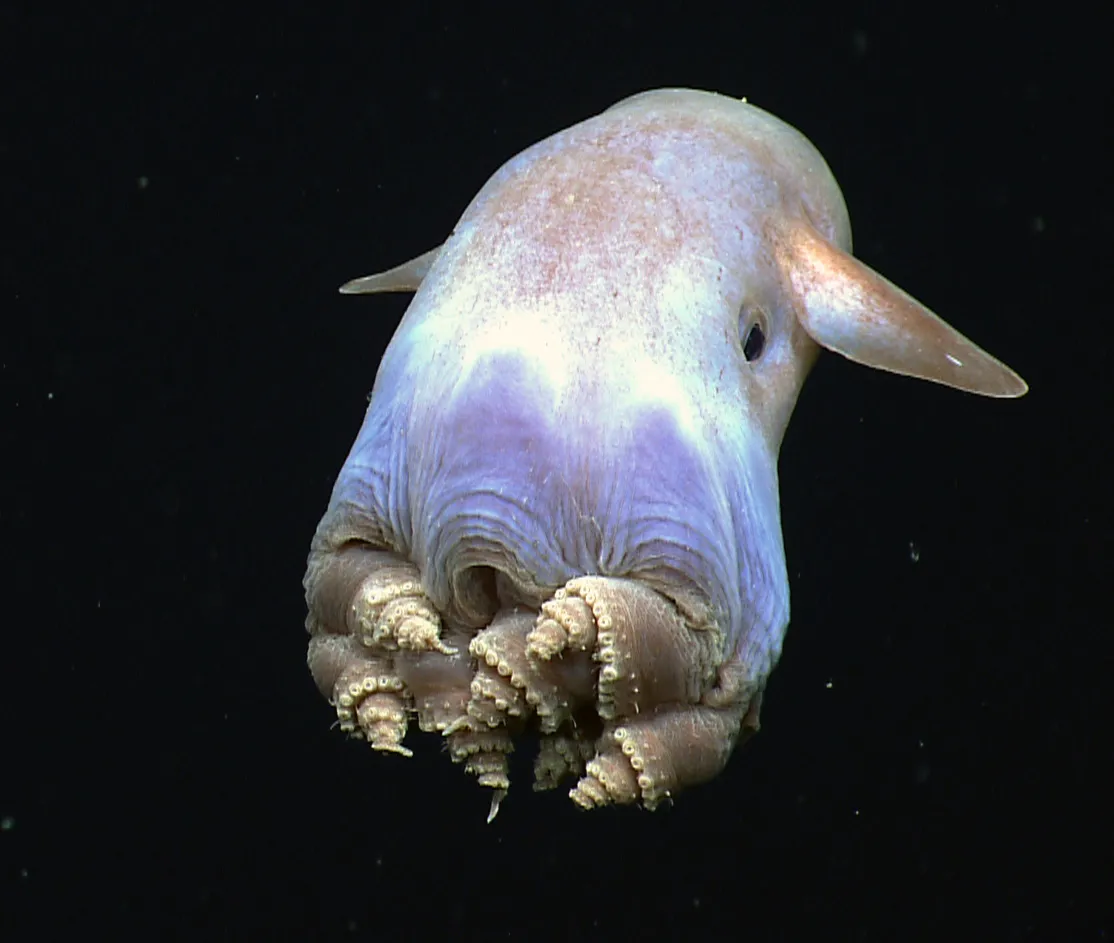
"Dumbo-hires" by NOAA Okeanos Explorer / Wikimedia Commons.
The Dumbo octopus (genus Grimpoteuthis) is one of the most unique and enchanting creatures of the deep ocean. Named after Disney’s beloved flying elephant due to its ear-like fins, this deep-sea dweller lives in extreme depths of 3,000 to 13,000 feet, where sunlight never reaches. Unlike shallow-water octopuses, the Dumbo octopus lacks an ink sac—since its dark, high-pressure habitat has few predators, it doesn’t need to squirt ink to escape!
Dumbo octopuses are found in oceans worldwide, from the Atlantic to the Pacific, thriving near the seafloor where temperatures are near freezing. Their soft, gelatinous bodies help them withstand the crushing pressure of the deep sea. They move gracefully by flapping their ear-like fins, drifting like underwater ghosts in search of food.
Food is scarce in the deep ocean, so Dumbo octopuses aren’t picky eaters. They primarily feast on small deep-sea creatures, including worms, snails, shrimp, and even tiny fish. Using their eight webbed arms, they gently capture prey, sometimes swallowing it whole. Since hunting is difficult in the dark, they rely on their excellent sense of touch to locate meals.
These deep-sea cephalopods live for about 3 to 5 years, shorter than many other octopus species. Females carry eggs in their arms until they hatch, releasing fully developed miniature octopuses into the water. Unlike shallow-water octopuses that die after reproducing, some Dumbo octopuses may survive to breed multiple times.
Fun Fact: The Dumbo octopus can turn itself inside out to confuse predators—a rare and bizarre defense mechanism!
Where do Dumbo octopuses live?
Coral reefsDeep ocean (3,000–13,000 feet)Freshwater lakesNear the shore
What do Dumbo octopuses primarily eat?
SeaweedLarge fishWorms and snailsDead whales
How long do Dumbo octopuses usually live?
1–2 years3–5 years10–15 yearsOver 20 years
Why don’t Dumbo octopuses have ink sacs?
They don’t need them in the deep oceanThey use camouflage insteadThey are too smallThey squirt water instead
How do Dumbo octopuses move?
Jet propulsionFlapping their ear-like finsCrawling on the seafloorSwimming like fish
What is unique about Dumbo octopus reproduction?
Babies hatch fully developedMothers die immediately after laying eggsThey give live birthThey only reproduce once
What is the Dumbo octopus named after?
A famous scientistA Disney characterA type of plantA deep-sea submarine
What is a bizarre defense mechanism of the Dumbo octopus?
It glows in the darkIt can turn itself inside outIt mimics other sea creaturesIt releases toxic slime
Perfect For:
👩🏫 Teachers
• Reading comprehension practice
• Auto-graded assessments
• Literacy skill development
👨👩👧👦 Parents
• Reading practice at home
• Comprehension improvement
• Educational reading time
🏠 Homeschoolers
• Reading curriculum support
• Independent reading practice
• Progress monitoring
Reading Features:
📖
Reading Passage
Engaging fiction or nonfiction text
❓
Comprehension Quiz
Auto-graded questions
📊
Instant Feedback
Immediate results and scoring
📄
Printable Version
Download for offline reading
🔊
Read Aloud
Voice-over with word highlighting
Reviews & Ratings
No reviews yet. Be the first to share your experience!
Related Content
What Abiotic Factors Determine the Type of Biome?
This NGSS-aligned middle school reading passage explains how abiotic factors—specifically temperature and precipitation—...
MS-LS1-5
Growth and Development of Organisms
This middle school science passage, aligned with NGSS standards MS-LS1-4 and MS-LS1-5, provides an in-depth look at the ...
MS-LS1-4MS-LS1-5
Animal Survival Behaviors
This passage, aligned with NGSS standards MS-LS1-4 and MS-LS1-5, explores the complex and fascinating world of animal be...
MS-LS1-4MS-LS1-5
Cyclones and Anticyclones: A Comparison
Cyclones are low-pressure systems that bring stormy weather, while anticyclones are high-pressure systems that bring cle...
7.RI.7.1RI.5.3RI.5.5RI.6.9
Cold Fronts and Warm Fronts: A Comparison
Cold fronts bring thunderstorms and cooler temperatures, while warm fronts bring light rain and warmer temperatures. Bot...
7.RI.7.3RI.5.3RI.5.5RI.6.9
The Great Pacific Garbage Patch
The Great Pacific Garbage Patch is a massive collection of plastic waste in the North Pacific Ocean. It harms marine lif...
RI.5.3RI.6.3RI.7.3
Surface Water Runoff
Surface water runoff replenishes rivers and lakes but can cause flooding and pollution. Solutions like rain gardens and ...
RI.5.3RI.6.3RI.7.3
Freshwater and Its Sources
Freshwater is a limited resource, with most stored in glaciers and aquifers. Rivers, lakes, and groundwater are key sour...
RI.5.3RI.6.3RI.7.3
Runoff from Precipitation
Runoff from precipitation replenishes rivers and lakes but can cause flooding and pollution. Solutions like rain gardens...
RI.5.3RI.6.3RI.7.3
Large Streams of Moving Water
Large streams of moving water, like rivers and creeks, shape landscapes, support ecosystems, and provide freshwater for ...
RI.5.3RI.6.3RI.7.3
What is Transpiration
Transpiration is the process by which plants release water vapor into the atmosphere. It cools plants, contributes to hu...
RI.5.3RI.6.3RI.7.3
The Mississippi River
The Mississippi River is one of the longest rivers in North America, stretching 2,340 miles from Lake Itasca to the Gulf...
RI.5.3RI.6.3RI.7.3
The Amazon River
The Amazon River is the largest river in the world by discharge volume, stretching 4,000 miles from the Andes Mountains ...
RI.5.3RI.6.3RI.7.3
The Mekong River
The Mekong River flows 2,700 miles through six countries in Southeast Asia, ending in the fertile Mekong Delta. It suppo...
RI.5.3RI.6.3RI.7.3
The Brahmaputra River
The Brahmaputra River originates in the Himalayas and flows 1,800 miles through China, India, and Bangladesh, joining th...
RI.5.3RI.6.3RI.7.3
The Amazon River Dolphin
The Amazon River dolphin, also known as the pink river dolphin or boto, is a unique freshwater species found in the Amaz...
RI.5.3RI.6.3RI.7.3
Vertical Farming
Vertical farming is an innovative method of growing crops in vertically stacked layers, often in controlled environments...
RI.5.3RI.6.3RI.7.3
What is Deforestation?
Deforestation is the large-scale removal of forests, primarily caused by human activities like agriculture, logging, and...
RI.5.3RI.6.3RI.7.3
Difference Between a Rock and a Mineral
Rocks are mixtures of minerals, while minerals are naturally occurring, inorganic solids with a specific composition and...