California Bracero Program — Reading Comprehension
Rate this
Premium Resource
Present
Present in classroom. No work saved
Assign
Classroom with student accounts, Track progress
Quick Play
No student accounts, assign with a link
Grades
3
4
5
Standards
D2.HIS.1.5-6
D2.HIS.2.5-6
RI.5.3
RI.5.4
W.5.2
PRINT+DIGITAL RESOURCE
This learning resource is available in interactive and printable formats. The interactive worksheet can be played online and assigned to students. The Printable PDF version can be downloaded and printed for completion by hand.
This passage explores the history of the Bracero Program, which brought Mexican farmworkers to the United States during World War II. Students will learn about the causes and effects of this program, including how it helped both countries during a time of need. The passage is written for upper elementary learners and emphasizes clear, chronological storytelling. It includes a glossary of key terms, a timeline of important events, and activities such as a multiple-choice quiz and a writing prompt to help students connect past events with the present. The content is aligned with C3 Framework and Common Core standards, making it a valuable resource for history and literacy instruction. This resource also offers a Spanish translation and read aloud audio, supporting bilingual and diverse classrooms.
CONTENT PREVIEW
Expand content preview
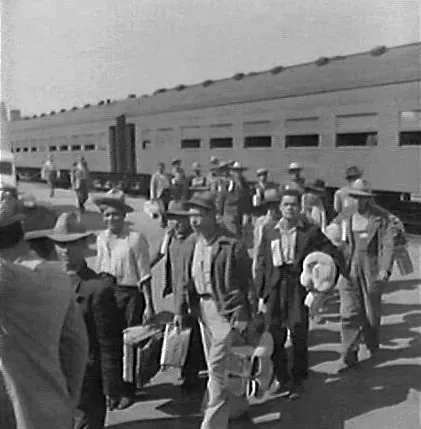
"BraceroProgram" by Dorothea Lange, working for the US Government. Source: Wikimedia Commons (Public domain).
The California Bracero Program was a special agreement between the United States and Mexico. It started in 1942, during World War II, when there were not enough workers to harvest crops on American farms. The U.S. government needed help to grow and pick food. Many American men were away fighting in the war. To solve this problem, a deal was made with Mexico to bring in guest workers called braceros. The word "bracero" comes from the Spanish word for "arm," showing the hard work done by hand.
Millions of Mexican men signed up to be braceros. They traveled from their homes in Mexico to work in California and other states. Most of them worked in the fields, picking fruits and vegetables like strawberries, tomatoes, and lettuce. The braceros helped keep American farms running and made sure people had enough food during the war. They often worked long hours under the hot sun and lived in simple camps near the farms.
The Bracero Program was supposed to be temporary. But after the war ended in 1945, the program continued because there were still not enough farm workers in the United States. Farmers and the government saw how important the braceros were for growing food. The program lasted for more than 20 years, ending in 1964. Over this time, more than four million braceros worked in the U.S.
Braceros faced many challenges. Some did not get paid fairly or lived in poor conditions. Still, many braceros were proud to help their families and to support the United States during a hard time. Their hard work helped shape California’s farming industry and brought new ideas and cultures to American communities.
The Bracero Program is important because it shows how people from different countries can work together to solve problems. It also teaches us how immigration and labor have shaped the United States. Today, many families in California and across the country remember the braceros and their contributions.
Interesting Fact: Some braceros returned to Mexico, but many stayed and became part of American life, helping to build strong communities.
When did the Bracero Program start?
1942192919641950
Who were the braceros?
Mexican farm workersAmerican soldiersCalifornia teachersU.S. government officials
Why did the U.S. need braceros?
Farm labor shortageTo build roadsTo open schoolsTo start businesses
How did the Bracero Program affect California farming?
It helped farms stay openIt made farms closeIt ended farmingIt reduced crop growth
What is one challenge braceros faced?
Not paid fairlyToo much free timeNo food to eatNo crops to pick
What does the program teach us about countries?
They can work togetherThey always fightThey ignore problemsThey stop growing food
The Bracero Program ended in 1964. True or false?
TrueFalse
What does "harvest" mean in the passage?
Pick cropsDrive trucksBuild housesTeach students
Perfect For:
👩🏫 Teachers
• Reading comprehension practice
• Auto-graded assessments
• Literacy skill development
👨👩👧👦 Parents
• Reading practice at home
• Comprehension improvement
• Educational reading time
🏠 Homeschoolers
• Reading curriculum support
• Independent reading practice
• Progress monitoring
Reading Features:
📖
Reading Passage
Engaging fiction or nonfiction text
❓
Comprehension Quiz
Auto-graded questions
📊
Instant Feedback
Immediate results and scoring
📄
Printable Version
Download for offline reading
🔊
Read Aloud
Voice-over with word highlighting
Reviews & Ratings
No reviews yet. Be the first to share your experience!
Related Content
How the Intolerable Acts United the Colonies
This engaging history reading passage explores how the Intolerable Acts, a series of strict British laws, brought the Am...
D2.HIS.1.5-6D2.HIS.2.5-6RI.5.3RI.5.4
The Life and Legacy of Mahatma Gandhi
RF.5.4.ARF.5.4.BW.5.2L.5.6
Mesopotamia—Informatonal Text
This informational text on Mesopotamia is a great way to practice reading comprehension. Students will read the text the...
RI.5.3RI.5.10
Pollination: A Crucial Ecosystem Service
Explore the vital role of pollination beyond plant reproduction, as it sustains ecosystems by ensuring food security, pr...
RI.4.2RI.4.3RI.4.4RI.5.1
The States of Matter: Solid
Discover the differences between solids, liquids and gases by exploring how their particles are arranged and move. This ...
RI.4.2RI.4.3RI.4.4RI.5.1
What is a Simple Machine
Discover the power of simple machines! This informational text explores how basic tools like levers, pulleys and incline...
RI.4.2RI.4.3RI.4.4RI.5.1
The Role of Pollinators in Nature
Learn about the fascinating world of pollinators and discover their crucial role in the reproductive process of flowerin...
RI.4.2RI.4.3RI.4.4RI.5.1
Seed Dispersal: How Plants Travel
Plants may seem stationary, but their seeds have amazing ways to travel! Explore the fascinating world of seed dispersal...
RI.4.2RI.4.3RI.4.4RI.5.1
Cyclones and Anticyclones: A Comparison
Cyclones are low-pressure systems that bring stormy weather, while anticyclones are high-pressure systems that bring cle...
7.RI.7.1RI.5.3RI.5.5RI.6.9
Cold Fronts and Warm Fronts: A Comparison
Cold fronts bring thunderstorms and cooler temperatures, while warm fronts bring light rain and warmer temperatures. Bot...
7.RI.7.3RI.5.3RI.5.5RI.6.9
Latitude: A Key Factor Affecting Climate
Latitude determines a region’s climate by affecting sunlight and temperature. Tropical regions near the equator are warm...
RI.5.3
Elevation: A Key Factor Affecting Climate
Elevation influences climate by causing temperatures to drop as altitude increases. High-elevation areas receive more so...
RI.5.3
Vegetation: A Key Factor Affecting Climate
Vegetation influences climate by cooling temperatures, increasing humidity, and supporting rainfall. Forests also preven...
RI.5.3
Topography of the Ocean Floor
This science passage with questions and answers on the ocean floor features diverse landscapes like continental shelves,...
RI.5.3
Composition of the Ocean
The ocean is made up of water, dissolved salts, gases, and organic matter. Its composition varies with depth and influen...
RI.5.3
Circulation in the Ocean
Ocean circulation involves the movement of seawater driven by wind, temperature, and salinity. It includes surface curre...
RI.5.3
Surface Ocean Currents
Surface ocean currents are driven by wind and influenced by Earth’s rotation. They transport warm and cold water, regula...
RI.5.3
The Great Pacific Garbage Patch
The Great Pacific Garbage Patch is a massive collection of plastic waste in the North Pacific Ocean. It harms marine lif...
RI.5.3RI.6.3RI.7.3
Surface Water Runoff
Surface water runoff replenishes rivers and lakes but can cause flooding and pollution. Solutions like rain gardens and ...