How the Intolerable Acts United the Colonies — Reading Comprehension
Rate this
Premium Resource
Present
Present in classroom. No work saved
Assign
Classroom with student accounts, Track progress
Quick Play
No student accounts, assign with a link
Grades
3
4
5
Standards
D2.HIS.1.5-6
D2.HIS.2.5-6
RI.5.3
RI.5.4
W.5.2
PRINT+DIGITAL RESOURCE
This learning resource is available in interactive and printable formats. The interactive worksheet can be played online and assigned to students. The Printable PDF version can be downloaded and printed for completion by hand.
This engaging history reading passage explores how the Intolerable Acts, a series of strict British laws, brought the American colonies together and led to the First Continental Congress. Students will learn about the Boston Tea Party, the British response, and how colonial leaders worked to protect their rights. The passage emphasizes themes of bravery, unity, and problem-solving, and is structured to support both literacy and historical understanding. Aligned with C3 Framework and Common Core standards, the resource includes a glossary of key vocabulary, an interactive quiz, writing prompts, a timeline of major events, and a graphic organizer activity. The passage is available with read aloud audio and a Spanish translation, making it accessible for a wide range of learners. Keywords include Intolerable Acts, American Revolution, and First Continental Congress.
CONTENT PREVIEW
Expand content preview
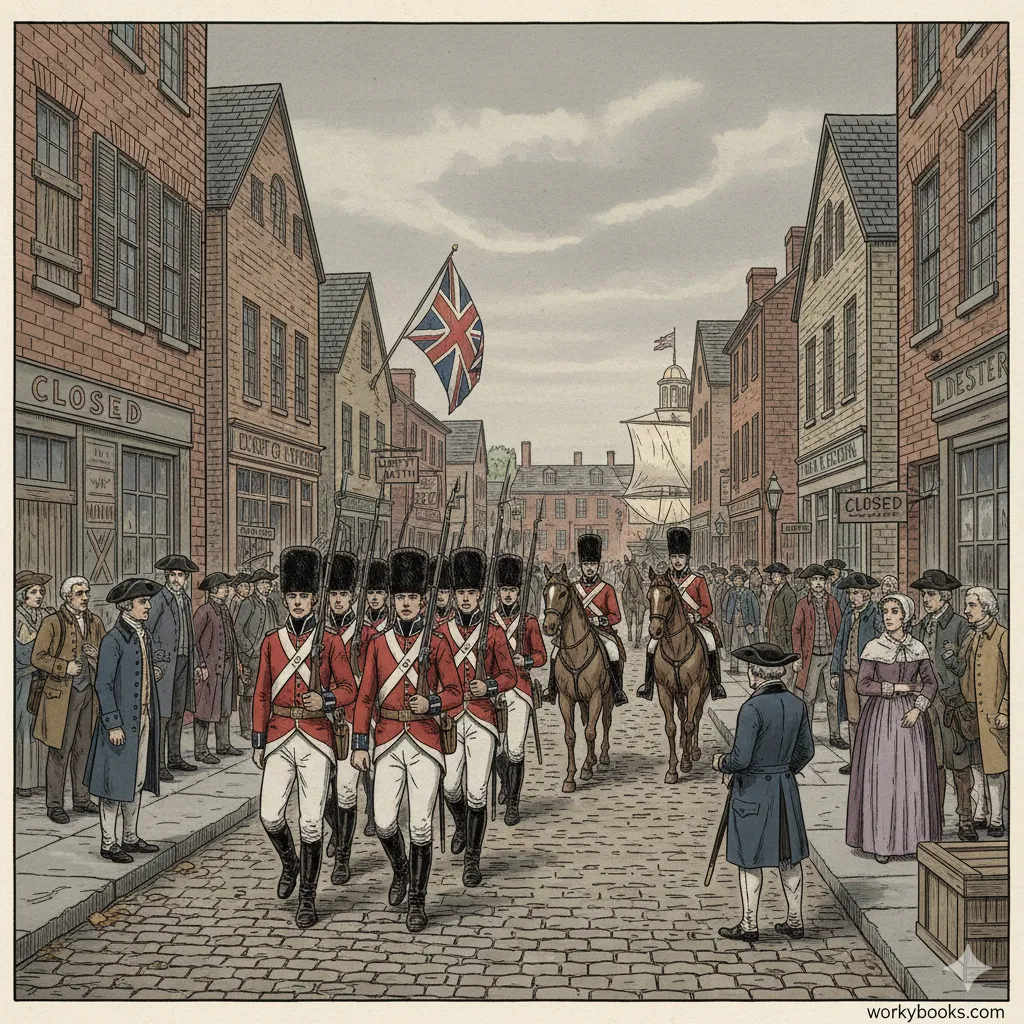
Intolerable Acts punished Boston for the Tea Party with strict British laws (1774).
The Intolerable Acts were a group of harsh laws passed by the British Parliament in 1774. These laws were meant to punish the colony of Massachusetts for the Boston Tea Party. The Boston Tea Party happened when colonists, angry about taxes, dumped British tea into Boston Harbor. This act of protest made the British government very angry.
Parliament decided to make an example of Massachusetts so that other colonies would not rebel. They passed several new laws. One law closed the port of Boston. This meant that no ships could go in or out. As a result, people in Boston could not receive food, supplies, or trade goods. Another law stopped the colony from holding town meetings. Town meetings were important because they let colonists talk about their problems and plan what to do next.
The British also made it so that any British official accused of a crime in the colonies would be sent to Britain for trial. Colonists believed this was unfair. They thought British officials could break the law and not be punished. Another law forced colonists to let British soldiers stay in their homes if needed. This made many people angry because they lost their privacy and control over their own houses.
These laws were called the "Intolerable Acts" by the colonists because they found them impossible to accept. The laws were also known as the Coercive Acts in Britain. The harsh rules hurt not just Boston, but all of Massachusetts. Many people in other colonies were shocked by the punishment. They felt that if it could happen to Boston, it could happen to them too.
The Intolerable Acts had a big effect. People in all thirteen colonies began to work together. They sent food and supplies to Boston. They also met at the First Continental Congress in 1774. This meeting was important because leaders from all the colonies talked about how to deal with Britain. The colonies decided to stand together. This unity was a key step toward the American Revolution.
The Intolerable Acts showed how unfair treatment could bring people together. Colonists realized they needed to protect their rights. Soon, they would fight for their freedom.
Interesting Fact: The First Continental Congress was the first time leaders from all thirteen colonies met together to solve a problem with Britain.
What was the Boston Tea Party?
Colonists dumped tea into the harborBritish drank tea at a partyColonists paid extra taxesBritish closed all ports
Why did Britain pass the Intolerable Acts?
To reward the colonistsTo punish MassachusettsTo lower taxesTo start a parade
What did closing Boston’s port mean?
No ships could enter or leaveOnly British ships could dockMore tea was deliveredColonists got new rights
What was one effect of the Intolerable Acts?
Colonists had more freedomColonists united togetherBritish left the coloniesTown meetings increased
Why did other colonies send help to Boston?
They wanted to tradeThey were shocked by the punishmentThey wanted more lawsThey were friends with the king
What right did colonists lose with British soldiers staying in homes?
PrivacyVotingTravelSpeech
The Intolerable Acts made colonists unite. True or false?
TrueFalse
What does 'unity' mean?
Joining together for a goalFighting each otherLiving aloneMaking new laws
Perfect For:
👩🏫 Teachers
• Reading comprehension practice
• Auto-graded assessments
• Literacy skill development
👨👩👧👦 Parents
• Reading practice at home
• Comprehension improvement
• Educational reading time
🏠 Homeschoolers
• Reading curriculum support
• Independent reading practice
• Progress monitoring
Reading Features:
📖
Reading Passage
Engaging fiction or nonfiction text
❓
Comprehension Quiz
Auto-graded questions
📊
Instant Feedback
Immediate results and scoring
📄
Printable Version
Download for offline reading
🔊
Read Aloud
Voice-over with word highlighting
Reviews & Ratings
No reviews yet. Be the first to share your experience!
Related Content
California Bracero Program
This passage explores the history of the Bracero Program, which brought Mexican farmworkers to the United States during ...
D2.HIS.1.5-6D2.HIS.2.5-6RI.5.3RI.5.4
The Life and Legacy of Mahatma Gandhi
RF.5.4.ARF.5.4.BW.5.2L.5.6
Mesopotamia—Informatonal Text
This informational text on Mesopotamia is a great way to practice reading comprehension. Students will read the text the...
RI.5.3RI.5.10
Pollination: A Crucial Ecosystem Service
Explore the vital role of pollination beyond plant reproduction, as it sustains ecosystems by ensuring food security, pr...
RI.4.2RI.4.3RI.4.4RI.5.1
The States of Matter: Solid
Discover the differences between solids, liquids and gases by exploring how their particles are arranged and move. This ...
RI.4.2RI.4.3RI.4.4RI.5.1
What is a Simple Machine
Discover the power of simple machines! This informational text explores how basic tools like levers, pulleys and incline...
RI.4.2RI.4.3RI.4.4RI.5.1
The Role of Pollinators in Nature
Learn about the fascinating world of pollinators and discover their crucial role in the reproductive process of flowerin...
RI.4.2RI.4.3RI.4.4RI.5.1
Seed Dispersal: How Plants Travel
Plants may seem stationary, but their seeds have amazing ways to travel! Explore the fascinating world of seed dispersal...
RI.4.2RI.4.3RI.4.4RI.5.1
Cyclones and Anticyclones: A Comparison
Cyclones are low-pressure systems that bring stormy weather, while anticyclones are high-pressure systems that bring cle...
7.RI.7.1RI.5.3RI.5.5RI.6.9
Cold Fronts and Warm Fronts: A Comparison
Cold fronts bring thunderstorms and cooler temperatures, while warm fronts bring light rain and warmer temperatures. Bot...
7.RI.7.3RI.5.3RI.5.5RI.6.9
Latitude: A Key Factor Affecting Climate
Latitude determines a region’s climate by affecting sunlight and temperature. Tropical regions near the equator are warm...
RI.5.3
Elevation: A Key Factor Affecting Climate
Elevation influences climate by causing temperatures to drop as altitude increases. High-elevation areas receive more so...
RI.5.3
Vegetation: A Key Factor Affecting Climate
Vegetation influences climate by cooling temperatures, increasing humidity, and supporting rainfall. Forests also preven...
RI.5.3
Topography of the Ocean Floor
This science passage with questions and answers on the ocean floor features diverse landscapes like continental shelves,...
RI.5.3
Composition of the Ocean
The ocean is made up of water, dissolved salts, gases, and organic matter. Its composition varies with depth and influen...
RI.5.3
Circulation in the Ocean
Ocean circulation involves the movement of seawater driven by wind, temperature, and salinity. It includes surface curre...
RI.5.3
Surface Ocean Currents
Surface ocean currents are driven by wind and influenced by Earth’s rotation. They transport warm and cold water, regula...
RI.5.3
The Great Pacific Garbage Patch
The Great Pacific Garbage Patch is a massive collection of plastic waste in the North Pacific Ocean. It harms marine lif...
RI.5.3RI.6.3RI.7.3
Surface Water Runoff
Surface water runoff replenishes rivers and lakes but can cause flooding and pollution. Solutions like rain gardens and ...