Columbian Exchange Impact on Native Americans — Reading Comprehension
Rate this
Present
Present in classroom. No work saved
Assign
Classroom with student accounts, Track progress
Quick Play
No student accounts, assign with a link
Grades
6
7
8
Standards
D2.HIS.2.3-5
D2.HIS.3.3-5
RI.4.3
RI.4.4
W.4.2
PRINT+DIGITAL RESOURCE
This learning resource is available in interactive and printable formats. The interactive worksheet can be played online and assigned to students. The Printable PDF version can be downloaded and printed for completion by hand.
This passage examines the complex effects of the Columbian Exchange on Native Americans, analyzing the causes, consequences, and perspectives of both Indigenous peoples and Europeans. Students will explore how the movement of plants, animals, people, and diseases across the Atlantic transformed societies on both sides, with a focus on the dramatic impact on Native American communities. Key disciplinary vocabulary is integrated throughout, and a primary source quote deepens understanding. Activities include a rigorous multiple-choice quiz, explanatory writing tasks, a T-Chart graphic organizer, and a clear timeline. This resource is aligned with D2.His.2.3-5, D2.His.3.3-5, RI.4.3, RI.4.4, W.4.2 standards. The passage is also available in Spanish and includes read aloud audio, making it accessible for diverse learners. Designed to foster historical reasoning, evidence-based analysis, and critical thinking, this engaging resource is ideal for U.S. history students seeking to understand one of the most transformative periods in the Americas.
CONTENT PREVIEW
Expand content preview
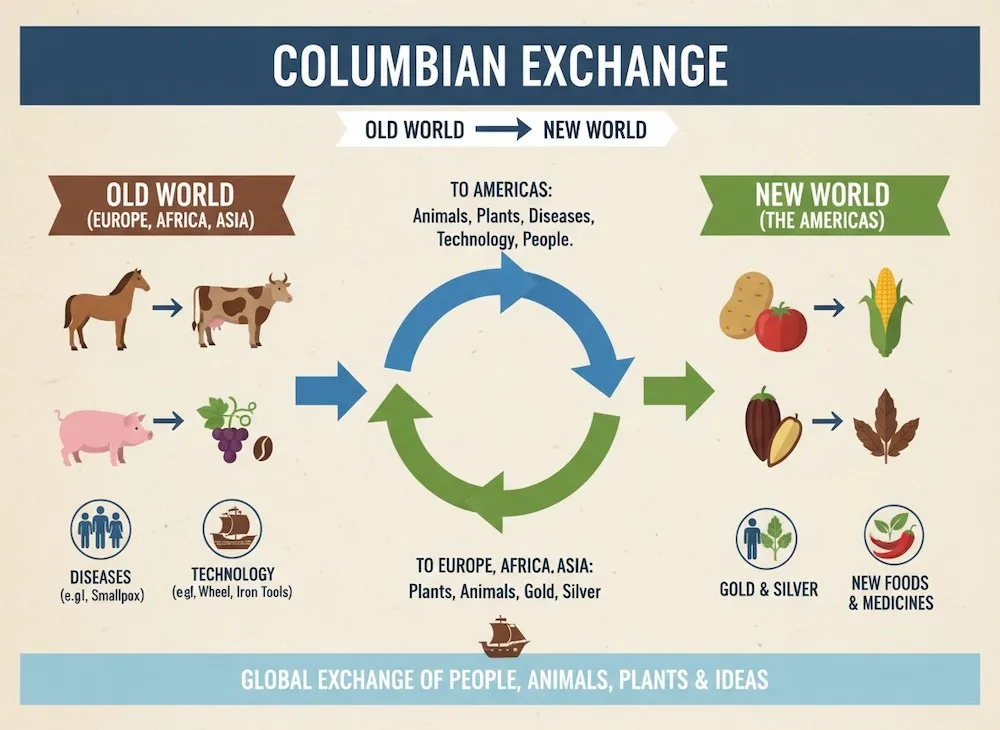
The Columbian Exchange refers to the vast movement of plants, animals, people, and diseases between the Americas and Europe after Christopher Columbus arrived in 1492. This biological transfer transformed life on both continents. For Native Americans, the consequences were complex, involving new opportunities and serious challenges.
Before 1492, the Americas had unique plants and animals developed over thousands of years. The arrival of Europeans led to the introduction of new species such as horses, cattle, pigs, and wheat. Horses, in particular, changed Native American life on the Great Plains. Tribes like the Comanche and Lakota became skilled horse riders, using these animals for hunting and travel. The new crops and animals sometimes improved diets and increased mobility, but they also disrupted traditional ways of life.
However, the exchange did not only bring benefits. Along with animals and crops, Europeans brought diseases like smallpox, measles, and influenza. Native Americans had no natural immunity to these illnesses, leading to devastating epidemics. Historians estimate that up to 90% of some indigenous populations died within decades of contact. Entire villages disappeared, and ancient cultures were nearly lost.
The arrival of Europeans also marked the beginning of violent conquest. Spanish and other European invaders sought wealth, land, and power. They used advanced weapons and sometimes formed alliances with local tribes against others. The combination of disease and military force made resistance incredibly difficult for Native Americans, leading to the collapse of many civilizations, like the Aztec and Inca empires.
Despite these tragedies, Native Americans adapted in creative ways. Some groups integrated new crops like wheat and sugarcane into their agriculture. Others used horses to expand their hunting territories or improve trade networks. These adaptations showed resilience, but the overall impact of the Columbian Exchange was deeply disruptive and often destructive for indigenous communities.
Today, historians continue to debate the long-term effects of the Columbian Exchange. Some emphasize the increased global connections and the exchange of ideas. Others focus on the catastrophic loss of life and culture among Native Americans. By comparing both the positive and negative outcomes, we gain a more balanced understanding of this pivotal period in history.
Interesting Fact: Horses became extinct in North America thousands of years before Columbus, so when Europeans brought them back, Native Americans had to learn how to train and use them all over again.
What was the Columbian Exchange?
Movement of plants, animals, and diseasesA war between Europe and AmericaA trade agreement between tribesA new government system
Which animal changed Plains tribes most?
HorsePigChickenSheep
Which disease was NOT mentioned?
SmallpoxMeaslesMalariaInfluenza
What effect did diseases have?
High death ratesImproved tradeNew cropsBuilt cities
How did Native Americans adapt?
Used new animalsRefused all changeMoved to EuropeDestroyed crops
What is a conquest?
Taking control by forceSharing resourcesTrading animalsMaking peace
Columbian Exchange brought only benefits. True or false?
TrueFalse
What does 'epidemic' mean?
Sudden disease outbreakSharing ideasNew animalType of food
Perfect For:
👩🏫 Teachers
• Reading comprehension practice
• Auto-graded assessments
• Literacy skill development
👨👩👧👦 Parents
• Reading practice at home
• Comprehension improvement
• Educational reading time
🏠 Homeschoolers
• Reading curriculum support
• Independent reading practice
• Progress monitoring
Reading Features:
📖
Reading Passage
Engaging fiction or nonfiction text
❓
Comprehension Quiz
Auto-graded questions
📊
Instant Feedback
Immediate results and scoring
📄
Printable Version
Download for offline reading
🔊
Read Aloud
Voice-over with word highlighting
Reviews & Ratings
No reviews yet. Be the first to share your experience!
Related Content
Informational Text —Healthy Teeth and Gums
RI.4.10RI.4.3RF.4.4RF.4.4.A
Informational Text —Migratory Birds
Engage young minds with this worksheet that delves into the wonders of migratory birds. Learn about their extraordinary ...
RI.4.10RI.4.3RF.4.4RF.4.4.A
Natural Disasters and Urban flooding
This reading comprehension worksheet focuses on the topic of natural disasters, specifically urban flooding. Following t...
RI.4.44-ESS3ESS3.B4-ESS3-1
The Formation of Fossils
L.4.2.DL.4.6RI.4.4
Climate and Water Cycle
W.4.2.ARI.4.4RI.4.1
Ocean Acidification
Download this reading comprehension worksheet about ocean acidification. The worksheet includes an informational text ab...
RI.4.4
Understanding Climate Action Context Clues
Understanding Climate Action" worksheet, aligned with CCS L.4.4.A and NGSS. This resource introduces key concepts such a...
L.4.4.ARI.4.1RI.4.4
Informational Text —The History of Toothpaste
RI.4.4RI.4.4
Informational Text —All About Dentists
Students read an informational text explaining what dentists do and how they are trained. Aligned to RI.4.3-2
RI.4.10RI.4.3RF.4.4RF.4.4.A
The Role of Pollinators in Nature
Learn about the fascinating world of pollinators and discover their crucial role in the reproductive process of flowerin...
RI.4.2RI.4.3RI.4.4RI.5.1
Pollination: A Crucial Ecosystem Service
Explore the vital role of pollination beyond plant reproduction, as it sustains ecosystems by ensuring food security, pr...
RI.4.2RI.4.3RI.4.4RI.5.1
Seed Dispersal: How Plants Travel
Plants may seem stationary, but their seeds have amazing ways to travel! Explore the fascinating world of seed dispersal...
RI.4.2RI.4.3RI.4.4RI.5.1
The States of Matter: Solid
Discover the differences between solids, liquids and gases by exploring how their particles are arranged and move. This ...
RI.4.2RI.4.3RI.4.4RI.5.1
What is a Simple Machine
Discover the power of simple machines! This informational text explores how basic tools like levers, pulleys and incline...
RI.4.2RI.4.3RI.4.4RI.5.1
The Life Cycle of a Salmon
Salmon have a remarkable life cycle that takes them from rivers to the ocean and back again. They hatch as alevin, grow ...
RI.3.1RI.4.4RI.4.2
Journey of a Sea Turtle
Sea turtles lay their eggs on beaches, and their hatchlings begin a dangerous journey to the ocean. After growing in the...
RI.3.1RI.4.4RI.4.2
Heroes for Freedom: Harriet Tubman
Harriet Tubman, born into slavery, became a hero who risked her life to lead others to freedom through the Underground R...
RI.3.1RI.4.4RI.4.2RI.5.2
Heroes for Freedom: Fannie Lou Hamer
Fannie Lou Hamer overcame racial segregation and poverty to become a powerful voice for civil rights. Her fight for voti...
RI.3.1RI.4.4RI.4.2RI.5.2
Sports: Lionel Messi
Lionel Messi, known for his unparalleled dribbling and passing, has broken records, won multiple FIFA Ballon d'Or awards...
RI.3.1RI.4.4RI.4.2RI.5.2
Natural Disaster: Droughts
Droughts are long periods with insufficient water, leading to crop failures and water shortages. Conserving water and pl...