Cottage Industry vs. Factories
Interactive passage with audio narration, comprehension questions, and printable PDF.
By completing this purchase you agree to our Terms of Use and Privacy Policy. Your subscription renews automatically until you cancel. You can cancel anytime from your account settings. All sales are final and non-refundable. Digital content is available for download in your account immediately upon purchase.
What's included
Part of this bundle

Cottage Industry vs. Factories preview and details
About this printable Cottage Industry vs. Factories reading passage (Grades 3-5)
Sample passage and quiz from Cottage Industry vs. Factories
Reading passage and comprehension quiz preview
Cottage Industry vs. Factories
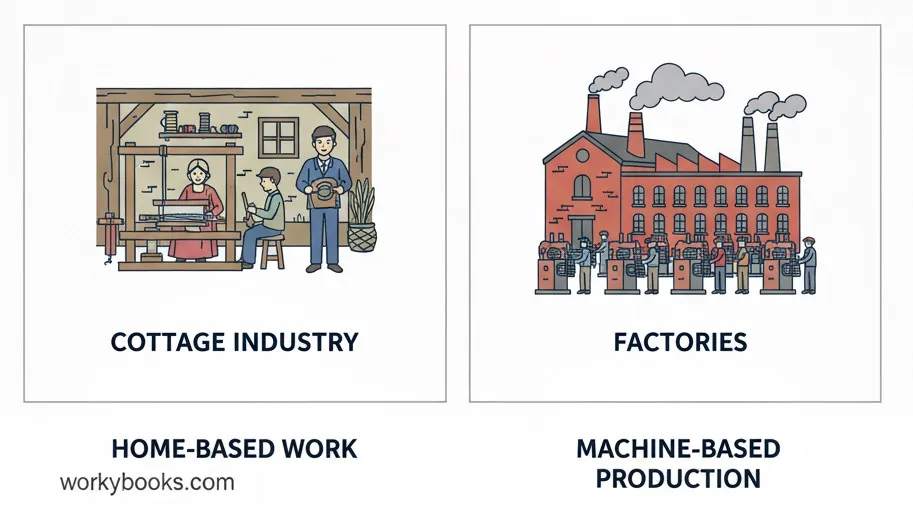
During the Progressive Era in the United States, the way people made goods changed greatly. Before big factories, many families worked in what is called a cottage industry. This meant that people made things like clothing, shoes, and tools at home. Each family used their own hands or simple tools to create items. They often worked together in small groups. Goods were made slowly, one at a time, and each item was special.
In the cottage industry, families had control over their work. They could decide when to start and stop. Children and parents worked side by side. Sometimes, neighbors helped each other. People sold their products at local markets or traded with friends. Life in the cottage industry was busy but personal.
Then, in the late 1800s and early 1900s, factories began to appear. This was part of a big change called the Industrial Revolution. Factories brought together many workers in one place. Inside the factory, machines did much of the work. People had to follow strict rules and work on a schedule. Each worker did one small part of the job, over and over.
This new way of working was called the factory system. Factories made it possible to produce more goods much faster. Items like cloth, shoes, and tools became cheaper because they could be made in large numbers. However, factory work was often hard and sometimes dangerous. Workers had to keep up with machines. They did not always get to choose their hours or work with family.
The rise of factories changed American life. Towns grew around factories. Many people moved from farms and villages into cities to find jobs. This change was called urbanization. Cities became crowded, and new neighborhoods formed. Life was different from the quiet days of the cottage industry.
There were good things and bad things about both systems. In cottage industries, people had more freedom and closer families, but they could not make goods as quickly. In factories, people could earn more money and buy cheaper goods, but they had to work long hours and follow strict rules.
Over time, most home production disappeared as factories took over. The manufacturing change during the Progressive Era helped shape the modern United States. Today, most goods are still made in factories, but the story of the cottage industry reminds us of how people worked together in the past.
Interesting Fact: Some small cottage industries still exist today, making handmade goods that are unique and special.
Comprehension quiz (8 questions)
1. What is a cottage industry?
2. Why did people move to cities?
3. What did factories use to make goods fast?
4. What was one effect of factory work?
5. How did cottage industry workers control their day?
6. Why did factories replace home production?
7. Most goods today are made in factories.
8. What does 'urbanization' mean?
Common Core standards for Cottage Industry vs. Factories
Explain events, procedures, ideas, or concepts in a historical, scientific, or technical text, including what happened and why, based on specific information in the text.
Determine the meaning of general academic and domain-specific words or phrases in a text relevant to a grade 4 topic or subject area.
Write informative/explanatory texts to examine a topic and convey ideas and information clearly.
Perfect for the way you teach
- Build comprehension skills
- Auto-graded quiz
- Differentiated reading
- Read together at home
- Improve fluency
- Quiet reading time
- Reading curriculum support
- Independent practice
- Track Lexile growth