D-Day June 6 1944: Normandy Invasion
Interactive passage with audio narration, comprehension questions, and printable PDF.
By completing this purchase you agree to our Terms of Use and Privacy Policy. Your subscription renews automatically until you cancel. You can cancel anytime from your account settings. All sales are final and non-refundable. Digital content is available for download in your account immediately upon purchase.
What's included
D-Day June 6 1944: Normandy Invasion preview and details
About this printable D-Day June 6 1944: Normandy Invasion reading passage (Grades 6-8)
Sample passage and quiz from D-Day June 6 1944: Normandy Invasion
Reading passage and comprehension quiz preview
D-Day Normandy Invasion
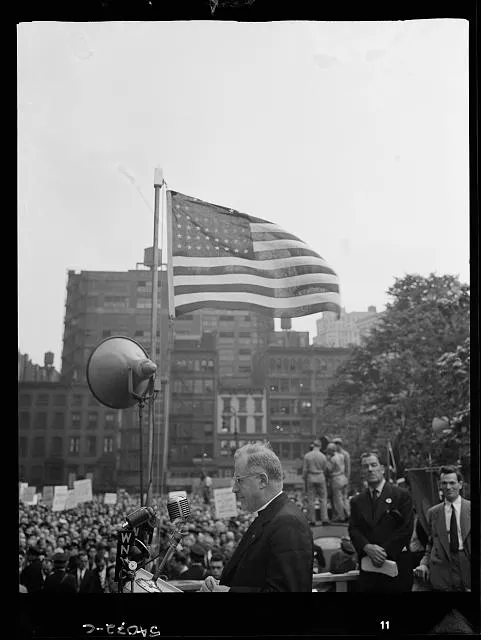
Source: Library of Congress - Hollem, Howard R.
On June 6, 1944, the Allies launched a massive invasion on the coast of Normandy, France, during World War II. This operation, called D-Day, involved over 156,000 soldiers from the United States, Britain, Canada, and other Allied forces. The goal was to break through German defenses and begin the liberation of Western Europe from Nazi occupation.
The Normandy landings were the largest amphibious military operation in history, meaning troops arrived by sea onto hostile beaches. Planning for D-Day was complex and required careful coordination among different nations and military branches. Commanders used secret codes and deception to convince the Germans the attack would happen elsewhere. This strategy was crucial for achieving surprise and reducing Allied losses.
Despite extensive preparations, the soldiers faced many obstacles on June 6. The beaches were heavily defended with barbed wire, mines, and machine-gun nests. Rough seas and bad weather made landing difficult. Many units landed far from their original targets, causing confusion. However, Allied commanders adapted quickly, using flexible tactics to overcome German resistance.
The cost of the invasion was high. Thousands of Allied soldiers were killed or wounded on the first day. But by the evening, the Allies had secured several beachheads. This success allowed them to bring in more troops, vehicles, and supplies, eventually leading to the breakthrough of German lines in France.
D-Day was a turning point in World War II. The successful invasion forced Germany to fight on two fronts and began the slow process of freeing Europe from Nazi control. The operation required immense bravery, careful planning, and international cooperation. It demonstrated how nations could unite against oppression and changed the course of the war.
Interesting Fact: The term "D-Day" does not stand for "decision day" or "doomsday"—it is a general military term for the day an operation begins.
Comprehension quiz (8 questions)
1. What date did D-Day take place?
2. Where did the Allied invasion occur?
3. Which countries were involved in D-Day?
4. Why was the invasion important?
5. What made the landing difficult?
6. What was one strategy used by the Allies?
7. D-Day was a turning point in WWII.
8. What does 'amphibious' mean?
Common Core standards for D-Day June 6 1944: Normandy Invasion
Explain events, procedures, ideas, or concepts in a historical, scientific, or technical text, including what happened and why, based on specific information in the text.
Determine the meaning of general academic and domain-specific words or phrases in a text relevant to a grade 4 topic or subject area.
Write informative/explanatory texts to examine a topic and convey ideas and information clearly.
Perfect for the way you teach
- Build comprehension skills
- Auto-graded quiz
- Differentiated reading
- Read together at home
- Improve fluency
- Quiet reading time
- Reading curriculum support
- Independent practice
- Track Lexile growth