Does the Moon Face Change? — Reading Comprehension
Rate this
Premium Resource
Present
Present in classroom. No work saved
Assign
Classroom with student accounts, Track progress
Quick Play
No student accounts, assign with a link
Grades
1
2
3
Standards
1-ESS1-1
PRINT+DIGITAL RESOURCE
This learning resource is available in interactive and printable formats. The interactive worksheet can be played online and assigned to students. The Printable PDF version can be downloaded and printed for completion by hand.
This engaging 1st-grade reading comprehension passage, 'The Moon's Changing Face,' is specifically designed to align with NGSS Standard 1-ESS1-1, focusing on Earth's Place in the Universe. It introduces young learners to the observable and predictable patterns of the moon's appearance, explaining how its shape seems to change over time. The passage emphasizes the importance of observation in science, encouraging students to watch the sky to understand celestial movements. This resource supports early science literacy and deepens understanding of core ESS1.A Disciplinary Core Ideas, making complex astronomical concepts accessible and exciting for first graders.
CONTENT PREVIEW
Expand content preview
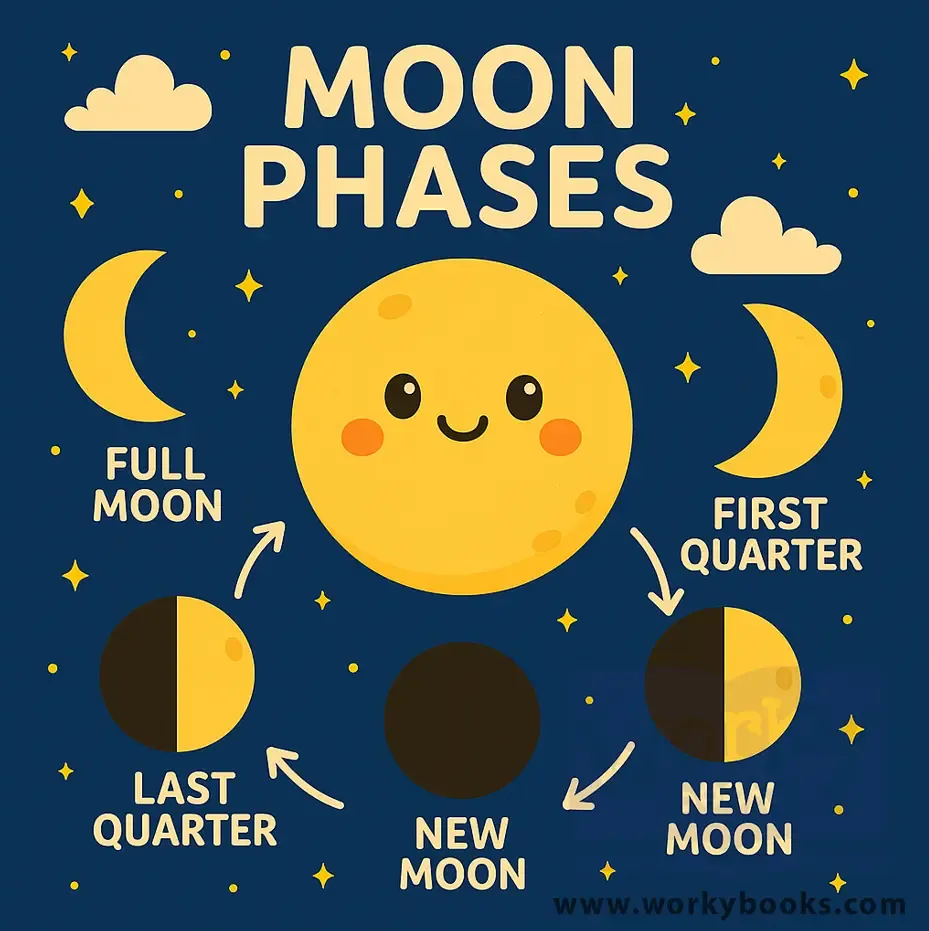
Have you ever looked at the moon in the night sky? Sometimes it looks like a big, bright circle, like a giant cookie! Other times, it looks like a thin banana, or maybe just half a circle. Isn't that interesting? The moon doesn't always look the same.
The moon is always there, but its shape seems to change. It's like it's playing a trick on our eyes! One night you might see a full, round moon. A few nights later, it might look like only half of it is lit up. Then, after some more nights, it might look like just a tiny sliver.
These changes are not magic. They are a pattern! The moon goes through its different shapes in a predictable way. If you watch the moon every night, or even just once a week, you can see these changes happening. It takes about a month for the moon to go through all its shapes and come back to where it started.
Just like the sun rising and setting every day, the moon also follows a pattern in its appearance. Knowing these patterns helps us understand more about our sky and the amazing things in space! Keep observing the sky, and you'll see these wonderful, predictable changes for yourself
Fun Fact! Even though the moon looks bright in our night sky, it doesn't make its own light! It actually reflects light from the sun, just like a giant mirror in space.
What is the passage mainly about?
How hot the sun isThe moon's changing lookWhy stars twinkleHow to play outside
What is one way the moon can look sometimes?
Like a tiny sunA big, bright circleA dark cloudA flying bird
What causes the moon to look different shapes?
It plays a trick on us. It is a magic trick.It is a natural pattern. Clouds cover it.
How long does it take for the moon to show all its shapes?
About a weekAbout a dayAbout a monthAbout a year
What does the passage suggest you do to see the moon's changes?
Sleep all nightWatch it every nightPlay insideRead a book
How is the moon's pattern like the sun's pattern?
Both are always round. Both give warmth.Both are predictable. Both disappear.
If you see only a tiny sliver of the moon tonight, what might it look like in a few weeks?
Still a tiny sliverA full, round moonIt will be goneA bright star
What does "predictable" mean in this story?
It is a surprise. It happens sometimes. We know it will happen again.It is very fast.
Perfect For:
👩🏫 Teachers
• Reading comprehension practice
• Auto-graded assessments
• Literacy skill development
👨👩👧👦 Parents
• Reading practice at home
• Comprehension improvement
• Educational reading time
🏠 Homeschoolers
• Reading curriculum support
• Independent reading practice
• Progress monitoring
Reading Features:
📖
Reading Passage
Engaging fiction or nonfiction text
❓
Comprehension Quiz
Auto-graded questions
📊
Instant Feedback
Immediate results and scoring
📄
Printable Version
Download for offline reading
🔊
Read Aloud
Voice-over with word highlighting
Reviews & Ratings
No reviews yet. Be the first to share your experience!
Related Content
Patterns In The Sky
This engaging 1st-grade reading comprehension passage, 'Being a Sky Observer,' directly aligns with NGSS Standard 1-ESS1...
1-ESS1-1
Sun Pattern
This reading passage on patterns of the Sun supports the NGSS 1-ESS1-1 standard for understanding the Sun's apparent mov...
1-ESS1-1
Earth's Place in the Universe
This reading passage explains Earth's place in the universe, supporting NGSS 1-ESS1-1. It describes how Earth is one of ...
1-ESS1-1
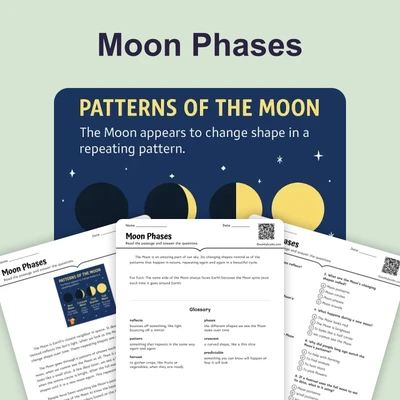
Moon Phases
This informational reading passage explores the patterns of the Moon to support NGSS 1-ESS1-1. It describes how the Moon...
1-ESS1-1
When Was Neptune Discovered?
This reading passage explains how Neptune, the eighth planet from the Sun, was discovered in 1846 by astronomers Johann ...
1-ESS1-1
Sun, Moon, and Stars
This engaging 1st-grade reading comprehension passage, 'The Sun, Moon, and Stars,' is perfectly aligned with NGSS Standa...
1-ESS1-1
The Twinkling Stars
This engaging 1st-grade reading comprehension passage, 'The Twinkling Stars,' is designed to meet NGSS Standard 1-ESS1-1...