This learning resource is available in interactive and printable formats. The interactive worksheet can be played online and assigned to students. The Printable PDF version can be downloaded and printed for completion by hand.
This engaging 1st-grade reading comprehension passage, 'Being a Sky Observer,' directly aligns with NGSS Standard 1-ESS1-1, Earth's Place in the Universe. It introduces students to the scientific practice of observation, encouraging them to watch the sun, moon, and stars carefully to identify predictable patterns. The passage clearly explains how these observations lead to the ability to make predictions about future appearances of celestial bodies. This resource reinforces early science literacy and helps students grasp core ESS1.A Disciplinary Core Ideas, fostering a foundational understanding of astronomical patterns and the process of scientific inquiry.
CONTENT PREVIEW
Expand content preview
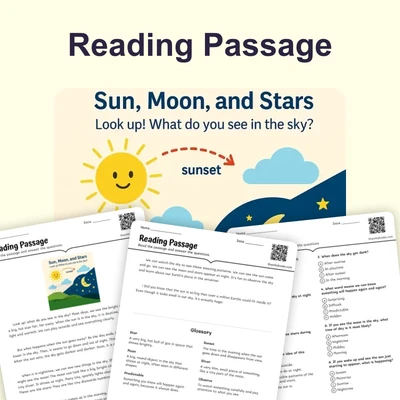
Do you like to look up at the sky? You can be a sky observer! An observer is someone who watches things very carefully. When you observe the sky, you can learn so much about our Earth's place in the universe.
What can you observe? You can watch the sun. Every morning, the sun appears in the sky. It gives us light and warmth for playtime. You can also observe the moon. Sometimes it is big and round, and other times it is thin like a smile. And when the sky gets dark, you can observe the twinkling stars.
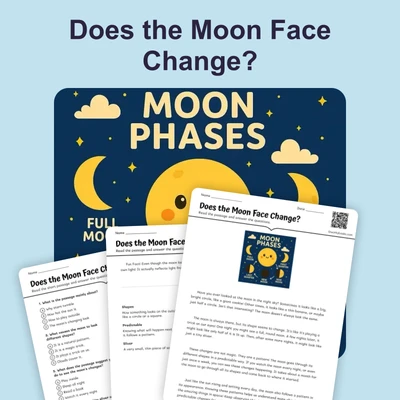
When you observe the sun, moon, and stars, you will notice something special: they follow patterns. A pattern means something happens the same way again and again. The sun always comes up in the morning. Night always comes after day. The moon's shape always changes in the same way. These are all predictable patterns. Predictable means we know what will happen next!
Because these patterns are predictable, you can start to make predictions. If you see the sun setting, you can predict that nighttime is coming. If you see a tiny moon, you can predict that it will get bigger over the next few days. Being a sky observer is like being a detective! You watch, you find patterns, and then you can predict. It's a fun way to understand the amazing world around us.
Fun Fact! Did you know that long, long ago, before clocks or calendars, people used the predictable patterns of the sun, moon, and stars to tell time and seasons? They were amazing sky observers!
What is an observer?
Someone who likes to playSomeone who watches things carefullySomeone who sings songsSomeone who hides
What can you observe in the sky?
The sun, moon, and starsOnly cloudsOnly birdsTrees and houses
What do the sun, moon, and stars all follow?
SurprisesGamesPatternsRules
What word means we know what will happen next?
HiddenPredictableDifficultMagical
What happens after daytime, based on a predictable pattern?
The sun gets bigger.Nighttime comes.The moon hides.Stars disappear.
If you observe the moon looking like a tiny smile, what can you predict about its shape in a few days?
It will stay the same.It will get smaller.It will get bigger.It will disappear.
What is the main idea of this passage?
How to play outside safely.Being a sky observer helps understand patterns and make predictions.What astronauts do in space.How to draw stars.
Why is it important to watch the sky carefully?
To find lost toys.To see predictable patterns.To see new animals.To count the clouds.
Perfect For:
👩🏫 Teachers
• Reading comprehension practice
• Auto-graded assessments
• Literacy skill development
👨👩👧👦 Parents
• Reading practice at home
• Comprehension improvement
• Educational reading time
🏠 Homeschoolers
• Reading curriculum support
• Independent reading practice
• Progress monitoring
Reading Features:
📖
Reading Passage
Engaging fiction or nonfiction text
❓
Comprehension Quiz
Auto-graded questions
📊
Instant Feedback
Immediate results and scoring
📄
Printable Version
Download for offline reading
🔊
Read Aloud
Voice-over with word highlighting
Reviews & Ratings
No reviews yet. Be the first to share your experience!
Related Content
Sun Pattern
This reading passage on patterns of the Sun supports the NGSS 1-ESS1-1 standard for understanding the Sun's apparent mov...
1-ESS1-1
Earth's Place in the Universe
This reading passage explains Earth's place in the universe, supporting NGSS 1-ESS1-1. It describes how Earth is one of ...
1-ESS1-1
Moon Phases
This informational reading passage explores the patterns of the Moon to support NGSS 1-ESS1-1. It describes how the Moon...
1-ESS1-1
When Was Neptune Discovered?
This reading passage explains how Neptune, the eighth planet from the Sun, was discovered in 1846 by astronomers Johann ...
1-ESS1-1
Sun, Moon, and Stars
This engaging 1st-grade reading comprehension passage, 'The Sun, Moon, and Stars,' is perfectly aligned with NGSS Standa...
1-ESS1-1
Does the Moon Face Change?
This engaging 1st-grade reading comprehension passage, 'The Moon's Changing Face,' is specifically designed to align wit...
1-ESS1-1
The Twinkling Stars
This engaging 1st-grade reading comprehension passage, 'The Twinkling Stars,' is designed to meet NGSS Standard 1-ESS1-1...