Moon Phases
Interactive passage with audio narration, comprehension questions, and printable PDF.
What's included
Moon Phases preview and details
About this printable Moon Phases science reading passage, NGSS-aligned (Grades 1-8)
Sample passage and quiz from Moon Phases
Reading passage and comprehension quiz preview
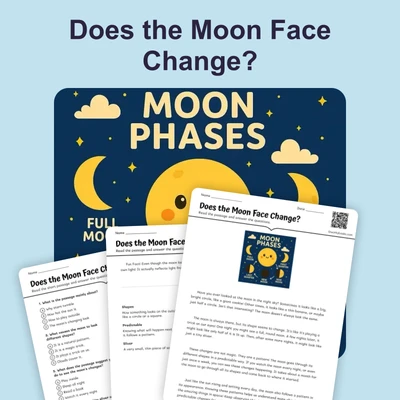
Moon Phases

The Moon is Earth’s closest neighbor in space. It does not make its own light, but instead reflects the Sun’s light. When we look at the Moon in the night sky, it seems to change shape over time. These repeating shapes are called the phases of the Moon.
The Moon goes through a pattern of phases each month. It starts with the new moon, when we cannot see the Moon at all. Then it changes to a crescent moon, which looks like a small slice. A few days later, we see a half moon, and then a full moon, when the entire circle is bright. After the full moon, it goes backward through these shapes until it is a new moon again. This repeating pattern takes about 29 days.
People have been watching the Moon’s patterns for thousands of years. Farmers used the phases of the Moon to know the best times to plant and harvest crops. Some cultures even made calendars based on the Moon’s cycle.
The Moon’s patterns are very predictable. We can look at a calendar and know what the Moon will look like on a certain day. These patterns help scientists study the Moon and learn more about space. They also help people plan special events, like festivals or holidays.
The Moon is an amazing part of our sky. Its changing shapes remind us of the patterns that happen in nature, repeating again and again in a beautiful cycle.
Fun Fact: The same side of the Moon always faces Earth because the Moon spins once each time it goes around Earth!
Comprehension quiz (8 questions)
1. What does the Moon reflect?
2. What are the Moon’s changing shapes called?
3. About how long is the Moon’s pattern cycle?
4. What happens during a new moon?
5. Which phase shows the entire Moon bright?
6. Why did people long ago watch the Moon’s patterns?
7. What is the main idea of the passage?
8. If a festival uses the full moon to set its date, what is it using?
Perfect for the way you teach
- Build comprehension skills
- Auto-graded quiz
- Differentiated reading
- Read together at home
- Improve fluency
- Quiet reading time
- Reading curriculum support
- Independent practice
- Track Lexile growth