The Twinkling Stars
Interactive passage with audio narration, comprehension questions, and printable PDF.
By completing this purchase you agree to our Terms of Use and Privacy Policy. Your subscription renews automatically until you cancel. You can cancel anytime from your account settings. All sales are final and non-refundable. Digital content is available for download in your account immediately upon purchase.
What's included
The Twinkling Stars preview and details
About this printable The Twinkling Stars science reading passage, NGSS-aligned (Grades 1-3)
Sample passage and quiz from The Twinkling Stars
Reading passage and comprehension quiz preview
The Twinkling Stars
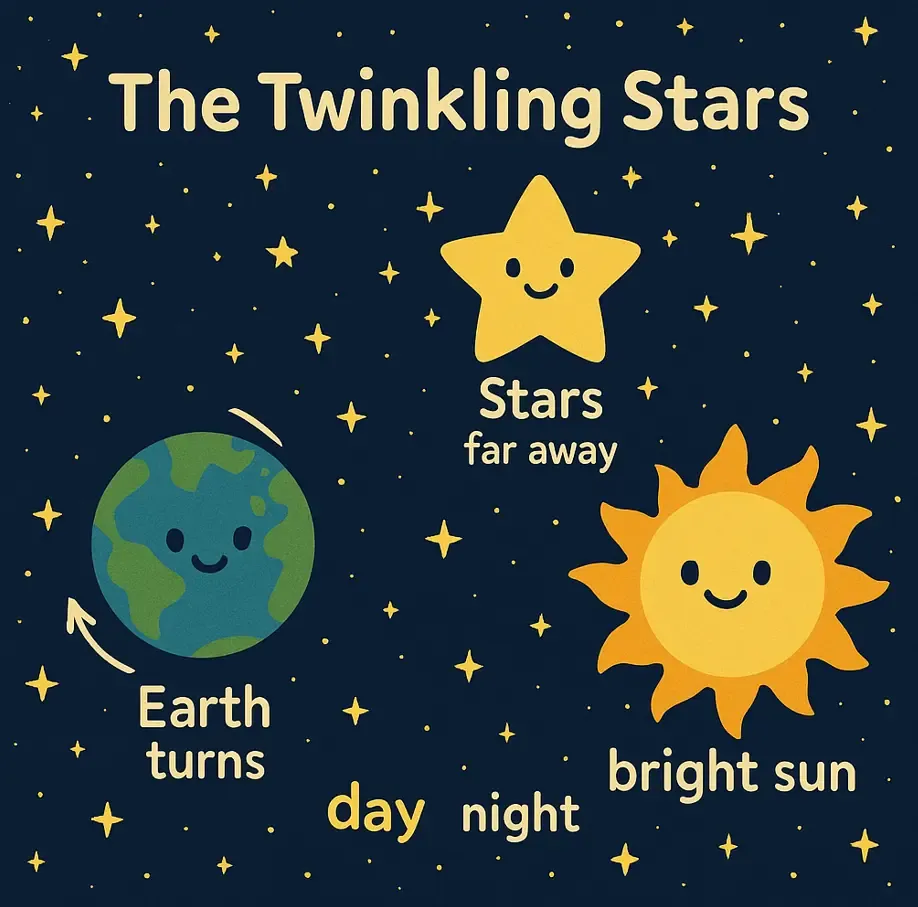
When the sun goes down and the sky turns dark, what else can you see? If it's a clear night, you will see many tiny, sparkling lights! These are the stars. They look like little diamonds sprinkled all across the night sky. Sometimes, they even seem to twinkle.
Stars are actually giant balls of hot gas, much like our sun. But they are so, so far away that they look like tiny points of light to us. During the day, we cannot see the stars. This is because the sun is so bright! The sun's light fills up the sky and hides the stars, making them invisible until darkness comes.
The stars are always there, even when we cannot see them. They don't go away during the day. They just get hidden by the sun's strong light. As the Earth turns, our part of the world faces away from the sun, and then we can see the stars again.
Seeing the stars come out at night is a predictable pattern. Every clear night, when it's dark enough, the stars will be there, waiting for us to observe them. Watching them twinkle can be a magical part of the night sky, helping us learn more about our amazing universe.
Fun Fact! Did you know that some of the stars you see at night are even bigger and brighter than our sun? They just look tiny because they are incredibly far away!
Comprehension quiz (8 questions)
1. What do stars look like in the night sky?
2. When can we usually see the stars?
3. Why can't we see stars during the day?
4. What are stars actually made of?
5. What happens to the stars during the day?
6. How is seeing stars at night a "predictable pattern"?
7. What is the main idea of this passage?
8. If you are in a very dark place far from city lights, what might you see more of?
Perfect for the way you teach
- Build comprehension skills
- Auto-graded quiz
- Differentiated reading
- Read together at home
- Improve fluency
- Quiet reading time
- Reading curriculum support
- Independent practice
- Track Lexile growth