When Was Neptune Discovered
Interactive passage with audio narration, comprehension questions, and printable PDF.
By completing this purchase you agree to our Terms of Use and Privacy Policy. Your subscription renews automatically until you cancel. You can cancel anytime from your account settings. All sales are final and non-refundable. Digital content is available for download in your account immediately upon purchase.
What's included
When Was Neptune Discovered preview and details
About this printable When Was Neptune Discovered science reading passage, NGSS-aligned (Grades 1-8)
Sample passage and quiz from When Was Neptune Discovered
Reading passage and comprehension quiz preview
When Was Neptune Discovered?
Neptune’s Discovery
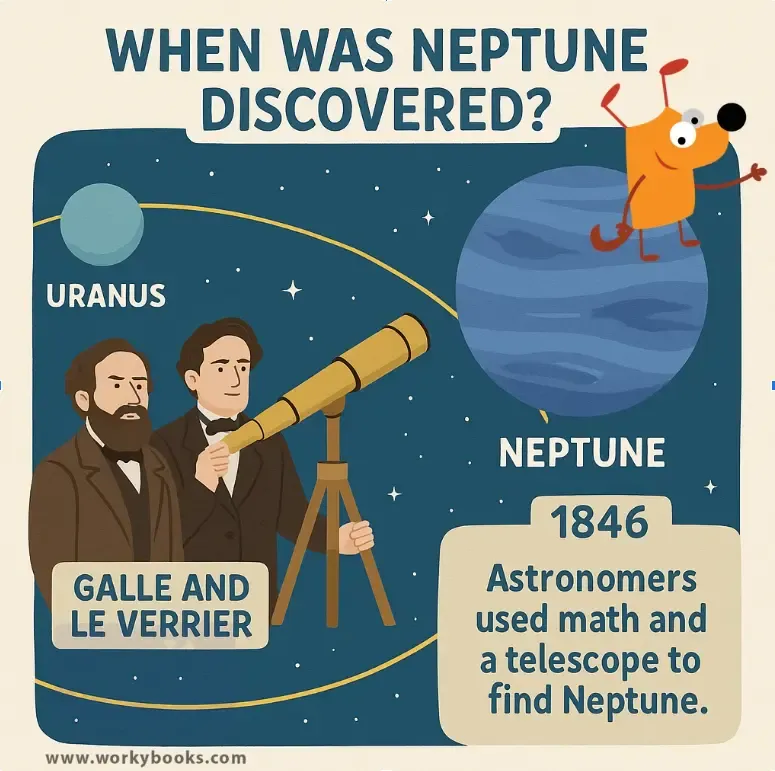
Neptune is the eighth and farthest planet from the Sun in our solar system. Unlike other planets, Neptune was not found just by looking through a telescope. It was discovered in 1846 by using mathematics and predictions!
The Mystery of Uranus
Scientists noticed that Uranus, the seventh planet, was not moving as expected. Its path was a little strange. They wondered if another planet’s gravity was pulling on Uranus. Two mathematicians, John Couch Adams in England and Urbain Le Verrier in France, worked separately to solve this mystery. They used math and Newton’s laws of gravity to predict where the unknown planet might be.
Finding Neptune with Math
Urbain Le Verrier sent his calculations to Johann Galle, an astronomer in Germany. On September 23, 1846, Galle pointed his telescope exactly where Le Verrier suggested. He found Neptune that very night—less than one degree away from the predicted spot! This was the first time a planet had been found by math, not just observation.
Why Was This Discovery Important?
Neptune’s discovery proved that Newton’s laws of gravity work even far out in the solar system. It also showed how teamwork between mathematicians and astronomers can help us learn about space.
Neptune Facts
Neptune is named after the Roman god of the sea because of its beautiful blue color. It takes 165 Earth years to orbit the Sun once. Neptune has 14 known moons and the strongest winds in the solar system—over 1,200 miles per hour!
Why Was Neptune Hard to Find?
Neptune is so far away and dim that ancient people could not see it. Even with telescopes, scientists did not know where to look until predictions and math showed the way.
Voyager 2 and Neptune
In 1989, the Voyager 2 spacecraft became the only one to visit Neptune, sending back amazing photos for scientists to study.
Interesting Fact: Finding Neptune was like solving a mystery with math—scientists figured out where an invisible planet must be hiding and found it exactly there!
Comprehension quiz (8 questions)
1. What year was Neptune discovered?
2. Who found Neptune with a telescope?
3. What planet's movement was strange?
4. Why was Neptune hard to find?
5. How did mathematicians help find Neptune?
6. What proved Newton’s laws work in space?
7. Voyager 2 visited Neptune. True or false?
8. What does 'astronomer' mean?
Perfect for the way you teach
- Build comprehension skills
- Auto-graded quiz
- Differentiated reading
- Read together at home
- Improve fluency
- Quiet reading time
- Reading curriculum support
- Independent practice
- Track Lexile growth