This learning resource is available in interactive and printable formats. The interactive worksheet can be played online and assigned to students. The Printable PDF version can be downloaded and printed for completion by hand.
This middle school science passage aligned to NGSS standard MS-PS3-5 explains the concept of energy transformation—the process of converting energy from one form to another. It gives students clear, real-world examples such as flashlights converting chemical energy to light, and the human body transforming food energy into movement and heat. Students will learn how energy changes form to make systems work, while understanding the law of conservation of energy. The passage uses grade-level vocabulary to support reading comprehension in physical science. It is designed to help students apply energy concepts in everyday life and is suitable for classroom science literacy activities. This passage strengthens students’ understanding of energy systems and supports NGSS-aligned learning goals.
CONTENT PREVIEW
Expand content preview
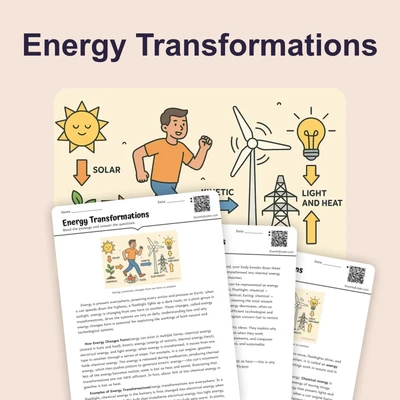
Energy transformation is the process of changing energy from one form to another. This is important because energy is constantly being transformed to power machines, move our bodies, and fuel natural systems. Energy doesn’t disappear—it just changes form to do work in different ways.
A common example of energy transformation is found in a flashlight. When you turn it on, chemical energy stored in the batteries is changed into electrical energy. That electrical energy then powers the bulb, which produces light energy and a bit of thermal energy (heat). Each step involves a transformation that allows the flashlight to work.
Another example is eating food. The food contains chemical energy. When your body digests it, the energy is transformed into mechanical energy that helps you move, and thermal energy that helps maintain your body temperature. This is how living things use energy transformations to survive and grow.
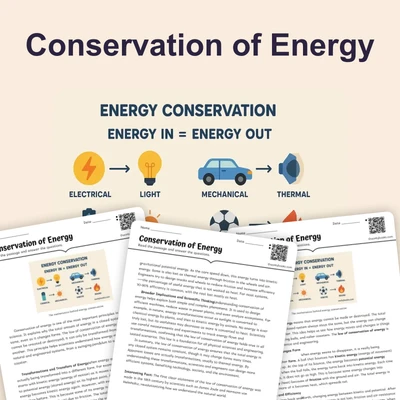
Energy can transform between many forms, including kinetic energy (energy of motion), potential energy (stored energy), sound energy, nuclear energy, and more. Each transformation follows the law of conservation of energy, which says that energy cannot be created or destroyed, only changed from one form to another.
Understanding energy transformations helps scientists and engineers design better engines, improve renewable energy sources like solar panels, and make everyday technology more efficient.
Fun Fact: Electric eels can transform chemical energy in their bodies into electrical energy strong enough to shock prey or defend themselves!
What is energy transformation?
Destroying energyStoring energyChanging energy formFreezing energy
What kind of energy does a flashlight battery store?
Sound energyChemical energyLight energyNuclear energy
What two energy forms are produced by a flashlight bulb?
Sound and mechanicalKinetic and potentialLight and thermalElectrical and magnetic
How does your body use the energy from food?
It becomes soundIt disappearsIt turns into heat and motionIt creates light
Which law states that energy cannot be created or destroyed?
Law of motionLaw of inertiaLaw of gravityLaw of conservation
Why is energy transformation important in real life?
It prevents growthIt keeps energy stored foreverIt helps systems workIt destroys heat
What is the main idea of the passage?
Energy can be destroyedEnergy transformation powers systemsEnergy is only stored in batteriesEnergy always becomes light
A toaster turns electrical energy into what two types?
Mechanical and nuclearSound and kineticLight and magneticThermal and light
Perfect For:
👩🏫 Teachers
• Reading comprehension practice
• Auto-graded assessments
• Literacy skill development
👨👩👧👦 Parents
• Reading practice at home
• Comprehension improvement
• Educational reading time
🏠 Homeschoolers
• Reading curriculum support
• Independent reading practice
• Progress monitoring
Reading Features:
📖
Reading Passage
Engaging fiction or nonfiction text
❓
Comprehension Quiz
Auto-graded questions
📊
Instant Feedback
Immediate results and scoring
📄
Printable Version
Download for offline reading
🔊
Read Aloud
Voice-over with word highlighting
Reviews & Ratings
No reviews yet. Be the first to share your experience!
Related Content
Energy Transfer
This NGSS-aligned science passage introduces middle school students to the concept of energy transfer, aligned to standa...
MS-PS3-5
Joule – The Unit of Energy
This NGSS-aligned reading passage introduces students to the joule, the standard unit of energy in the metric system, an...
MS-PS3-5
Work – A Scientific Definition
This NGSS-aligned science passage explains the definition of work as used in physical science and supports standard MS-P...
MS-PS3-5
Newton (N) – The Unit of Force
This NGSS-aligned passage introduces middle school students to the newton (N), the standard unit of force in the metric ...
MS-PS3-5
Energy Transformations
This engaging middle school science passage explores the concept of energy transformations, aligning with NGSS standards...
MS-PS3-1MS-PS3-2MS-PS3-5
Conservation of Energy
This comprehensive science passage introduces middle school students to the fundamental principle of the law of conserva...
MS-PS3-1MS-PS3-2MS-PS3-5
Electromagnetic Induction
This middle school science reading passage explores the concept of electromagnetic induction, focusing on Faraday's grou...
MS-PS2-3MS-PS3-5
Electric Motor
This comprehensive middle school science passage explores the science of electric motors, aligning with NGSS standards M...
MS-PS2-3MS-PS3-5
Electric Generators
This passage introduces middle school students to electric generators, explaining the physical science behind how mechan...