This learning resource is available in interactive and printable formats. The interactive worksheet can be played online and assigned to students. The Printable PDF version can be downloaded and printed for completion by hand.
This middle school science reading passage explores the concept of electromagnetic induction, focusing on Faraday's groundbreaking discovery that moving a magnet near a coil of wire can generate electricity. Students will learn the mechanisms behind this process, including how magnetic fields and electric currents interact, and how this principle serves as the foundation for modern generators and transformers. The passage aligns with NGSS standards MS-PS2-3 and MS-PS3-5, encouraging students to think deeply about cause-and-effect in physical systems and real-world applications, such as power generation. It integrates academic vocabulary, contextual explanations, and real-life examples. Activities include a comprehension quiz, writing prompts, and graphic organizers to support critical thinking and engagement. Audio integration and Spanish translations are available for diverse learners.
CONTENT PREVIEW
Expand content preview
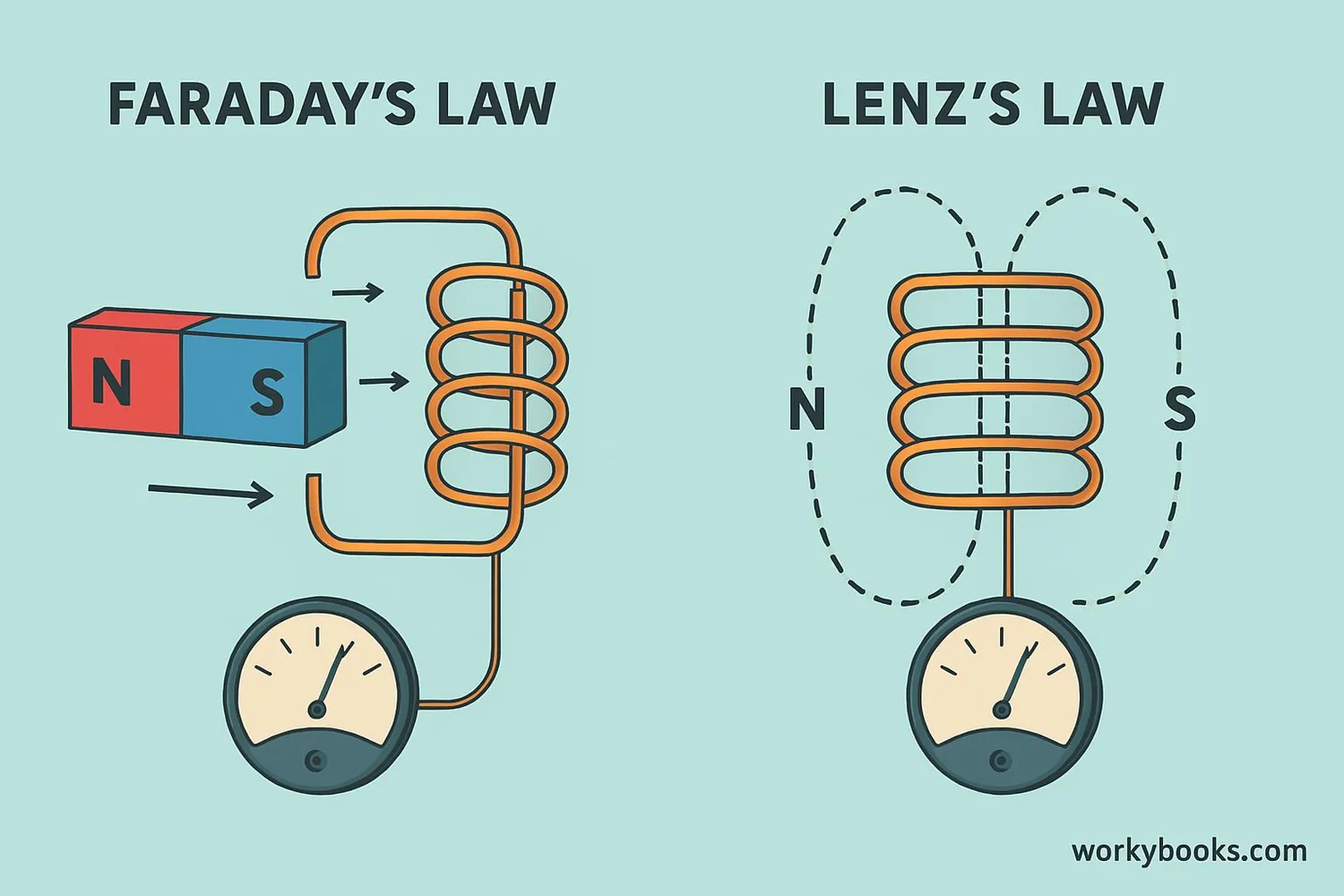
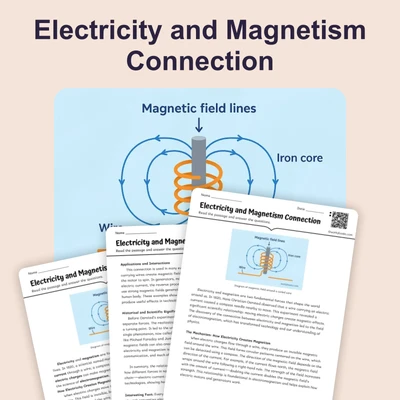
Diagram of electromagnetic induction principles
Electromagnetic induction is the process that allows us to generate electricity by moving a magnet near a coil of wire. This crucial discovery changed the world by making large-scale production of electricity possible. Before this, people could only produce electricity with batteries or static electricity. Understanding electromagnetic induction helps explain how most of our electrical energy is produced today.
How Does Electromagnetic Induction Work?
When a magnet is moved through a coil of wire, or when a coil is moved through a magnetic field, an electric current is produced in the wire. This process was first demonstrated by Michael Faraday in 1831. He noticed that electricity was only generated when the magnet or the coil was in motion—if both were still, nothing happened. The reason is that moving the magnet changes the magnetic field around the wire, causing the electrons inside the wire to move. The faster the magnet moves, or the more coils of wire there are, the greater the current produced. For example, a small hand-crank generator works by spinning a coil inside a magnetic field, lighting up a bulb. Faraday’s law describes the relationship: the amount of voltage induced in the coil depends on how fast the magnetic field changes and the number of loops in the coil.
From Discovery to Daily Life: Generators and Transformers
This principle is the foundation for devices called generators and transformers. In power plants, huge turbines spin magnets inside coils of wire, creating the electricity that powers homes and schools. Even wind turbines and hydroelectric dams use electromagnetic induction. Transformers use this same principle to increase or decrease the voltage of electricity so it can travel long distances without losing much energy. For example, when electricity leaves a power plant, it is sent at high voltage. Transformers near your home reduce the voltage to safer levels before the electricity enters your house. All of this is possible because of electromagnetic induction.
Magnetism and Electricity: Two Sides of the Same Coin
Electromagnetic induction shows a deep connection between magnetism and electricity. Previously, scientists knew that electric currents could create magnetic fields (as in electromagnets), but Faraday showed the opposite is also true: changing magnetic fields can create electric currents. This connection is central to the science of electromagnetism. Today, electromagnetic induction is used in countless devices, from credit card readers to wireless charging pads. It continues to shape technology and society in powerful ways.
Understanding electromagnetic induction helps us see the cause-and-effect relationships that allow electric energy to be generated and used on a global scale. This process is a key example of energy transfer and the interaction between physical forces described in the NGSS standards.
Interesting Fact: The world’s largest power plants, such as the Three Gorges Dam in China, use gigantic generators based on electromagnetic induction to supply electricity to millions of people.
What is electromagnetic induction?
The process of generating electricity by moving a magnet near a coil of wireThe process of storing energy in a batteryThe use of heat to create magnetic fieldsThe way light spreads through a lens
Who first demonstrated electromagnetic induction?
Isaac NewtonMichael FaradayBenjamin FranklinNikola Tesla
Which part must be moving for electricity to be generated by electromagnetic induction?
Only the coilOnly the magnetEither the magnet or the coilNeither, both must remain still
What device uses electromagnetic induction to increase or decrease voltage?
BatteryTransformerSwitchLight bulb
What is a magnetic field?
A type of energy stored in batteriesThe invisible area around a magnet where magnetic forces actA visible force that moves magnetsA device for making electricity
What happens if the magnet and coil are both still during an experiment?
Electricity is still producedNo electricity is producedThe magnet gets strongerThe coil melts
Why are transformers important in the transmission of electricity?
They make electricity safer and more efficient to travel long distancesThey store electricity for later useThey create magnetic fields for generatorsThey change light into electricity
Which statement best describes the relationship between magnetism and electricity shown in the passage?
They are unrelated and work separatelyThey are two sides of the same coin, able to create each other in certain situationsElectricity always destroys magnetsMagnetism only works with batteries
True or False: Generators in power plants rely on electromagnetic induction to produce electricity.
TrueFalse
True or False: Faraday’s discovery showed that changing magnetic fields can create electric currents.
TrueFalse
Perfect For:
👩🏫 Teachers
• Reading comprehension practice
• Auto-graded assessments
• Literacy skill development
👨👩👧👦 Parents
• Reading practice at home
• Comprehension improvement
• Educational reading time
🏠 Homeschoolers
• Reading curriculum support
• Independent reading practice
• Progress monitoring
Reading Features:
📖
Reading Passage
Engaging fiction or nonfiction text
❓
Comprehension Quiz
Auto-graded questions
📊
Instant Feedback
Immediate results and scoring
📄
Printable Version
Download for offline reading
🔊
Read Aloud
Voice-over with word highlighting
Reviews & Ratings
No reviews yet. Be the first to share your experience!
Related Content
Energy Transfer
This NGSS-aligned science passage introduces middle school students to the concept of energy transfer, aligned to standa...
MS-PS3-5
Energy Transformation
This middle school science passage aligned to NGSS standard MS-PS3-5 explains the concept of energy transformation—the p...
MS-PS3-5
Joule – The Unit of Energy
This NGSS-aligned reading passage introduces students to the joule, the standard unit of energy in the metric system, an...
MS-PS3-5
Work – A Scientific Definition
This NGSS-aligned science passage explains the definition of work as used in physical science and supports standard MS-P...
MS-PS3-5
Newton (N) – The Unit of Force
This NGSS-aligned passage introduces middle school students to the newton (N), the standard unit of force in the metric ...
MS-PS3-5
Energy Transformations
This engaging middle school science passage explores the concept of energy transformations, aligning with NGSS standards...
MS-PS3-1MS-PS3-2MS-PS3-5
Conservation of Energy
This comprehensive science passage introduces middle school students to the fundamental principle of the law of conserva...
MS-PS3-1MS-PS3-2MS-PS3-5
Types of Magnets
This science passage for grades 6-8 explains the types of magnets—permanent, temporary, natural, and briefly electromagn...
MS-PS2-3
Magnetic Materials
This passage, aligned to NGSS standard MS-PS2-3, explores the science behind magnetic materials and their importance in ...
MS-PS2-3
What Is Electricity?
This middle school science passage introduces the concept of electricity, aligned with NGSS standard MS-PS2-3. Students ...
MS-PS2-3
Electric Charge
This comprehensive middle school science passage introduces the concept of electric charge as a fundamental property of ...
MS-PS2-3
How Charges Interact
This standards-aligned passage for grades 6-8 introduces students to how electric charges interact, focusing on the fund...
MS-PS2-3MS-PS2-5
Electric Current
This comprehensive middle school science passage, aligned with NGSS standard MS-PS2-3, introduces students to the concep...
MS-PS2-3
Electrical Conductors and Insulators
This comprehensive science passage for grades 6-8 delves into the concepts of electrical conductors and insulators, alig...
MS-PS2-3
Electric Circuits
This middle school science passage explores electric circuits in depth, aligning with NGSS standard MS-PS2-3. Students w...
MS-PS2-3
Series and Parallel Circuits
This informative passage for grades 6-8 explains the scientific mechanisms behind series and parallel electrical circuit...
MS-PS2-3
Electrical Safety
This comprehensive informational passage for grades 6-8 explores the science behind electrical safety, focusing on the m...
MS-PS2-3
Voltage
This comprehensive passage for grades 6-8 explores the concept of voltage, defined as the electrical potential differenc...
MS-PS2-3
Resistance
This engaging middle school science passage explores the concept of resistance, a fundamental idea in the study of elect...
MS-PS2-3
Static Electricity
This passage provides a comprehensive exploration of static electricity, aimed at students in grades 6-8 and aligned wit...