This learning resource is available in interactive and printable formats. The interactive worksheet can be played online and assigned to students. The Printable PDF version can be downloaded and printed for completion by hand.
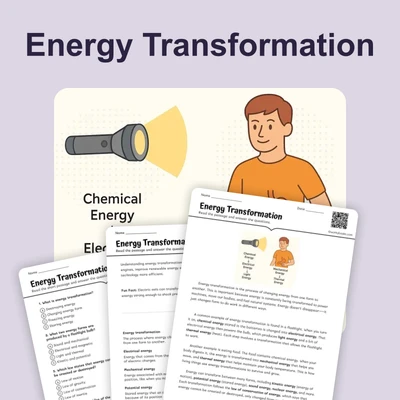
This engaging middle school science passage explores the concept of energy transformations, aligning with NGSS standards MS-PS3-1, MS-PS3-2, and MS-PS3-5. Students will learn how energy changes between forms—such as chemical, thermal, electrical, and kinetic energy—through real-world examples like car engines, flashlights, photosynthesis, and the human body. The passage explains the underlying mechanisms of energy transfer, highlights observable phenomena, and connects these concepts to broader scientific principles and societal implications. Designed for grades 6-8, the resource also includes differentiated reading levels, Spanish translations, a glossary, and multimedia supports. Interactive activities, multiple-choice quizzes, and graphic organizers help reinforce learning and foster deeper understanding. Audio integration aids accessibility for diverse learners. This resource is ideal for classroom instruction, homework, or independent study, making science both accessible and relevant.
CONTENT PREVIEW
Expand content preview
Energy constantly changes from one form to another
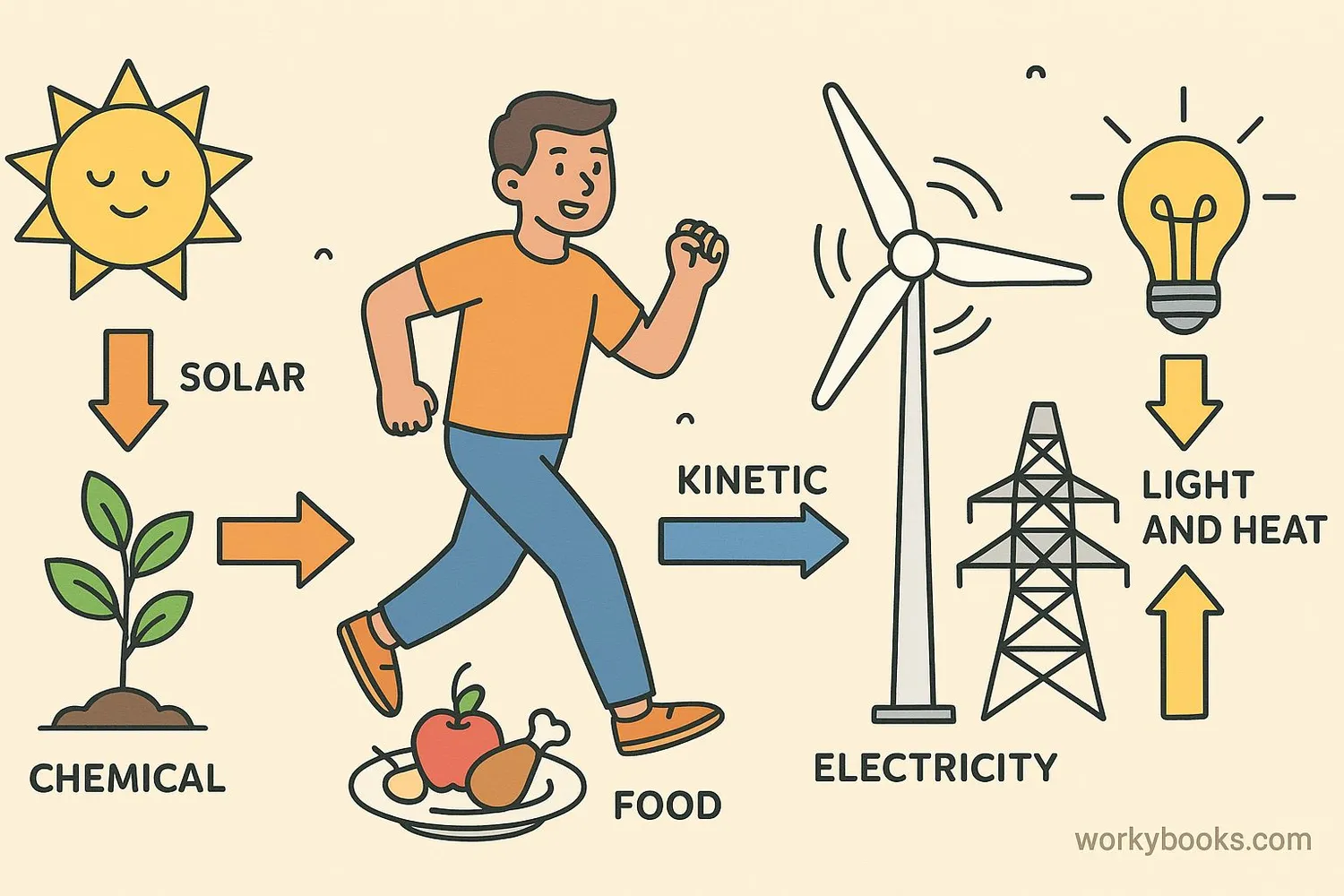
Energy is present everywhere, powering every action and process on Earth. When a car speeds down the highway, a flashlight lights up a dark room, or a plant grows in sunlight, energy is changing from one form to another. These changes, called energy transformations, drive the systems we rely on daily. Understanding how and why energy changes form is essential for explaining the workings of both natural and technological systems.
How Energy Changes Form Energy can exist in multiple forms: chemical energy (stored in fuels and food), kinetic energy (energy of motion), thermal energy (heat), electrical energy, and light energy. When energy is transformed, it moves from one type to another through a series of steps. For example, in a car engine, gasoline holds chemical energy. This energy is released during combustion, producing thermal energy, which then pushes pistons to generate kinetic energy—the car's movement. Not all the energy becomes motion; some is lost as heat and sound, illustrating that transformations are not 100% efficient. In fact, about 70% of the chemical energy in gasoline is lost as heat.
Examples of Energy Transformations Energy transformations are everywhere. In a flashlight, chemical energy in the battery is first changed into electrical energy when the circuit is completed. The bulb then transforms electrical energy into light energy, which we see, and thermal energy, which we can feel if the bulb gets warm. In plants, photosynthesis captures light energy from the Sun and transforms it into chemical energy stored in glucose molecules. When you eat food, your body breaks down these molecules to release chemical energy, which is then transformed into thermal energy (to keep you warm) and kinetic energy (to move your muscles).
Energy Chains and Systems These transformations can be represented as energy chains. For example: Car: chemical → thermal → kinetic; Flashlight: chemical → electrical → light (+ thermal); Photosynthesis: light → chemical; Eating: chemical → kinetic + thermal. In each system, energy is conserved, meaning the total amount does not change, but the usefulness or availability of energy decreases, often as heat. Understanding these chains helps us design more efficient technologies and manage resources wisely. For example, improving how engines convert fuel to motion can reduce pollution and save energy.
Energy transformations also connect to bigger scientific ideas. They explain why we need to eat, how plants grow, and why machines get hot when they work. Scientists study these processes using experiments, measurements, and computer models to develop new materials, renewable energy sources, and sustainable solutions for the future.
Interesting Fact: Every time energy changes form, some is lost as heat—this is why machines and even our own bodies can never be perfectly efficient!
What is an energy transformation?
The process of energy changing from one form to anotherThe movement of objects from place to placeThe production of electricity from batteriesThe storage of energy in food
Which form of energy is stored in gasoline?
Kinetic energyChemical energyElectrical energyThermal energy
During photosynthesis, plants transform which type of energy into chemical energy?
Thermal energyKinetic energyLight energyElectrical energy
According to the passage, what percentage of chemical energy in gasoline is typically lost as heat?
10%30%50%70%
What does it mean when energy is 'conserved' in a system?
Energy disappears after use.The total amount of energy stays the same even if it changes form.All energy becomes heat.Energy can only be stored, not used.
What is the main reason machines and our bodies are not perfectly efficient?
Energy is always lost as heat in each transformation.Chemical energy cannot be used.Motion uses up all the energy.Light energy is more powerful.
In a flashlight, which form of energy is NOT involved in the transformation chain?
Chemical energyElectrical energyNuclear energyLight energy
How can understanding energy transformations help us in society?
By designing more efficient technologiesBy wasting more resourcesBy stopping energy from being conservedBy only using one type of energy
True or False: Energy can be created or destroyed during transformations.
TrueFalse
True or False: The energy we get from food is first chemical energy.
TrueFalse
Perfect For:
👩🏫 Teachers
• Reading comprehension practice
• Auto-graded assessments
• Literacy skill development
👨👩👧👦 Parents
• Reading practice at home
• Comprehension improvement
• Educational reading time
🏠 Homeschoolers
• Reading curriculum support
• Independent reading practice
• Progress monitoring
Reading Features:
📖
Reading Passage
Engaging fiction or nonfiction text
❓
Comprehension Quiz
Auto-graded questions
📊
Instant Feedback
Immediate results and scoring
📄
Printable Version
Download for offline reading
🔊
Read Aloud
Voice-over with word highlighting
Reviews & Ratings
No reviews yet. Be the first to share your experience!
Related Content
Work and Energy
This science reading passage for grades 6-8 introduces students to the concepts of work and energy, aligned with NGSS st...
MS-PS3-1
Conservation of Energy
This comprehensive science passage introduces middle school students to the fundamental principle of the law of conserva...
MS-PS3-1MS-PS3-2MS-PS3-5
Mechanical Energy
This comprehensive passage introduces middle school students to the concept of mechanical energy, defined as the sum of ...
MS-PS3-1MS-PS3-2
Work and Power
This comprehensive passage introduces middle school students to the scientific definitions of work and power, aligning w...
MS-PS3-1
Simple Machines
This comprehensive passage introduces middle school students to the concept of simple machines, aligning with NGSS stand...
MS-PS3-1MS-PS3-2
Inclined Planes
This passage provides middle school students with a deep exploration of inclined planes, a fundamental type of simple ma...
MS-PS3-1MS-PS3-2
Wedges and Screws
This passage for grades 6-8 provides an in-depth exploration of wedges and screws as examples of simple machines. Studen...
MS-PS3-1MS-PS3-2
Wheel and Axle
This comprehensive middle school science passage explores the wheel and axle, a fundamental simple machine found in coun...
MS-PS3-1MS-PS3-2
Mechanical Advantage
This grade 6-8 science passage introduces students to the concept of mechanical advantage (MA) and its crucial role in u...
MS-PS3-1MS-PS3-2
Pulleys
This passage for grades 6-8 explores the science of pulleys, a fundamental simple machine that makes lifting objects eas...
MS-PS3-1MS-PS3-2
Electric Power and Energy
This middle school science reading passage, aligned to NGSS standard MS-PS3-1, explores the concepts of electric power a...
MS-PS3-1
Compound Machines
This middle school science passage explores the concept of compound machines, which are devices formed by combining two ...
MS-PS3-1MS-PS3-2
Efficiency of Machines
This comprehensive passage for grades 6-8 explores the concept of efficiency in machines, aligning with NGSS standards M...
MS-PS3-1MS-PS3-2
Energy Transfer
This NGSS-aligned science passage introduces middle school students to the concept of energy transfer, aligned to standa...
MS-PS3-5
Energy Transformation
This middle school science passage aligned to NGSS standard MS-PS3-5 explains the concept of energy transformation—the p...
MS-PS3-5
Joule – The Unit of Energy
This NGSS-aligned reading passage introduces students to the joule, the standard unit of energy in the metric system, an...
MS-PS3-5
Work – A Scientific Definition
This NGSS-aligned science passage explains the definition of work as used in physical science and supports standard MS-P...
MS-PS3-5
Newton (N) – The Unit of Force
This NGSS-aligned passage introduces middle school students to the newton (N), the standard unit of force in the metric ...
MS-PS3-5
Electromagnetic Induction
This middle school science reading passage explores the concept of electromagnetic induction, focusing on Faraday's grou...