This learning resource is available in interactive and printable formats. The interactive worksheet can be played online and assigned to students. The Printable PDF version can be downloaded and printed for completion by hand.
This comprehensive science passage introduces middle school students to the fundamental principle of the law of conservation of energy, which states that energy cannot be created or destroyed but only transformed. Aligned with NGSS standards MS-PS3-1, MS-PS3-2, and MS-PS3-5, the passage explores how energy changes forms in systems such as pendulums, roller coasters, and bouncing balls, and explains why energy sometimes appears to be lost due to transformation into thermal energy. The passage connects these concepts to real-world applications, discusses energy efficiency, and integrates scientific vocabulary with context-based definitions. Differentiated and Spanish versions ensure accessibility for all learners. Activities include reading comprehension questions, writing prompts, and graphic organizers to deepen understanding. Audio integration supports varied learning styles. Ideal for grades 6-8 science classrooms.
CONTENT PREVIEW
Expand content preview
The mathematics behind energy conservation
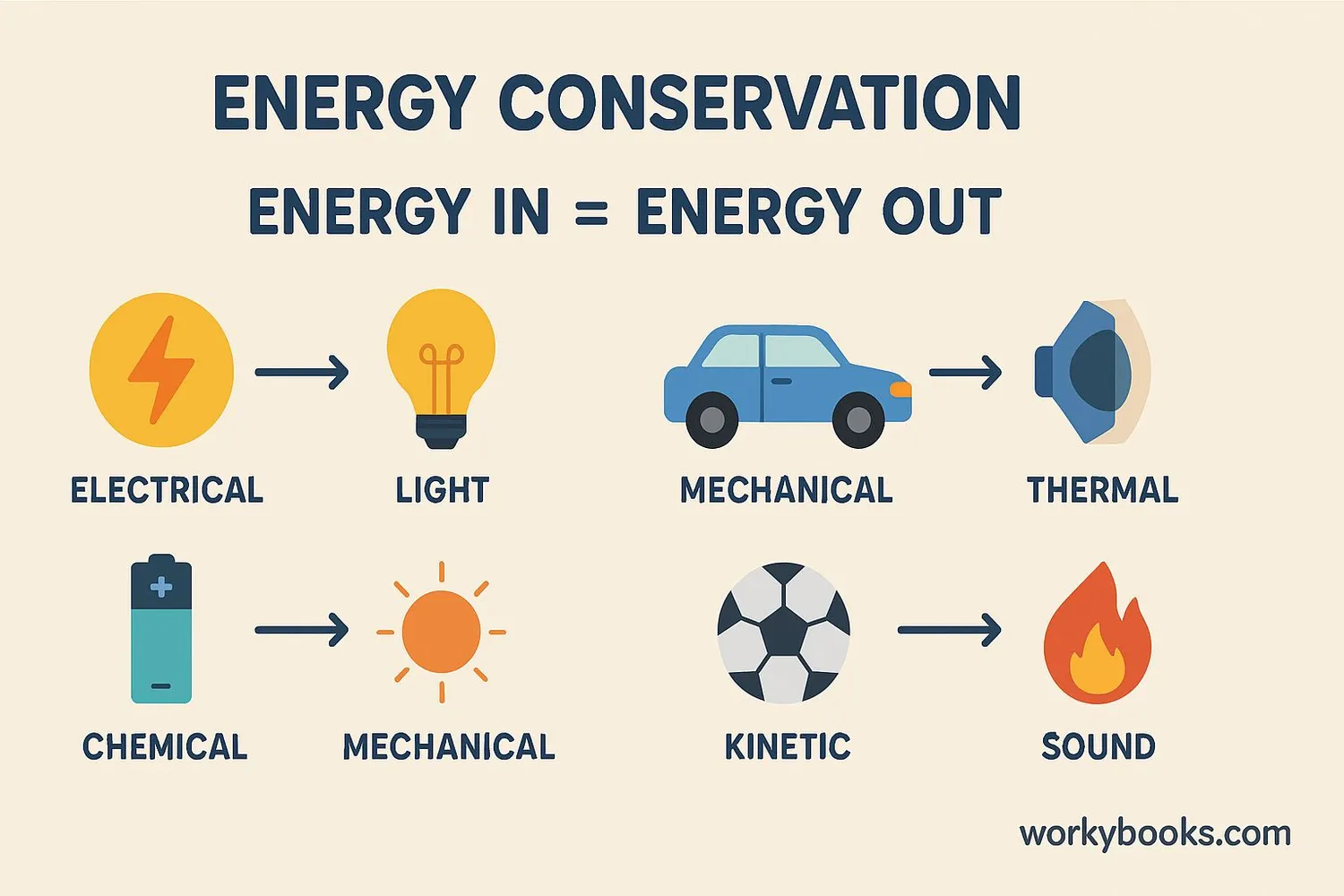
Conservation of energy is one of the most important principles in physical science. It explains why the total amount of energy in a closed system remains the same, even as it changes forms. The law of conservation of energy states that energy cannot be created or destroyed; it can only be transformed from one type to another. This principle helps scientists understand how energy moves and changes in natural and engineered systems, from a swinging pendulum to a speeding roller coaster.
Transformations and Transfers of Energy When energy appears to disappear, it is actually being transformed into a different form. For example, when a ball bounces, it starts with kinetic energy (energy of motion) as it moves upward, which transforms to potential energy (stored energy) at its highest point. As the ball falls, potential energy becomes kinetic energy again. However, with every bounce, the ball rises less high than before. This is because some of its energy is transferred to the ground and air as thermal energy (heat) due to friction. The total energy stays the same, but more of it ends up as heat, which spreads into the environment and is harder to use.
Examples in the Real World A pendulum is another classic example. As the pendulum swings, its energy changes back and forth between kinetic and potential forms. Over time, the pendulum slows down and eventually stops, but its energy isn't lost. Instead, friction at the pivot and air resistance turn some of its mechanical energy into heat. Similarly, roller coasters use motors to lift cars, giving them gravitational potential energy. As the cars speed down, this energy turns into kinetic energy. Some is also lost as thermal energy through friction in the wheels and air. Engineers try to design tracks and wheels to reduce friction and increase efficiency—the percentage of useful energy that is not wasted as heat. For most systems, 70-90% efficiency is common, with the rest lost mostly as heat.
Broader Implications and Scientific Thinking Understanding conservation of energy helps explain both simple and complex phenomena. It is used to design efficient machines, reduce waste in power plants, and even analyze ecosystems. For example, in nature, energy transformations occur as sunlight is converted to chemical energy by plants, and then to kinetic energy by animals. No energy is ever truly lost, but its usefulness may decrease as more is converted to heat. Scientists use careful measurements and experiments to track energy flows and transformations, confirming that the law of conservation of energy holds true in all tested scenarios. This law is a foundation for all physical sciences and engineering.
In summary, the law of conservation of energy ensures that the total energy in any closed system remains constant, though it may change forms many times. Apparent losses are actually transformations, usually to thermal energy. By understanding these transformations, scientists and engineers can design more efficient systems, benefiting technology, society, and the environment.
Interesting Fact: The first clear statement of the law of conservation of energy was made in the 19th century by scientists such as James Joule and Hermann von Helmholtz, revolutionizing how we understand the natural world.
What does the law of conservation of energy state?
Energy cannot be created or destroyed, only transformed.Energy can only be created in power plants.Energy disappears after use.Energy can only exist as heat.
What is one reason a bouncing ball loses height with each bounce?
Energy is destroyed.Some energy is transformed into thermal energy through friction.The ball gains energy from the air.Gravity increases on each bounce.
Which of the following is NOT a form of energy mentioned in the passage?
Mechanical energySolar energyPotential energyThermal energy
What is efficiency in the context of energy systems?
The percentage of useful energy compared to total energy used.The amount of heat produced by a system.The number of times energy changes form.The speed at which energy moves.
What is friction, according to the passage?
A force that helps objects move faster.A force that resists motion and causes energy to turn into heat.A form of potential energy.A tool used by engineers.
Why do roller coasters use motors to lift cars to the top of the track?
To give the cars potential energy.To increase friction.To cool down the cars.To transform thermal energy into kinetic energy.
Which statement best explains why energy is never truly lost in a system?
Energy always changes form, but the total amount remains constant.Energy disappears when it turns into heat.Energy can only be used once.Energy is destroyed by friction.
When a pendulum eventually stops swinging, what happens to its energy?
It is transformed into heat by friction and air resistance.It is destroyed.It stays as potential energy forever.It becomes electrical energy.
True or False: The law of conservation of energy is used to design efficient machines.
TrueFalse
True or False: Scientists have found cases where the law of conservation of energy does not hold.
TrueFalse
Perfect For:
👩🏫 Teachers
• Reading comprehension practice
• Auto-graded assessments
• Literacy skill development
👨👩👧👦 Parents
• Reading practice at home
• Comprehension improvement
• Educational reading time
🏠 Homeschoolers
• Reading curriculum support
• Independent reading practice
• Progress monitoring
Reading Features:
📖
Reading Passage
Engaging fiction or nonfiction text
❓
Comprehension Quiz
Auto-graded questions
📊
Instant Feedback
Immediate results and scoring
📄
Printable Version
Download for offline reading
🔊
Read Aloud
Voice-over with word highlighting
Reviews & Ratings
No reviews yet. Be the first to share your experience!
Related Content
Work and Energy
This science reading passage for grades 6-8 introduces students to the concepts of work and energy, aligned with NGSS st...
MS-PS3-1
Energy Transformations
This engaging middle school science passage explores the concept of energy transformations, aligning with NGSS standards...
MS-PS3-1MS-PS3-2MS-PS3-5
Mechanical Energy
This comprehensive passage introduces middle school students to the concept of mechanical energy, defined as the sum of ...
MS-PS3-1MS-PS3-2
Work and Power
This comprehensive passage introduces middle school students to the scientific definitions of work and power, aligning w...
MS-PS3-1
Simple Machines
This comprehensive passage introduces middle school students to the concept of simple machines, aligning with NGSS stand...
MS-PS3-1MS-PS3-2
Inclined Planes
This passage provides middle school students with a deep exploration of inclined planes, a fundamental type of simple ma...
MS-PS3-1MS-PS3-2
Wedges and Screws
This passage for grades 6-8 provides an in-depth exploration of wedges and screws as examples of simple machines. Studen...
MS-PS3-1MS-PS3-2
Wheel and Axle
This comprehensive middle school science passage explores the wheel and axle, a fundamental simple machine found in coun...
MS-PS3-1MS-PS3-2
Mechanical Advantage
This grade 6-8 science passage introduces students to the concept of mechanical advantage (MA) and its crucial role in u...
MS-PS3-1MS-PS3-2
Pulleys
This passage for grades 6-8 explores the science of pulleys, a fundamental simple machine that makes lifting objects eas...
MS-PS3-1MS-PS3-2
Electric Power and Energy
This middle school science reading passage, aligned to NGSS standard MS-PS3-1, explores the concepts of electric power a...
MS-PS3-1
Compound Machines
This middle school science passage explores the concept of compound machines, which are devices formed by combining two ...
MS-PS3-1MS-PS3-2
Efficiency of Machines
This comprehensive passage for grades 6-8 explores the concept of efficiency in machines, aligning with NGSS standards M...
MS-PS3-1MS-PS3-2
Energy Transfer
This NGSS-aligned science passage introduces middle school students to the concept of energy transfer, aligned to standa...
MS-PS3-5
Energy Transformation
This middle school science passage aligned to NGSS standard MS-PS3-5 explains the concept of energy transformation—the p...
MS-PS3-5
Joule – The Unit of Energy
This NGSS-aligned reading passage introduces students to the joule, the standard unit of energy in the metric system, an...
MS-PS3-5
Work – A Scientific Definition
This NGSS-aligned science passage explains the definition of work as used in physical science and supports standard MS-P...
MS-PS3-5
Newton (N) – The Unit of Force
This NGSS-aligned passage introduces middle school students to the newton (N), the standard unit of force in the metric ...
MS-PS3-5
Electromagnetic Induction
This middle school science reading passage explores the concept of electromagnetic induction, focusing on Faraday's grou...