Joule – The Unit of Energy — Reading Comprehension
Rate this
Present
Present in classroom. No work saved
Assign
Classroom with student accounts, Track progress
Quick Play
No student accounts, assign with a link
Grades
5
6
7
8
Standards
MS-PS3-5
PRINT+DIGITAL RESOURCE
This learning resource is available in interactive and printable formats. The interactive worksheet can be played online and assigned to students. The Printable PDF version can be downloaded and printed for completion by hand.
This NGSS-aligned reading passage introduces students to the joule, the standard unit of energy in the metric system, and supports the MS-PS3-5 performance expectation. It explains what a joule is, who it’s named after, and why it matters in science and everyday life. Students learn that the joule measures all types of energy, including kinetic, potential, electrical, and thermal energy. Real-world examples include lifting objects, using toasters, and reading food labels. The passage reinforces the concept of energy conservation and provides context for how energy is tracked and compared. This resource supports science literacy and comprehension for middle school students exploring physical science concepts.
CONTENT PREVIEW
Expand content preview
A joule (J) is the standard unit used to measure energy in the metric system. It tells us how much energy is used to do work or produce heat. The joule is named after James Prescott Joule, a British scientist who studied energy and helped prove that energy is always conserved—it cannot be created or destroyed.
One joule is a small amount of energy. For example, if you lift a small apple about one meter off the ground, you use about one joule of energy. This shows that energy is needed even for simple tasks, and the joule helps scientists measure that energy in a clear, consistent way.
Joules can measure many forms of energy: kinetic energy (the energy of motion), potential energy (stored energy), thermal energy, electrical energy, and more. For instance, when a toaster uses electricity, the energy used is measured in joules. If it uses a lot of energy over time, we often measure it in kilojoules (kJ) or even megajoules (MJ)—larger units made up of thousands or millions of joules.
Energy use in daily life is often recorded using joules. Food labels may list energy in kilojoules, showing how much energy the body can get from eating it. Power companies also use joules when calculating how much electricity homes and businesses use.
Understanding the joule helps us compare energy amounts, design efficient machines, and track how energy flows in different systems. It’s a basic, but powerful concept in science and engineering.
Fun Fact: One kilojoule (1 kJ) equals 1,000 joules—about the energy it takes to run for 6 seconds or to keep a 100-watt light bulb on for 10 seconds!
What does a joule measure?
TemperatureSpeedEnergyMass
Who is the joule named after?
Isaac NewtonAlbert EinsteinJames JouleThomas Edison
How much energy is used to lift a small apple one meter?
1 gram1 newton1 joule1 calorie
Which of these is a larger unit than a joule?
MegagramKilojouleNewtonDegree
What kind of energy can joules measure?
Only heatOnly motionAny type of energyOnly stored energy
Why are joules useful in science?
They measure distanceThey are used in recipesThey help compare energy amountsThey are used to measure weight
What is the main idea of the passage?
Joules are used to track speedJoules are the unit for energyJoules replace kilogramsJoules measure light levels
If a machine uses 2,000 joules of energy, how many kilojoules is that?
2 kJ20 kJ200 kJ2 kJ
Perfect For:
👩🏫 Teachers
• Reading comprehension practice
• Auto-graded assessments
• Literacy skill development
👨👩👧👦 Parents
• Reading practice at home
• Comprehension improvement
• Educational reading time
🏠 Homeschoolers
• Reading curriculum support
• Independent reading practice
• Progress monitoring
Reading Features:
📖
Reading Passage
Engaging fiction or nonfiction text
❓
Comprehension Quiz
Auto-graded questions
📊
Instant Feedback
Immediate results and scoring
📄
Printable Version
Download for offline reading
🔊
Read Aloud
Voice-over with word highlighting
Reviews & Ratings
No reviews yet. Be the first to share your experience!
Related Content
Energy Transfer
This NGSS-aligned science passage introduces middle school students to the concept of energy transfer, aligned to standa...
MS-PS3-5
Energy Transformation
This middle school science passage aligned to NGSS standard MS-PS3-5 explains the concept of energy transformation—the p...
MS-PS3-5
Work – A Scientific Definition
This NGSS-aligned science passage explains the definition of work as used in physical science and supports standard MS-P...
MS-PS3-5
Newton (N) – The Unit of Force
This NGSS-aligned passage introduces middle school students to the newton (N), the standard unit of force in the metric ...
MS-PS3-5
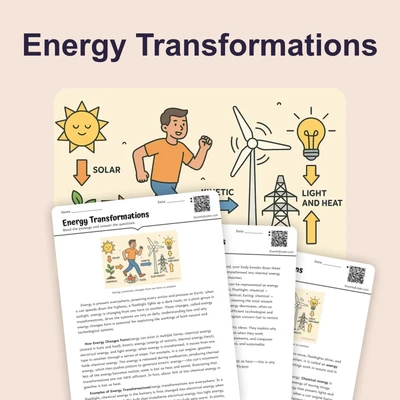
Energy Transformations
This engaging middle school science passage explores the concept of energy transformations, aligning with NGSS standards...
MS-PS3-1MS-PS3-2MS-PS3-5
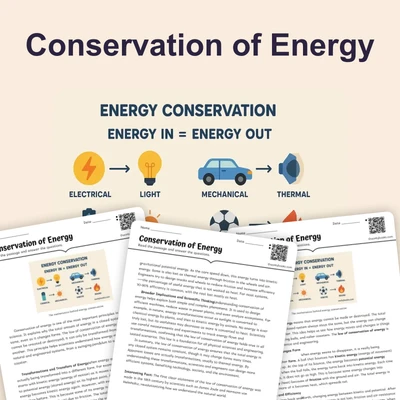
Conservation of Energy
This comprehensive science passage introduces middle school students to the fundamental principle of the law of conserva...
MS-PS3-1MS-PS3-2MS-PS3-5
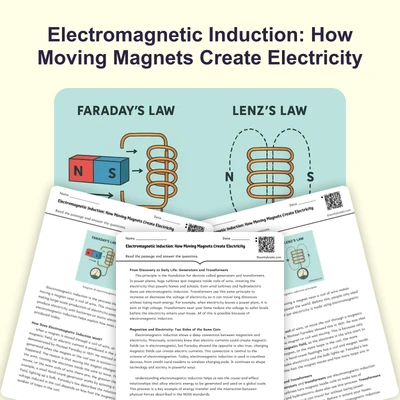
Electromagnetic Induction
This middle school science reading passage explores the concept of electromagnetic induction, focusing on Faraday's grou...
MS-PS2-3MS-PS3-5
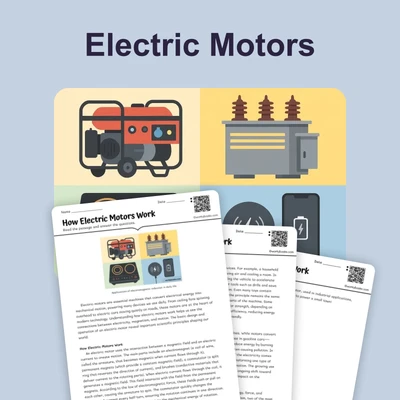
Electric Motor
This comprehensive middle school science passage explores the science of electric motors, aligning with NGSS standards M...
MS-PS2-3MS-PS3-5
Electric Generators
This passage introduces middle school students to electric generators, explaining the physical science behind how mechan...