This learning resource is available in interactive and printable formats. The interactive worksheet can be played online and assigned to students. The Printable PDF version can be downloaded and printed for completion by hand.
This rigorous history reading passage explores the 2008 Great Recession, a major financial crisis that reshaped the U.S. and global economy. Students will learn about the causes of the crisis, including the housing bubble, risky bank practices, and government responses. The passage incorporates multiple perspectives, including families, banks, and government officials, and integrates a primary source quotation for analysis. Activities include a multiple-choice quiz, writing prompts that emphasize causation and evidence, and a graphic organizer. A Spanish translation and glossary of key terms are provided for accessibility. This resource aligns to C3 Framework standards D2.His.2.3-5 and D2.His.3.3-5, as well as Common Core RI.4.3, RI.4.4, and W.4.2, supporting skills in historical analysis, informational reading, and explanatory writing. Includes read aloud audio and is ideal for enhancing understanding of economic history and its real-world impacts.
CONTENT PREVIEW
Expand content preview
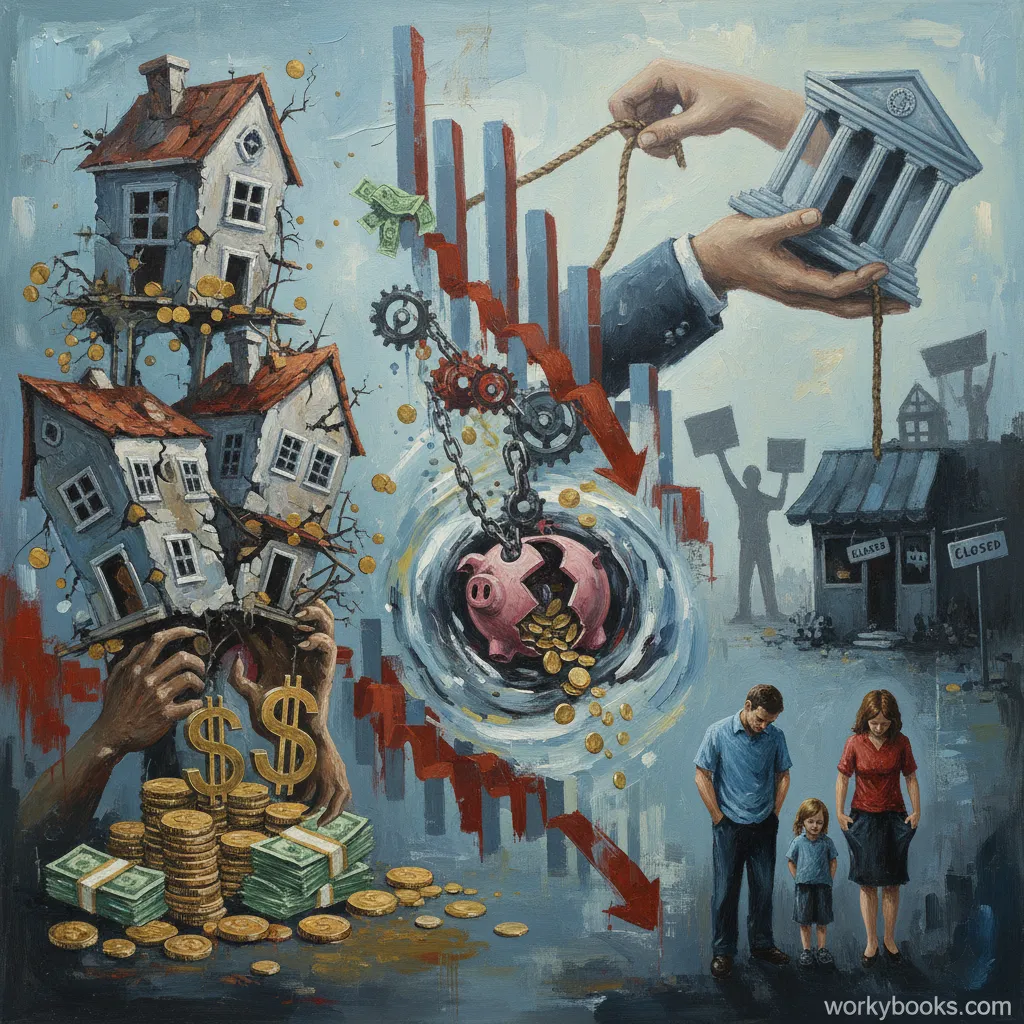
Artist Representation of art showing the causes and effects of the 2008 Great Recession.
The Great Recession of 2008 was one of the worst economic downturns in U.S. history. It started in late 2007 and lasted until mid-2009. The crisis began with problems in the nation’s housing market, which is the market where people buy and sell homes. For many years, banks gave out home loans, called mortgages, to people who could not always afford to pay them back. These risky loans are known as subprime mortgages.
As more people bought homes, prices increased rapidly. This created a housing bubble, which is when prices rise much higher than the true value. Eventually, home prices stopped rising and began to fall. Many people who had subprime mortgages could no longer pay their loans, leading to foreclosures. A foreclosure is when a bank takes back a home because the owner cannot pay their mortgage.
The wave of foreclosures caused massive losses for banks and financial companies that owned these risky mortgages. This led to a financial crisis. Banks lost trust in each other and stopped lending money, which made it hard for people and businesses to get loans. As a result, businesses could not grow or hire workers, leading to rising unemployment. Unemployment is when people who want to work cannot find jobs.
The crisis spread quickly across the United States and the world. Millions of Americans lost their jobs and homes. The government stepped in with intervention by providing financial support to banks and key industries to prevent a complete collapse. One major step was the bailout of several large banks to stabilize the financial system. The government also passed new laws, like the Dodd-Frank Act, to improve regulation of banks and protect consumers.
The problem/solution process of the Great Recession teaches important lessons. First, risky lending and lack of oversight can lead to major problems. Second, quick and decisive government intervention can help stop economic disasters from getting worse. Finally, improved regulation can reduce the chance of a future crisis, but recovery takes time and effort from everyone.
Interesting Fact: The Great Recession caused the unemployment rate in the U.S. to reach 10% in October 2009, the highest level in over 25 years.
When did the Great Recession start?
2007199920121987
What caused many foreclosures?
High home pricesSubprime mortgagesGovernment jobsStock market gains
Which law improved bank regulation?
Civil Rights ActDodd-Frank ActHomestead ActNew Deal
Why did banks lose trust in each other?
Too many risky mortgagesLow taxesNew technologyHigh gold prices
What was a result of unemployment?
More homes soldBusinesses could not hireBanks made more loansGovernment stopped helping
How did the government intervene?
By raising home pricesBy bailing out banksBy closing schoolsBy lowering gold prices
The Great Recession lasted from 2007 to 2009.
TrueFalse
What does 'foreclosure' mean?
Bank takes back a homeBank gives a loanHouse price goes upGovernment hires workers
Perfect For:
👩🏫 Teachers
• Reading comprehension practice
• Auto-graded assessments
• Literacy skill development
👨👩👧👦 Parents
• Reading practice at home
• Comprehension improvement
• Educational reading time
🏠 Homeschoolers
• Reading curriculum support
• Independent reading practice
• Progress monitoring
Reading Features:
📖
Reading Passage
Engaging fiction or nonfiction text
❓
Comprehension Quiz
Auto-graded questions
📊
Instant Feedback
Immediate results and scoring
📄
Printable Version
Download for offline reading
🔊
Read Aloud
Voice-over with word highlighting
Reviews & Ratings
No reviews yet. Be the first to share your experience!
Related Content
Informational Text —Healthy Teeth and Gums
RI.4.10RI.4.3RF.4.4RF.4.4.A
Informational Text —Migratory Birds
Engage young minds with this worksheet that delves into the wonders of migratory birds. Learn about their extraordinary ...
RI.4.10RI.4.3RF.4.4RF.4.4.A
Natural Disasters and Urban flooding
This reading comprehension worksheet focuses on the topic of natural disasters, specifically urban flooding. Following t...
RI.4.44-ESS3ESS3.B4-ESS3-1
The Formation of Fossils
L.4.2.DL.4.6RI.4.4
Climate and Water Cycle
W.4.2.ARI.4.4RI.4.1
Ocean Acidification
Download this reading comprehension worksheet about ocean acidification. The worksheet includes an informational text ab...
RI.4.4
Understanding Climate Action Context Clues
Understanding Climate Action" worksheet, aligned with CCS L.4.4.A and NGSS. This resource introduces key concepts such a...
L.4.4.ARI.4.1RI.4.4
Informational Text —The History of Toothpaste
RI.4.4RI.4.4
Informational Text —All About Dentists
Students read an informational text explaining what dentists do and how they are trained. Aligned to RI.4.3-2
RI.4.10RI.4.3RF.4.4RF.4.4.A
The Role of Pollinators in Nature
Learn about the fascinating world of pollinators and discover their crucial role in the reproductive process of flowerin...
RI.4.2RI.4.3RI.4.4RI.5.1
Pollination: A Crucial Ecosystem Service
Explore the vital role of pollination beyond plant reproduction, as it sustains ecosystems by ensuring food security, pr...
RI.4.2RI.4.3RI.4.4RI.5.1
Seed Dispersal: How Plants Travel
Plants may seem stationary, but their seeds have amazing ways to travel! Explore the fascinating world of seed dispersal...
RI.4.2RI.4.3RI.4.4RI.5.1
The States of Matter: Solid
Discover the differences between solids, liquids and gases by exploring how their particles are arranged and move. This ...
RI.4.2RI.4.3RI.4.4RI.5.1
What is a Simple Machine
Discover the power of simple machines! This informational text explores how basic tools like levers, pulleys and incline...
RI.4.2RI.4.3RI.4.4RI.5.1
The Life Cycle of a Salmon
Salmon have a remarkable life cycle that takes them from rivers to the ocean and back again. They hatch as alevin, grow ...
RI.3.1RI.4.4RI.4.2
Journey of a Sea Turtle
Sea turtles lay their eggs on beaches, and their hatchlings begin a dangerous journey to the ocean. After growing in the...
RI.3.1RI.4.4RI.4.2
Heroes for Freedom: Harriet Tubman
Harriet Tubman, born into slavery, became a hero who risked her life to lead others to freedom through the Underground R...
RI.3.1RI.4.4RI.4.2RI.5.2
Heroes for Freedom: Fannie Lou Hamer
Fannie Lou Hamer overcame racial segregation and poverty to become a powerful voice for civil rights. Her fight for voti...
RI.3.1RI.4.4RI.4.2RI.5.2
Sports: Lionel Messi
Lionel Messi, known for his unparalleled dribbling and passing, has broken records, won multiple FIFA Ballon d'Or awards...
RI.3.1RI.4.4RI.4.2RI.5.2
Natural Disaster: Droughts
Droughts are long periods with insufficient water, leading to crop failures and water shortages. Conserving water and pl...