Hoovervilles: Cities Made of Cardboard and Scraps
Interactive passage with audio narration, comprehension questions, and printable PDF.
By completing this purchase you agree to our Terms of Use and Privacy Policy. Your subscription renews automatically until you cancel. You can cancel anytime from your account settings. All sales are final and non-refundable. Digital content is available for download in your account immediately upon purchase.
What's included
Hoovervilles: Cities Made of Cardboard and Scraps preview and details
About this printable Hoovervilles: Cities Made of Cardboard and Scraps reading passage (Grades 3-5)
Sample passage and quiz from Hoovervilles: Cities Made of Cardboard and Scraps
Reading passage and comprehension quiz preview
Hoovervilles
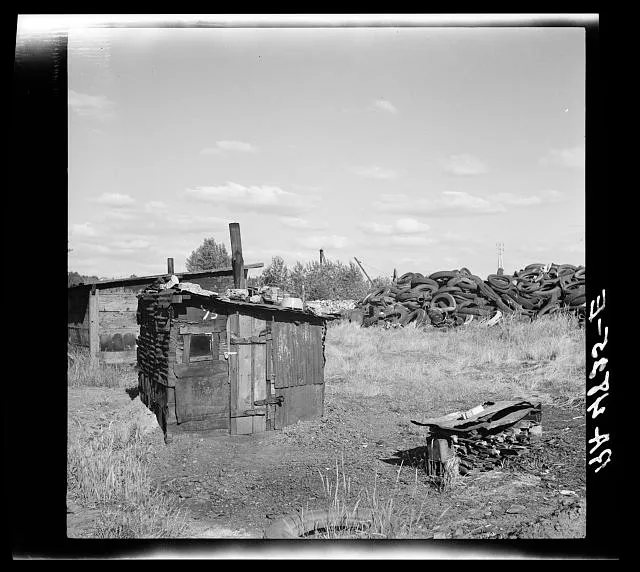
Source: Library of Congress - Rothstein, Arthur, 1915-1985
The Great Depression was a time when many American families lost their jobs and homes. People could not find work, and banks closed. Many became homeless. With nowhere to go, thousands of families built their own shelters in open areas. These camps became known as Hoovervilles. They were named after President Herbert Hoover, who was blamed for not solving the crisis quickly.
Hoovervilles popped up in cities all over the country. People used whatever they could find to make their homes. They built small shacks from cardboard, tin, wood scraps, and old blankets. Some shelters had only a roof and no floor. Others were just tents. There was no running water or electricity in these camps. Life was very hard, but people tried to help each other.
Families living in Hoovervilles worked together to survive. Adults searched for food and jobs every day. Children gathered firewood and helped with chores. Many families grew small gardens or raised chickens to have enough to eat. Some people shared meals with their neighbors. They also formed small groups to keep the camp safe and clean.
Life in Hoovervilles was not easy. Rain and cold weather made the shacks wet and uncomfortable. Disease spread quickly because there was no plumbing. Even so, people showed great determination. They found creative ways to make their lives better. Some started schools or churches right in the camp. Kids played games together and tried to have fun, even during tough times.
Over time, the government began to help. New programs created jobs and built better housing. Slowly, families left Hoovervilles as the economy improved. By the early 1940s, most of the shanty towns were gone. The story of Hoovervilles shows how Americans worked together and never gave up, even during hard times.
Interesting Fact: The largest Hooverville was in Seattle, Washington, and lasted almost ten years, housing hundreds of people at its peak.
Comprehension quiz (8 questions)
1. What were Hoovervilles made of?
2. Why were they called Hoovervilles?
3. Where was the largest Hooverville?
4. Why did people build Hoovervilles?
5. How did families survive in Hoovervilles?
6. What was one problem in Hoovervilles?
7. Hoovervilles still exist today.
8. What does 'determination' mean?
Common Core standards for Hoovervilles: Cities Made of Cardboard and Scraps
Explain events, procedures, ideas, or concepts in a historical, scientific, or technical text, including what happened and why, based on specific information in the text.
Determine the meaning of general academic and domain-specific words or phrases in a text relevant to a grade 4 topic or subject area.
Engage effectively in a range of collaborative discussions (one-on-one, in groups, and teacher-led) with diverse partners on grade 4 topics and texts, building on others' ideas and expressing their own clearly.
Write informative/explanatory texts to examine a topic and convey ideas and information clearly.
Perfect for the way you teach
- Build comprehension skills
- Auto-graded quiz
- Differentiated reading
- Read together at home
- Improve fluency
- Quiet reading time
- Reading curriculum support
- Independent practice
- Track Lexile growth