How Does Air Pollution Affect Organisms? A Reading Passage on Ecosystems — Reading Comprehension
Rate this
Premium Resource
Present
Present in classroom. No work saved
Assign
Classroom with student accounts, Track progress
Quick Play
No student accounts, assign with a link
Grades
5
6
7
8
PRINT+DIGITAL RESOURCE
This learning resource is available in interactive and printable formats. The interactive worksheet can be played online and assigned to students. The Printable PDF version can be downloaded and printed for completion by hand.
This audio-integrated passage, "How Does Air Pollution Affect Organisms?", is designed for middle school students and aligns with the NGSS standard MS-LS2-4. It explains how changes to the physical and biological components of an ecosystem affect organism populations. The passage introduces and defines key concepts like air pollution and acid rain, providing clear examples of how these environmental changes impact plants and animals. Students will learn about the interconnectedness of living things within an ecosystem and how pollutants can disrupt this balance. The content is crafted to be accessible and engaging, encouraging students to consider the real-world effects of air pollution on the environment. The text supports critical thinking and helps students construct arguments based on empirical evidence as required by the standard.
CONTENT PREVIEW
Expand content preview
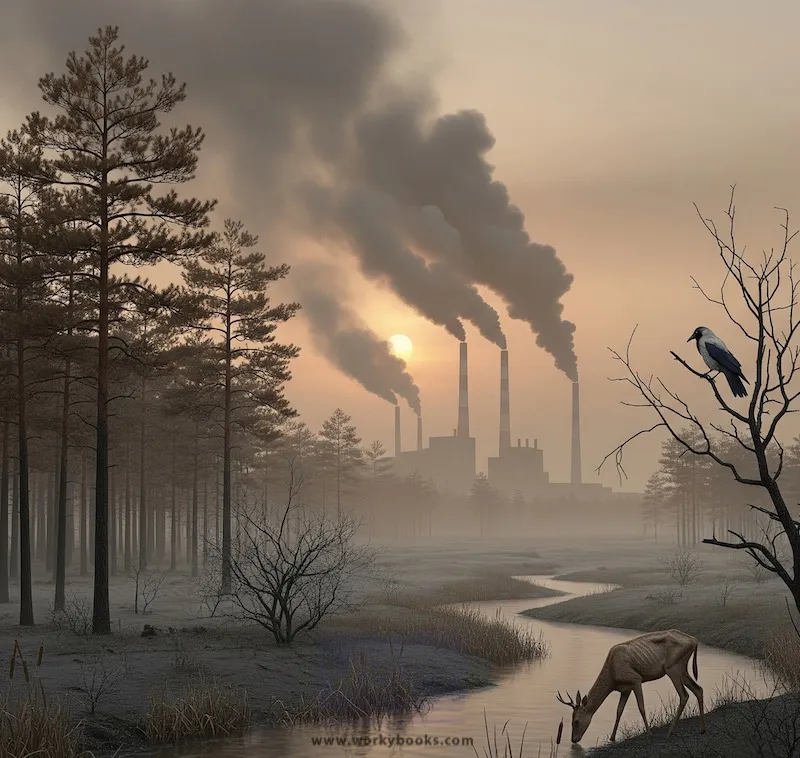
Air pollution is the release of harmful substances into the air. These pollutants come from many places, like cars, factories, and burning fossil fuels. When these substances get into the air, they can cause big problems for living things. These problems can be a change to a physical or biological component of an ecosystem. An ecosystem is a community of living and non-living things that interact with each other.
One of the most common air pollutants is ozone, which can damage the lungs of humans and other animals, making it hard to breathe. Air pollution can also hurt plants. For example, it can damage leaves and make it difficult for plants to grow. This affects the entire ecosystem, as plants are the base of many food chains.
Another type of air pollution is acid rain. Acid rain forms when pollutants like sulfur dioxide and nitrogen oxides mix with water in the atmosphere. When it falls, acid rain can harm forests and lakes. It makes the soil and water too acidic for many plants and aquatic animals to survive. This can lead to a decrease in the number of organisms in an area.
Changes to an ecosystem's physical parts, like the air and water, can have a big effect on the biological parts, like the plants and animals that live there. For example, if air pollution kills off a certain type of plant, animals that eat that plant will have less food and their population will decrease. This is a clear example of how a change to one part of an ecosystem can affect the entire system.
Fun Fact: Air pollution can even affect the weather and climate, contributing to global warming.
What is the main cause of acid rain?
OzoneSulfur dioxide and nitrogen oxidesDamaged leavesCars and factories
What can air pollution do to plants?
Make them grow fasterMake them healthierDamage their leavesTurn them green
How does a decrease in a plant population due to air pollution affect animals?
Animals will find more foodThe animal population will increaseAnimals that eat the plant will have less foodThe animals will not be affected
What is the definition of an ecosystem?
A community of living thingsOnly non-living thingsA community of living and non-living thingsA community of harmful substances
How does acid rain harm a lake?
It makes the water too warmIt makes the water too acidicIt adds nutrients to the waterIt makes the water cloudy
A factory releases a new pollutant that kills off all the grass in an area. What would likely happen to the population of rabbits that eat the grass?
The rabbit population would increaseThe rabbit population would decreaseThe rabbit population would not be affectedThe rabbits would switch to a new food source
A city passes a law requiring factories to reduce their air pollution. What is a likely long-term effect of this law on the local ecosystem?
The population of animals would decreaseThe ecosystem's health would improveThe air would become more acidicThe number of plants would decrease
A scientist discovers a new type of moss that is highly sensitive to air pollution. What could this moss be used for?
To clean up oil spillsTo act as a biological indicator of air qualityTo create new medicinesTo filter water
Perfect For:
👩🏫 Teachers
• Reading comprehension practice
• Auto-graded assessments
• Literacy skill development
👨👩👧👦 Parents
• Reading practice at home
• Comprehension improvement
• Educational reading time
🏠 Homeschoolers
• Reading curriculum support
• Independent reading practice
• Progress monitoring
Reading Features:
📖
Reading Passage
Engaging fiction or nonfiction text
❓
Comprehension Quiz
Auto-graded questions
📊
Instant Feedback
Immediate results and scoring
📄
Printable Version
Download for offline reading
🔊
Read Aloud
Voice-over with word highlighting
Reviews & Ratings
No reviews yet. Be the first to share your experience!
Related Content
Tools and Technology in Earth Science
This middle school science reading passage explores the wide range of tools and technologies used in Earth science, from...
MS-ESS2-2MS-ESS3-2MS-ETS1-1MS-PS4-3
What Is Earth Science?
This engaging middle school science passage introduces students to the field of Earth science, aligning with NGSS standa...
MS-ESS1MS-ESS2MS-ESS3SEP
Scientific Inquiry in Earth Science
This passage explores scientific inquiry in Earth science for grades 6-8, aligned with NGSS standards MS-ESS1-4, MS-ESS2...
MS-ESS1-4MS-ESS2-1MS-ESS3-5SEP
What Is Space Weather and How Does It Affect the Earth?
This NGSS-aligned science passage for middle school explains what space weather is and how it affects Earth. Students le...
MS-ESS2-2
Earth: Our Home in Space
This engaging Grade 4-5 science passage, aligned to NGSS, introduces students to Earth's special place in the solar syst...
My Planet Earth
In this passage, students explore Earth as their home planet. They learn that Earth is made of land, water, and air, and...
FL.SS.2.G.1.1SS.2.G.1.3
Meteorite Impacts on Earth
This engaging science reading passage for Grades 4-5 explores meteorite impacts on Earth, aligning with NGSS standards. ...
Facts About Earth
This engaging science reading passage introduces Grade 4 and 5 students to Earth, our home planet. Aligned with NGSS sta...
Earth's Quick and Slow Changes
In 'Earth's Quick and Slow Changes,' students categorize 12 Earth events by their speed of occurrence, enhancing underst...
Earth Day and Types of Pollution
Earth Day is coming! Get ready to learn about pollution and test your knowledge. Click for a free reading passage and qu...
RI.4.1RI.4.2ESS3.CESS3.A
Earth Changes Over Millions of Years
This engaging, audio-integrated science passage for Grade 4-5 students explores how Earth has changed over millions of y...
Rare Earth Minerals in Smartphones and Computers
Rare earth minerals are critical for smartphones, computers, and renewable energy. Mining them has environmental impacts...
RI.5.3RI.6.3RI.7.3
What Makes Earth Perfect for Life?
This Grade 4-5 science passage, aligned with NGSS standards, explores the essential features that make Earth the perfect...
Earth Changes Word Sort
This word sort activity helps students understand different rates of change in Earth's systems. Students classify 12 geo...
Escape Velocity and Space Travel
This middle school science passage introduces students to the concept of escape velocity—the minimum speed required to b...
MS-ESS1-2MS-PS2-4
Earth's Spheres
This middle school science passage introduces students to Earth's four major spheres: the geosphere, hydrosphere, atmosp...
MS-ESS2-4MS-ESS2-6
The Diameter of Earth
This science reading passage explains the diameter of Earth, describing it as about 12,742 kilometers or 7,918 miles acr...
5-PS2-1
Earth: Our Home Planet
This comprehensive science passage for grades 6-8 explores Earth’s unique characteristics and the interconnected systems...
MS-ESS1-2
Aphelion and Perihelion
This engaging reading passage, 'Aphelion and Perihelion,' delves into the fascinating aspects of Earth's elliptical orbi...
MS-ESS1-1: DEVELOP AND USE A MODEL OF THE EARTH-SUN-MOON SYSTEM TO DESCRIBE THE CYCLIC PATTERNS OF LUNAR PHASESECLIPSES OF THE SUN AND MOONAND SEASONS.
Earth's Rotation
This middle school science passage, aligned with NGSS standard MS-ESS1-1, focuses on Earth's rotation—how Earth spins on...