Earth Changes Over Millions of Years — Reading Comprehension
Rate this
Premium Resource
Present
Present in classroom. No work saved
Assign
Classroom with student accounts, Track progress
Quick Play
No student accounts, assign with a link
Grades
3
4
5
6
PRINT+DIGITAL RESOURCE
This learning resource is available in interactive and printable formats. The interactive worksheet can be played online and assigned to students. The Printable PDF version can be downloaded and printed for completion by hand.
This engaging, audio-integrated science passage for Grade 4-5 students explores how Earth has changed over millions of years. Aligned with NGSS standards, the passage explains important concepts such as weathering, erosion, plate tectonics, and fossils. Students will learn how natural forces like wind, water, and earthquakes shape Earth’s surface, and discover evidence of ancient life through fossils. Real-world examples, clear definitions of key terms, and an interesting science fact enhance understanding. The resource includes a glossary, Spanish translation, reading comprehension quiz, and writing activities that encourage students to connect science with everyday life and analyze cause and effect in nature. Keywords include Earth changes, fossils, weathering, erosion, plate tectonics, and NGSS. Perfect for classrooms looking to build foundational knowledge in earth science with interactive, student-friendly content.
CONTENT PREVIEW
Expand content preview
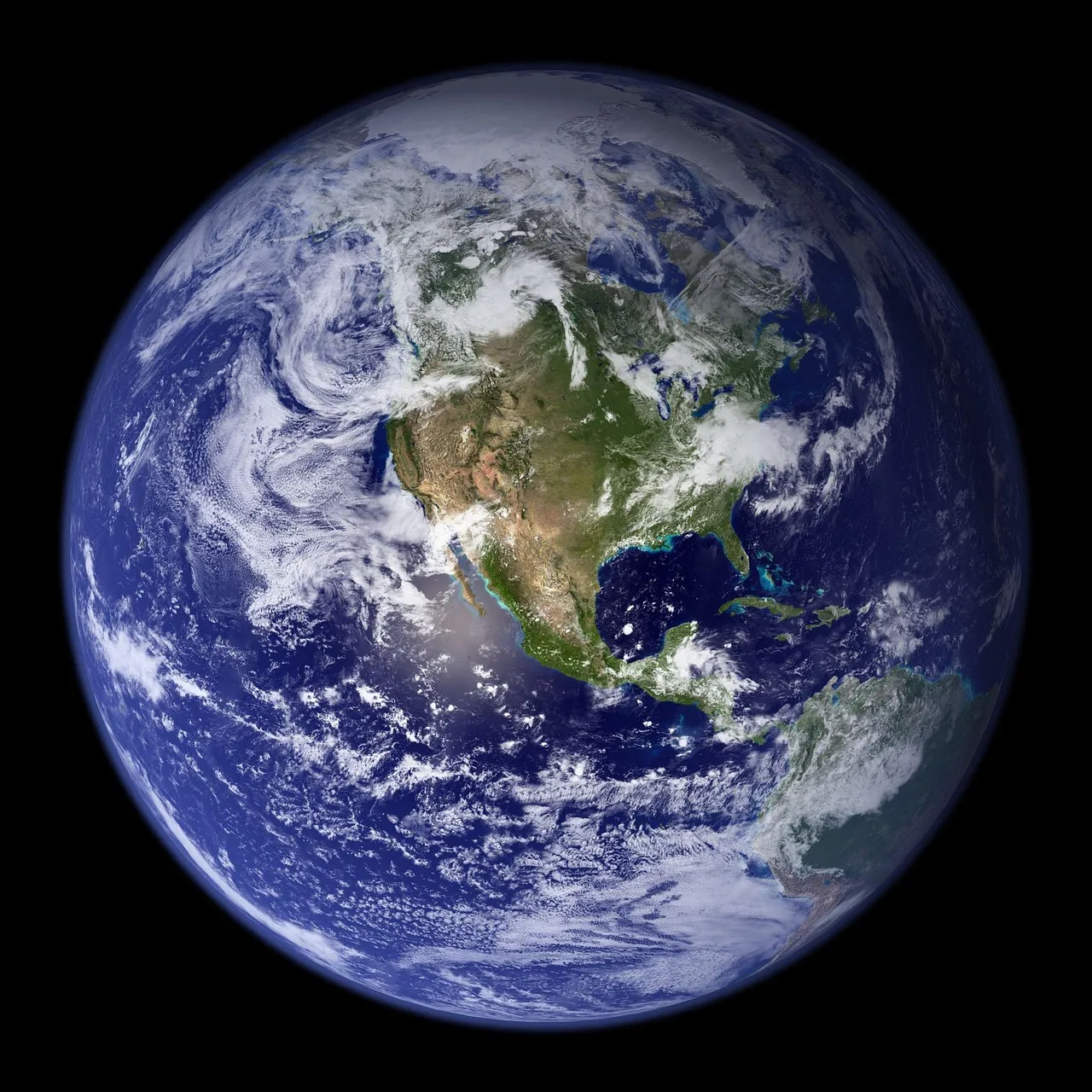
"Earth" by WikiImages / Source: Pixabay.
Geological time is the way scientists measure Earth's incredibly long history. Geological time refers to the billions of years that Earth has existed. Understanding geological time helps us learn how mountains, canyons, and other features formed on our planet's surface.
Earth is about 4.5 billion years old. That number is so large it's hard to imagine! To understand this better, think of Earth's entire history as a 24-hour clock. If Earth formed at midnight, humans wouldn't appear until the very last second before the next midnight. Dinosaurs—the giant reptiles that once lived on Earth—existed between 230 and 66 million years ago. That seems like a long time, but it's only a small part of Earth's total history.
Many of Earth's features took millions of years to form. The Rocky Mountains, a major mountain range in North America, began forming about 80 million years ago and are still being shaped today by wind, water, and weather. The Grand Canyon, a massive valley in Arizona, took about 5 to 6 million years for the Colorado River to carve through layers of rock.
Humans have been on Earth for only about 300,000 years. This is a tiny fraction of Earth's history. Most of the dramatic changes to Earth's surface—like the formation of mountains and the carving of canyons—happened long before people existed.
Interesting Fact: If you could stack all the years humans have existed into a pile of pennies, and stack all of Earth's history the same way, the human pile would be about as tall as a pencil, while Earth's pile would be taller than a 30-story building!
How old is Earth?
About 4.5 billion years oldAbout 300,000 years oldAbout 80 million years oldAbout 230 million years old
When did dinosaurs live on Earth?
Between 230 and 66 million years agoAbout 300,000 years agoAbout 5 million years agoIn the last second of Earth's history
How long have humans existed on Earth?
About 300,000 yearsAbout 4.5 billion yearsAbout 80 million yearsAbout 230 million years
Why does the 24-hour clock analogy help?
It shows how short human history isIt tells the exact age of EarthIt proves dinosaurs were realIt measures the Grand Canyon's depth
What carved the Grand Canyon over time?
The Colorado River cutting through rockDinosaurs walking through the valleyHumans digging with toolsWind blowing away all the dirt
Why are the Rocky Mountains still changing?
Wind, water, and weather shape themDinosaurs are still living thereHumans are building on themThey stopped changing millions of years ago
Most dramatic Earth changes happened before humans existed.
TrueFalse
What does 'geological time' mean?
Earth's incredibly long historyThe time dinosaurs livedHow humans measure one dayThe age of the Rocky Mountains
Perfect For:
👩🏫 Teachers
• Reading comprehension practice
• Auto-graded assessments
• Literacy skill development
👨👩👧👦 Parents
• Reading practice at home
• Comprehension improvement
• Educational reading time
🏠 Homeschoolers
• Reading curriculum support
• Independent reading practice
• Progress monitoring
Reading Features:
📖
Reading Passage
Engaging fiction or nonfiction text
❓
Comprehension Quiz
Auto-graded questions
📊
Instant Feedback
Immediate results and scoring
📄
Printable Version
Download for offline reading
🔊
Read Aloud
Voice-over with word highlighting
Reviews & Ratings
No reviews yet. Be the first to share your experience!
Related Content
Tools and Technology in Earth Science
This middle school science reading passage explores the wide range of tools and technologies used in Earth science, from...
MS-ESS2-2MS-ESS3-2MS-ETS1-1MS-PS4-3
Scientific Inquiry in Earth Science
This passage explores scientific inquiry in Earth science for grades 6-8, aligned with NGSS standards MS-ESS1-4, MS-ESS2...
MS-ESS1-4MS-ESS2-1MS-ESS3-5SEP
What Is Earth Science?
This engaging middle school science passage introduces students to the field of Earth science, aligning with NGSS standa...
MS-ESS1MS-ESS2MS-ESS3SEP
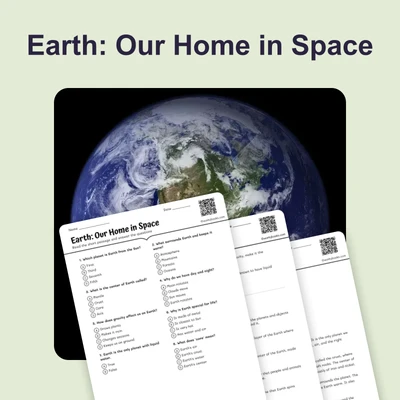
Earth: Our Home in Space
This engaging Grade 4-5 science passage, aligned to NGSS, introduces students to Earth's special place in the solar syst...
Earth's Spheres
This middle school science passage introduces students to Earth's four major spheres: the geosphere, hydrosphere, atmosp...
MS-ESS2-4MS-ESS2-6
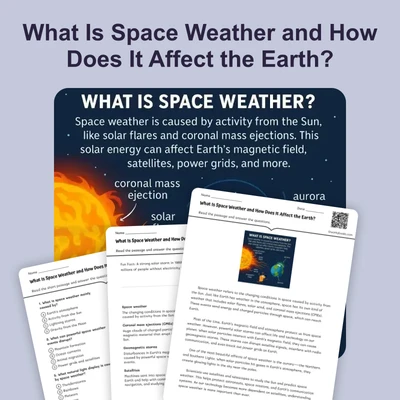
What Is Space Weather and How Does It Affect the Earth?
This NGSS-aligned science passage for middle school explains what space weather is and how it affects Earth. Students le...
MS-ESS2-2
Earth's Energy Balance
This engaging, NGSS-aligned science passage for grades 6–8 explores Earth's energy balance, a key process that keeps our...
MS-ESS2-6
Earth's Rotation
This middle school science passage, aligned with NGSS standard MS-ESS1-1, focuses on Earth's rotation—how Earth spins on...
MS-ESS1-1
Earth's Interior
This comprehensive passage for grades 6-8 explores Earth's layered interior, including the crust, mantle, outer core, an...
MS-ESS2-1MS-ESS2-2
Facts About Earth
This engaging science reading passage introduces Grade 4 and 5 students to Earth, our home planet. Aligned with NGSS sta...
Meteorite Impacts on Earth
This engaging science reading passage for Grades 4-5 explores meteorite impacts on Earth, aligning with NGSS standards. ...
Venus: Earth's Twin?
This comprehensive science passage for grades 6-8 examines Venus—often called Earth's twin—by exploring its similarities...
MS-ESS1-2MS-ESS1-3
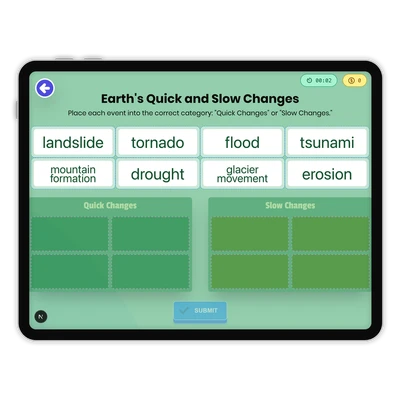
Earth's Quick and Slow Changes
In 'Earth's Quick and Slow Changes,' students categorize 12 Earth events by their speed of occurrence, enhancing underst...
Earth's Moon Facts
This engaging science passage, 'The Moon: Earth's Companion,' is designed for Grade 4-5 students and aligns with NGSS ge...
Earth: Our Home Planet
This comprehensive science passage for grades 6-8 explores Earth’s unique characteristics and the interconnected systems...
MS-ESS1-2
Earth's Revolution
This middle school science passage explores the science behind Earth's revolution around the Sun, closely aligned with N...
MS-ESS1-1
Earth's Seasons
This comprehensive reading passage for grades 6-8 explains why Earth has seasons, revealing the scientific mechanisms be...
MS-ESS1-1
Earth's Place in the Universe
This reading passage explains Earth's place in the universe, supporting NGSS 1-ESS1-1. It describes how Earth is one of ...
1-ESS1-1
Aphelion and Perihelion
This engaging reading passage, 'Aphelion and Perihelion,' delves into the fascinating aspects of Earth's elliptical orbi...
MS-ESS1-1: DEVELOP AND USE A MODEL OF THE EARTH-SUN-MOON SYSTEM TO DESCRIBE THE CYCLIC PATTERNS OF LUNAR PHASESECLIPSES OF THE SUN AND MOONAND SEASONS.