The Four Seasons: Earth's Tilt and Orbit — Reading Comprehension
Rate this|
3
Present
Present in classroom. No work saved
Assign
Classroom with student accounts, Track progress
Quick Play
No student accounts, assign with a link
Grades
3
4
5
6
PRINT+DIGITAL RESOURCE
This learning resource is available in interactive and printable formats. The interactive worksheet can be played online and assigned to students. The Printable PDF version can be downloaded and printed for completion by hand.
This engaging Grade 4-5 science passage, aligned with NGSS standards, explores how Earth's tilt and orbit cause the four seasons. Students will learn key terms such as axis, orbit, solstice, and equinox, and discover how sunlight changes throughout the year. The passage offers clear explanations, real-world examples, a glossary, Spanish translation, and interactive activities, including a multiple-choice quiz and writing prompts. Each section is designed for easy reading and audio integration, making it accessible for all learners. Teachers and students can use this resource to deepen understanding of Earth's movement and seasonal changes, while building science vocabulary and critical thinking skills.
CONTENT PREVIEW
Expand content preview
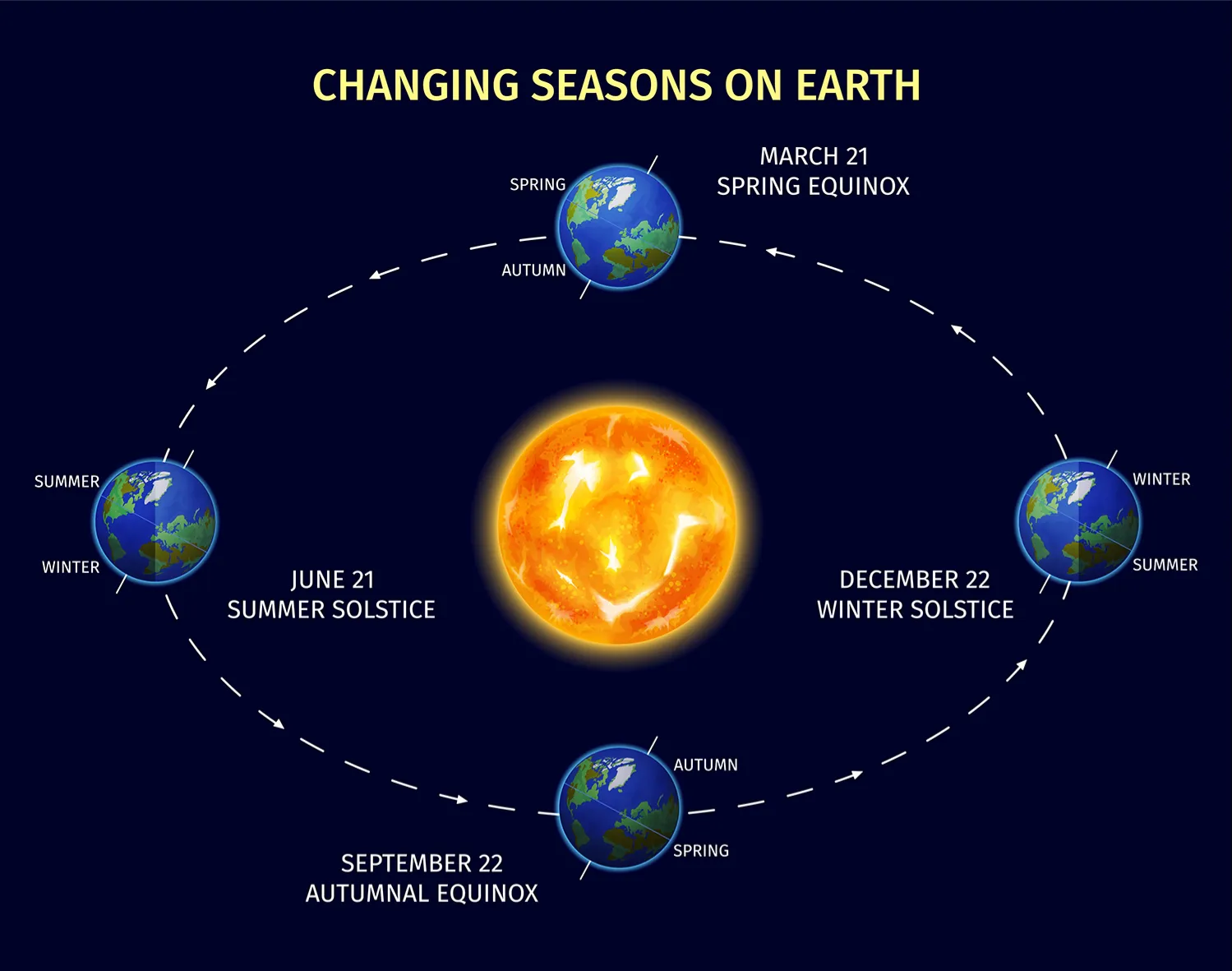
Earth seasons realistic poster with planet rotation symbols vector illustration
The planet we live on, Earth, goes through four main seasons: spring, summer, fall (autumn), and winter. These changes happen each year because of two important things: Earth's tilt and its orbit around the Sun.
Earth spins around an invisible line called its axis. This axis is not straight up and down—it is tilted at an angle of about 23.5 degrees. Because of this tilt, different parts of Earth get different amounts of sunlight during the year.
As Earth moves in its orbit (the path it takes around the Sun), the tilt causes the Sun’s rays to hit the Northern and Southern Hemispheres differently. When the North Pole is tilted toward the Sun, the Northern Hemisphere gets more sunlight and has warmer weather. This is called summer there. At the same time, the Southern Hemisphere is tilted away from the Sun, so it has winter. Six months later, the situation switches, and the Northern Hemisphere has winter while the Southern Hemisphere has summer.
When neither hemisphere is tilted directly toward or away from the Sun, both get about the same amount of sunlight. These times are called equinoxes and happen in spring and fall. Days and nights are nearly equal in length during equinoxes.
People notice the seasons in many ways. For example, trees lose their leaves in the fall, and flowers bloom in spring. In summer, the days are longer and warmer, which is perfect for swimming or playing outside. In winter, the days are shorter and colder, and some places even get snow!
Interesting Fact: The word “solstice” comes from Latin and means “sun stands still.” Solstices mark the longest and shortest days of the year!
What causes the four seasons?
Earth's tilt and orbitEarth's size and colorThe Moon's movementStars in the sky
Which season has the longest days?
SummerWinterSpringFall
What is Earth's axis?
An invisible spinning lineA type of weatherA kind of treeA season
Why do trees lose leaves in fall?
Seasons change and days get shorterIt rains more in fallThe Sun is closerAnimals eat the leaves
What happens during equinoxes?
Day and night are equalOnly one hemisphere gets sunlightIt snows everywhereEarth stops spinning
Which months have solstices?
June and DecemberMarch and SeptemberApril and OctoberMay and November
The Sun's rays always hit Earth the same way.
TrueFalse
What does 'orbit' mean?
Earth's path around SunThe Sun's lightA spinning axisA type of weather
Perfect For:
👩🏫 Teachers
• Reading comprehension practice
• Auto-graded assessments
• Literacy skill development
👨👩👧👦 Parents
• Reading practice at home
• Comprehension improvement
• Educational reading time
🏠 Homeschoolers
• Reading curriculum support
• Independent reading practice
• Progress monitoring
Reading Features:
📖
Reading Passage
Engaging fiction or nonfiction text
❓
Comprehension Quiz
Auto-graded questions
📊
Instant Feedback
Immediate results and scoring
📄
Printable Version
Download for offline reading
🔊
Read Aloud
Voice-over with word highlighting
Reviews & Ratings
No reviews yet. Be the first to share your experience!
Related Content
Earth: Our Home in Space
This engaging Grade 4-5 science passage, aligned to NGSS, introduces students to Earth's special place in the solar syst...
Tools and Technology in Earth Science
This middle school science reading passage explores the wide range of tools and technologies used in Earth science, from...
MS-ESS2-2MS-ESS3-2MS-ETS1-1MS-PS4-3
Earth's Place in the Universe
This reading passage explains Earth's place in the universe, supporting NGSS 1-ESS1-1. It describes how Earth is one of ...
1-ESS1-1
Scientific Inquiry in Earth Science
This passage explores scientific inquiry in Earth science for grades 6-8, aligned with NGSS standards MS-ESS1-4, MS-ESS2...
MS-ESS1-4MS-ESS2-1MS-ESS3-5SEP
What Is Space Weather and How Does It Affect the Earth?
This NGSS-aligned science passage for middle school explains what space weather is and how it affects Earth. Students le...
MS-ESS2-2
Escape Velocity and Space Travel
This middle school science passage introduces students to the concept of escape velocity—the minimum speed required to b...
MS-ESS1-2MS-PS2-4
Space Stations
This informational science reading passage for grades 6-8 explores the complex systems and technology behind space stati...
MS-ESS1-3MS-ETS1-1
What Is Earth Science?
This engaging middle school science passage introduces students to the field of Earth science, aligning with NGSS standa...
MS-ESS1MS-ESS2MS-ESS3SEP
The Space Garden
This innovative passage combines plant science with space exploration, aligning with NGSS standards for life sciences an...
RL.3.1RL.2.1RL.4.9
Measuring Distances in Space
This middle school science passage explores how astronomers measure the vast distances in space, aligning with NGSS stan...
MS-ESS1-3
Earth: Our Home Planet
This comprehensive science passage for grades 6-8 explores Earth’s unique characteristics and the interconnected systems...
MS-ESS1-2
Meteorite Impacts on Earth
This engaging science reading passage for Grades 4-5 explores meteorite impacts on Earth, aligning with NGSS standards. ...
Exploring Space: Rockets and Spacecraft
Space exploration has been one of humanity's greatest achievements, made possible by rockets and spacecraft. Rockets act...
RI.4.4RI.4.2
Earth's Rotation
This middle school science passage, aligned with NGSS standard MS-ESS1-1, focuses on Earth's rotation—how Earth spins on...
MS-ESS1-1
Facts About Earth
This engaging science reading passage introduces Grade 4 and 5 students to Earth, our home planet. Aligned with NGSS sta...
Earth's Moon Facts
This engaging science passage, 'The Moon: Earth's Companion,' is designed for Grade 4-5 students and aligns with NGSS ge...
International Space Station
Discover the wonders of the International Space Station with this informative coloring page showcasing the orbiting outpost where astronauts live and work in space. As children color the complex modul...
Earth's Seasons
This comprehensive reading passage for grades 6-8 explains why Earth has seasons, revealing the scientific mechanisms be...
MS-ESS1-1
Venus: Earth's Twin?
This comprehensive science passage for grades 6-8 examines Venus—often called Earth's twin—by exploring its similarities...
MS-ESS1-2MS-ESS1-3
What Makes Earth Perfect for Life?
This Grade 4-5 science passage, aligned with NGSS standards, explores the essential features that make Earth the perfect...