How Many Neutrons Does Hydrogen Have? — Reading Comprehension
Rate this
Present
Present in classroom. No work saved
Assign
Classroom with student accounts, Track progress
Quick Play
No student accounts, assign with a link
Grades
5
6
7
8
Standards
MS-PS1
HS-PS1
RI.6.3
RI.7.1
PRINT+DIGITAL RESOURCE
This learning resource is available in interactive and printable formats. The interactive worksheet can be played online and assigned to students. The Printable PDF version can be downloaded and printed for completion by hand.
This reading passage, 'How Many Neutrons Does Hydrogen Have?', introduces middle school students to atomic structure using hydrogen as an example. Students learn that the most common form of hydrogen, protium, has 1 proton, 1 electron, and 0 neutrons. The passage also explains hydrogen's isotopes—deuterium and tritium—which contain 1 and 2 neutrons, respectively. The concept of isotopes is introduced as atoms of the same element with different neutron counts. The passage supports NGSS MS-PS1-1 (structure and properties of matter) and Common Core standards RI.6.1 and RI.6.4. It includes a set of 8 comprehension questions, a fun fact, and uses clear, age-appropriate language. Great for reinforcing concepts of atomic structure and element variation in the science classroom.
Isotopes of hydrogenHydrogen is the lightest and simplest element in the universe. It’s also the most common—about 90% of the atoms in the universe are hydrogen! But what makes hydrogen so unique? One reason is that it usually has no neutrons at all.
Atoms are made up of three particles: protons, neutrons, and electrons. Protons and neutrons are found in the nucleus (the center of the atom), and electrons orbit around the outside. Most elements have both protons and neutrons in their nucleus—but hydrogen is different.
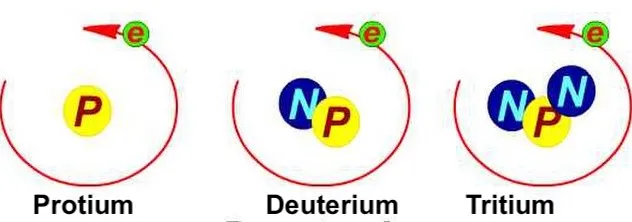
The most common form of hydrogen has:
● 1 proton
● 0 neutrons
● 1 electron
This form is called protium. It’s the simplest atom possible. But hydrogen can also exist in two other forms, called isotopes:
● Deuterium has 1 proton and 1 neutron
● Tritium has 1 proton and 2 neutrons
Even though these are still forms of hydrogen, they have different numbers of neutrons. Isotopes are atoms of the same element that have the same number of protons but different numbers of neutrons.
So, how many neutrons does hydrogen have? In its most common form—zero. But depending on the isotope, it can have 1 or 2.
Fun Fact; Tritium, a rare form of hydrogen with 2 neutrons, is slightly radioactive and is used to glow in watch dials and emergency signs!
What is the main idea of the passage?
Hydrogen is the heaviest elementHydrogen always has neutronsHydrogen has zero neutrons in its most common formHydrogen is made of only electrons
How many protons does hydrogen have?
210It changes every time
In its most common form, how many neutrons does hydrogen have?
2103
What are isotopes?
Different elements with the same number of protonsAtoms with different numbers of protons and electronsAtoms of the same element with different numbers of neutronsThe heaviest types of atoms
What is the name of the most common form of hydrogen?
HeliumTritiumDeuteriumProtium
How many neutrons does deuterium have?
2103
What do all forms of hydrogen have in common?
They have 2 neutronsThey all have 1 protonThey have no electronsThey have 3 protons
Why is hydrogen unique among the elements?
It is heavier than oxygenIt is made only of neutronsIts most common form has no neutronsIt is the rarest element in the universe
Perfect For:
👩🏫 Teachers
• Reading comprehension practice
• Auto-graded assessments
• Literacy skill development
👨👩👧👦 Parents
• Reading practice at home
• Comprehension improvement
• Educational reading time
🏠 Homeschoolers
• Reading curriculum support
• Independent reading practice
• Progress monitoring
Reading Features:
📖
Reading Passage
Engaging fiction or nonfiction text
❓
Comprehension Quiz
Auto-graded questions
📊
Instant Feedback
Immediate results and scoring
📄
Printable Version
Download for offline reading
🔊
Read Aloud
Voice-over with word highlighting
Reviews & Ratings
No reviews yet. Be the first to share your experience!
Related Content
The Mass of a Proton
This reading passage, 'The Mass of a Proton,' introduces middle school students to one of the smallest yet most importan...
MS-PS1HS-PS1RI.6.3RI.7.1
Do Protons and Electrons Have the Same Mass?
This reading passage, 'Do Protons and Electrons Have the Same Mass?', helps middle school students explore the massive d...
MS-PS1HS-PS1RI.6.3RI.7.1
What Charge Does a Neutron Have?
This middle school science passage, 'What Charge Does a Neutron Have?', teaches students about one of the key subatomic ...
MS-PS1HS-PS1RI.6.3RI.7.1
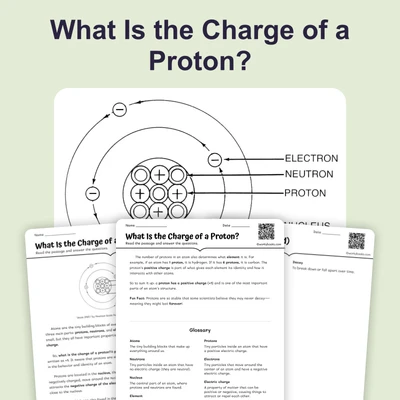
What Is the Charge of a Proton?
This reading passage, 'What Is the Charge of a Proton?', introduces middle school students to the concept of electric ch...
MS-PS1HS-PS1RI.6.3RI.7.1
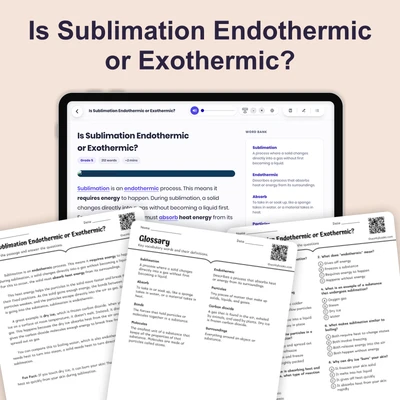
Is Sublimation Endothermic or Exothermic?
This NGSS-aligned science passage for middle school explains the thermodynamic nature of sublimation, showing how a soli...
MS-PS1-4HS-PS1
What is Deforestation?
Deforestation is the large-scale removal of forests, primarily caused by human activities like agriculture, logging, and...
RI.5.3RI.6.3RI.7.3
Cold Fronts and Warm Fronts: A Comparison
Cold fronts bring thunderstorms and cooler temperatures, while warm fronts bring light rain and warmer temperatures. Bot...
7.RI.7.3RI.5.3RI.5.5RI.6.9
The Great Pacific Garbage Patch
The Great Pacific Garbage Patch is a massive collection of plastic waste in the North Pacific Ocean. It harms marine lif...
RI.5.3RI.6.3RI.7.3
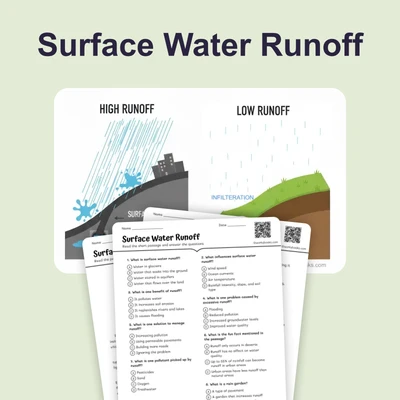
Surface Water Runoff
Surface water runoff replenishes rivers and lakes but can cause flooding and pollution. Solutions like rain gardens and ...
RI.5.3RI.6.3RI.7.3
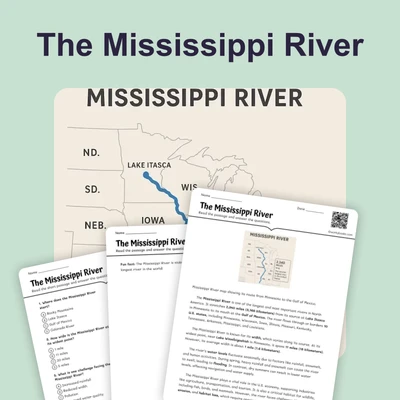
The Mississippi River
The Mississippi River is one of the longest rivers in North America, stretching 2,340 miles from Lake Itasca to the Gulf...
RI.5.3RI.6.3RI.7.3
The Mekong River
The Mekong River flows 2,700 miles through six countries in Southeast Asia, ending in the fertile Mekong Delta. It suppo...
RI.5.3RI.6.3RI.7.3
Freshwater and Its Sources
Freshwater is a limited resource, with most stored in glaciers and aquifers. Rivers, lakes, and groundwater are key sour...
RI.5.3RI.6.3RI.7.3
Difference Between a Rock and a Mineral
Rocks are mixtures of minerals, while minerals are naturally occurring, inorganic solids with a specific composition and...
RI.5.3RI.6.3RI.7.3
Runoff from Precipitation
Runoff from precipitation replenishes rivers and lakes but can cause flooding and pollution. Solutions like rain gardens...
RI.5.3RI.6.3RI.7.3
Large Streams of Moving Water
Large streams of moving water, like rivers and creeks, shape landscapes, support ecosystems, and provide freshwater for ...
RI.5.3RI.6.3RI.7.3
Cyclones and Anticyclones: A Comparison
Cyclones are low-pressure systems that bring stormy weather, while anticyclones are high-pressure systems that bring cle...
7.RI.7.1RI.5.3RI.5.5RI.6.9
The Brahmaputra River
The Brahmaputra River originates in the Himalayas and flows 1,800 miles through China, India, and Bangladesh, joining th...
RI.5.3RI.6.3RI.7.3
The Amazon River Dolphin
The Amazon River dolphin, also known as the pink river dolphin or boto, is a unique freshwater species found in the Amaz...
RI.5.3RI.6.3RI.7.3
Rare Earth Minerals in Smartphones and Computers
Rare earth minerals are critical for smartphones, computers, and renewable energy. Mining them has environmental impacts...