How To Calculate Atmospheric Pressure — Reading Comprehension
Rate this
Premium Resource
Present
Present in classroom. No work saved
Assign
Classroom with student accounts, Track progress
Quick Play
No student accounts, assign with a link
Grades
3
4
5
20
PRINT+DIGITAL RESOURCE
This learning resource is available in interactive and printable formats. The interactive worksheet can be played online and assigned to students. The Printable PDF version can be downloaded and printed for completion by hand.
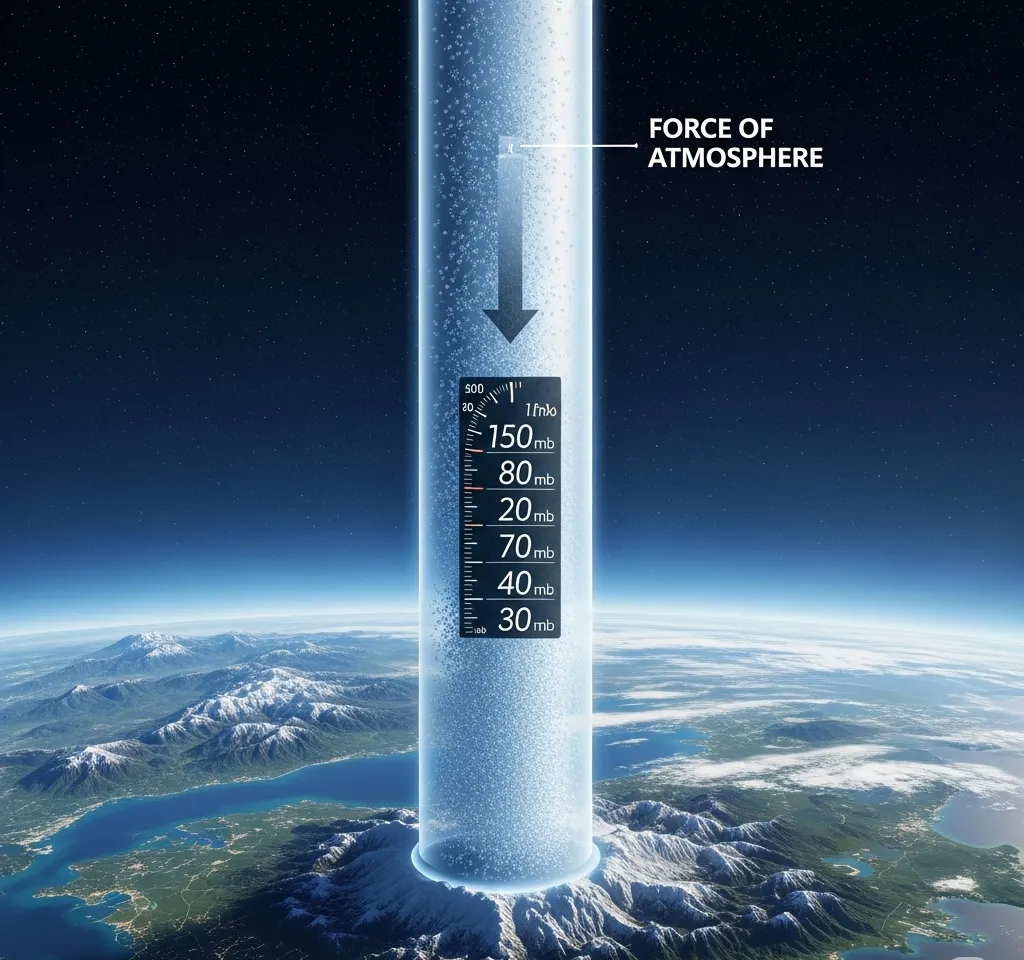
This audio-integrated reading passage, "The Pressure of Air: Calculating Atmospheric Pressure," explores the concept of atmospheric pressure and how it's calculated. It defines key terms like barometer and Pascals, and explains the factors that influence air pressure, such as altitude. Students will learn that atmospheric pressure is the force exerted by the weight of the air above us. The passage also touches on the simplified formula for pressure, P=ρ⋅g⋅h, and explains why our bodies are not crushed by this force. The information aligns with the NGSS Disciplinary Core Idea of PS1.A: Structure and Properties of Matter, as it discusses the properties of air and its effect on our environment. This resource is perfect for a middle school science lesson on the properties of matter and forces.
CONTENT PREVIEW
Expand content preview
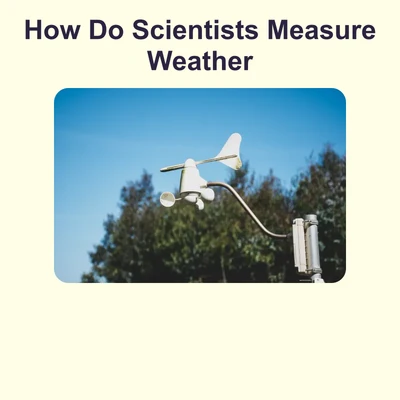
A barometer measures atmospheric pressure.
Atmospheric pressure is the force of air pressing down on everything at Earth’s surface. Even though air is invisible, it has weight. This weight creates pressure, almost like a giant, invisible hand pushing down on us all the time.
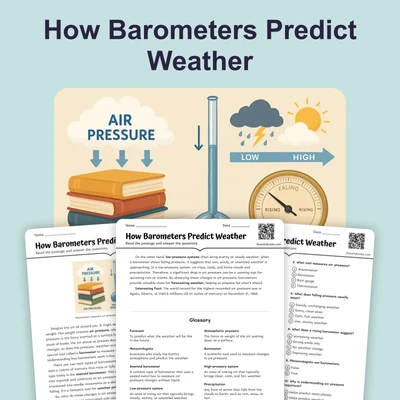
Scientists measure atmospheric pressure to understand the weather and how high a place is above sea level. The main tool for this is called a barometer. There are two main types. A mercury barometer uses a glass tube filled with liquid mercury, a heavy, silvery metal. When air pressure rises, it pushes the mercury higher in the tube. When pressure drops, the mercury falls. An aneroid barometer uses a small metal box that squishes in or out as air pressure changes. Weather stations often use electronic sensors to measure pressure quickly and send data to computers.
Atmospheric pressure is measured in special units. One unit is inches of mercury (inHg), which tells how high the pressure pushes the mercury in a barometer tube. At sea level, the average is about 29.92 inches of mercury. Scientists also use millibars (mb) or hectopascals (hPa), with average sea level pressure at about 1013 mb or hPa.
Pressure changes with altitude. At sea level, there is more air above, so pressure is higher. If you climb a mountain, there is less air above you, so the pressure becomes lower. For every 1,000 feet you go up, the pressure drops about 1 inch of mercury. It’s like weighing the invisible air above you—the higher you go, the less air there is to weigh!
Weather forecasters look at pressure to predict storms or nice weather. When pressure falls, it often means a storm is coming. When pressure rises, fair weather is likely. Pilots and hikers use special pressure tools called altimeters to know how high they are.
Interesting Fact: The highest air pressure ever recorded at sea level was over 32 inches of mercury, during a super cold winter in Siberia!
What does a barometer measure?
Air pressureWind speedTemperatureRainfall
What unit is used for air pressure?
Inches of mercuryCentimetersWattsLiters
What happens to pressure as you climb?
It dropsIt risesIt stays the sameIt disappears
Which tool do pilots use?
AltimeterThermometerRain gaugeWind vane
Pressure falls before a storm. True or false?
TrueFalse
Why do weather stations use electronic sensors?
To measure pressure quicklyTo make rainTo heat the airTo move clouds
Which is a type of barometer?
AneroidOdometerHygrometerSpeedometer
What does 'sea level' mean?
Average ocean heightHighest mountainDeepest lakeLevel of a river
Perfect For:
👩🏫 Teachers
• Reading comprehension practice
• Auto-graded assessments
• Literacy skill development
👨👩👧👦 Parents
• Reading practice at home
• Comprehension improvement
• Educational reading time
🏠 Homeschoolers
• Reading curriculum support
• Independent reading practice
• Progress monitoring
Reading Features:
📖
Reading Passage
Engaging fiction or nonfiction text
❓
Comprehension Quiz
Auto-graded questions
📊
Instant Feedback
Immediate results and scoring
📄
Printable Version
Download for offline reading
🔊
Read Aloud
Voice-over with word highlighting
Reviews & Ratings
No reviews yet. Be the first to share your experience!
Related Content
Tools and Technology in Earth Science
This middle school science reading passage explores the wide range of tools and technologies used in Earth science, from...
MS-ESS2-2MS-ESS3-2MS-ETS1-1MS-PS4-3
Scientific Inquiry in Earth Science
This passage explores scientific inquiry in Earth science for grades 6-8, aligned with NGSS standards MS-ESS1-4, MS-ESS2...
MS-ESS1-4MS-ESS2-1MS-ESS3-5SEP
What Is Earth Science?
This engaging middle school science passage introduces students to the field of Earth science, aligning with NGSS standa...
MS-ESS1MS-ESS2MS-ESS3SEP
Earth: Our Home in Space
This engaging Grade 4-5 science passage, aligned to NGSS, introduces students to Earth's special place in the solar syst...
Earth's Spheres
This middle school science passage introduces students to Earth's four major spheres: the geosphere, hydrosphere, atmosp...
MS-ESS2-4MS-ESS2-6
What Is Space Weather and How Does It Affect the Earth?
This NGSS-aligned science passage for middle school explains what space weather is and how it affects Earth. Students le...
MS-ESS2-2
Earth's Energy Balance
This engaging, NGSS-aligned science passage for grades 6–8 explores Earth's energy balance, a key process that keeps our...
MS-ESS2-6
Earth's Rotation
This middle school science passage, aligned with NGSS standard MS-ESS1-1, focuses on Earth's rotation—how Earth spins on...
MS-ESS1-1
Earth's Interior
This comprehensive passage for grades 6-8 explores Earth's layered interior, including the crust, mantle, outer core, an...
MS-ESS2-1MS-ESS2-2
Facts About Earth
This engaging science reading passage introduces Grade 4 and 5 students to Earth, our home planet. Aligned with NGSS sta...
Meteorite Impacts on Earth
This engaging science reading passage for Grades 4-5 explores meteorite impacts on Earth, aligning with NGSS standards. ...
Venus: Earth's Twin?
This comprehensive science passage for grades 6-8 examines Venus—often called Earth's twin—by exploring its similarities...
MS-ESS1-2MS-ESS1-3
Earth Changes Over Millions of Years
This engaging, audio-integrated science passage for Grade 4-5 students explores how Earth has changed over millions of y...
Earth's Moon Facts
This engaging science passage, 'The Moon: Earth's Companion,' is designed for Grade 4-5 students and aligns with NGSS ge...
Earth's Quick and Slow Changes
In 'Earth's Quick and Slow Changes,' students categorize 12 Earth events by their speed of occurrence, enhancing underst...
Earth: Our Home Planet
This comprehensive science passage for grades 6-8 explores Earth’s unique characteristics and the interconnected systems...
MS-ESS1-2
Earth's Revolution
This middle school science passage explores the science behind Earth's revolution around the Sun, closely aligned with N...
MS-ESS1-1
Earth's Seasons
This comprehensive reading passage for grades 6-8 explains why Earth has seasons, revealing the scientific mechanisms be...
MS-ESS1-1
Earth's Place in the Universe
This reading passage explains Earth's place in the universe, supporting NGSS 1-ESS1-1. It describes how Earth is one of ...
1-ESS1-1
Aphelion and Perihelion
This engaging reading passage, 'Aphelion and Perihelion,' delves into the fascinating aspects of Earth's elliptical orbi...
MS-ESS1-1: DEVELOP AND USE A MODEL OF THE EARTH-SUN-MOON SYSTEM TO DESCRIBE THE CYCLIC PATTERNS OF LUNAR PHASESECLIPSES OF THE SUN AND MOONAND SEASONS.