The Science of Hibernation — Reading Comprehension
Rate this
Premium Resource
Present
Present in classroom. No work saved
Assign
Classroom with student accounts, Track progress
Quick Play
No student accounts, assign with a link
Grades
6
PRINT+DIGITAL RESOURCE
This learning resource is available in interactive and printable formats. The interactive worksheet can be played online and assigned to students. The Printable PDF version can be downloaded and printed for completion by hand.
This educational module, featuring an audio-integrated reading passage titled 'The Science of Hibernation,' is designed for 6th-grade students. It aligns with NGSS standard MS-LS1-5, which focuses on constructing a scientific explanation based on evidence for how environmental and genetic factors influence the growth of organisms. The passage, rich with SEO keywords like animal adaptation, environmental factors, and genetic factors, explains how animals prepare for and survive the cold winter months through hibernation. It defines key terms and provides a comprehensive overview of this fascinating biological process. Following the passage, students engage in multiple-choice questions, a glossary activity, and short answer questions to deepen their understanding of how these factors impact an animal's ability to survive and thrive. This content is perfect for exploring animal survival strategies.
CONTENT PREVIEW
Expand content preview
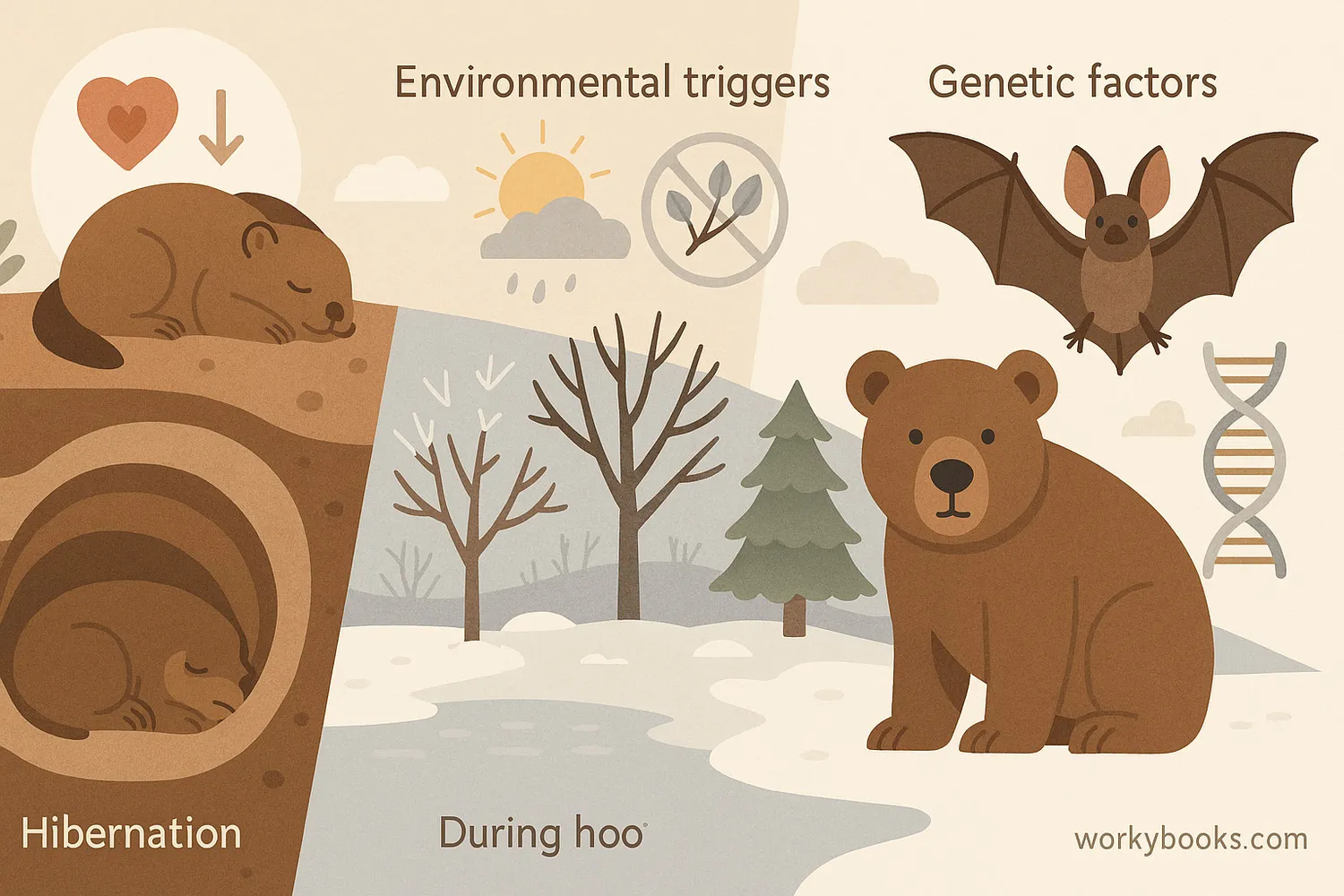
Hibernating animals survive winter using fat reserves and slowed metabolism in cold environments.
Imagine a long, cold winter stretching out before you. Food is scarce, and the temperature drops to freezing. What would you do to survive? For many animals, the answer is hibernation – a remarkable survival strategy.
Hibernation is a state of minimal activity and metabolic depression in endotherms. It's like taking a very long nap, but with incredible changes happening inside an animal's body. During hibernation, an animal's body temperature drops significantly, its heart rate slows down dramatically, and its breathing becomes very shallow. For example, a groundhog's heart rate can go from 80 beats per minute to just 5 beats per minute during hibernation! This dramatic slowdown helps conserve energy when food is unavailable or the weather is too harsh to forage.
Several factors influence whether an animal will hibernate. Environmental factors, such as the drop in temperature and the decrease in food availability, are major triggers. As days get shorter and colder, animals receive cues to begin preparing for their long sleep. They might eat a lot to build up fat reserves, which will be their fuel source during hibernation. These fat reserves are crucial for providing energy when the animal is not eating.
But it's not just the environment; genetic factors also play a significant role. Some animals are simply born with the ability to hibernate, while others are not. This inherited trait means that the instructions for hibernation are part of their DNA. For example, bears, groundhogs, and some bats are known hibernators. Their bodies are specially adapted to enter and exit this deep sleep safely. These adaptations allow them to slow down their metabolism without causing damage to their organs.
Hibernation isn't just about sleeping; it's a complex biological process that helps animals survive challenging conditions. It demonstrates how both their surroundings and their inherited traits work together to ensure their growth and survival. Understanding hibernation helps us appreciate the amazing ways life adapts to its environment, ensuring the continuation of various species.
Interesting Fact: Some animals, like certain species of frogs and turtles, can survive freezing solid during winter by producing a natural antifreeze in their bodies!
What is a main reason animals hibernate?
Find new friendsConserve energyTravel to new placesLearn new tricks
What happens to an animal's heart rate during hibernation?
Speeds upStays the sameSlows downStops completely
Which is an environmental factor for hibernation?
Animal's fur colorDecrease in foodAnimal's ageParent's size
How do fat reserves help hibernating animals?
Keep them warmMake them strongerProvide energyHelp them digest
Why are genetic factors important for hibernation?
Help them choose foodGive them hibernation abilityMake them run fasterTeach them to build dens
Which animal is mentioned as a hibernator?
DeerSquirrelGroundhogRabbit
Hibernation involves significant changes in an animal's body.
TrueFalse
What is the meaning of 'adaptations' as used in the passage?
Sudden changesEating habitsHelpful body changesSocial behaviors
If a species moves to a warmer climate, how might hibernation change?
They would hibernate longerThey might not hibernateTheir fat reserves decreaseTheir heart rate speeds up
How do genetic factors prepare an animal for winter survival?
Learning new skillsInheriting hibernation abilityFinding warmer spotsBuilding stronger nests
Perfect For:
👩🏫 Teachers
• Reading comprehension practice
• Auto-graded assessments
• Literacy skill development
👨👩👧👦 Parents
• Reading practice at home
• Comprehension improvement
• Educational reading time
🏠 Homeschoolers
• Reading curriculum support
• Independent reading practice
• Progress monitoring
Reading Features:
📖
Reading Passage
Engaging fiction or nonfiction text
❓
Comprehension Quiz
Auto-graded questions
📊
Instant Feedback
Immediate results and scoring
📄
Printable Version
Download for offline reading
🔊
Read Aloud
Voice-over with word highlighting
Reviews & Ratings
No reviews yet. Be the first to share your experience!
Related Content
The Nature of Life Science
This passage, aligned with NGSS MS-LS1-1, introduces students in grades 6-8 to the foundational concepts of life science...
MS-LS1-1
Science Vocabulary
This worksheet on domain-specific words will help students learn some science vocabulary. Students will be asked to matc...
L.3.6L.3.4.A
Simple Machines Science Report
This science writing task requires students to clearly explain how three simple machines work using precise domain-speci...
W.5.4
Adaptation
This engaging middle school science passage explores adaptation, focusing on how inherited traits enable organisms to su...
MS-LS4-4MS-LS4-6
Desert Rain Frog Behavioral Adaptations
Dive into the fascinating world of the Desert Rain Frog and discover its incredible unique adaptations for survival in a...
Animal Adaptations Word Sort
This engaging word sort activity helps students understand the difference between physical and behavioral adaptations in...
Herbivore Adaptations
This engaging reading passage, integrated with audio, delves into the fascinating world of herbivore adaptations. Studen...
Ocean Animal Adaptations
Students will read a passage that provides information about various adaptations that marine animals have developed to t...
W.4.9.B
Nocturnal Adaptations of the Strange Aye-Aye
This engaging reading passage, integrated with audio, takes grade 5 students on a journey to discover the fascinating no...
Early Life Forms and Their Adaptations
This educational passage focuses on early life forms and their basic adaptations, supporting NGSS standard 3-LS4-2 for e...
RI.3.3RI.4.3RI.5.33-LS4-2
Binturong Adaptations
This engaging, audio-integrated reading passage, 'Binturong Adaptations,' for Grade 6 students delves into the fascinati...
Barnacle Biology and Adaptations
Dive into the intriguing world of barnacles with this engaging Grade 6 reading passage. Students will learn about these ...
Whale Blubber: Function and Adaptation
This engaging, audio-integrated reading passage, 'Whale Blubber Function and Adaptation,' introduces young learners to t...
Mountain Animal Adaptations
This reading comprehension worksheet focuses on the topic of animal adaptations for survival in mountainous environments...
W.4.9.B
Amur Leopard Adaptations
This engaging, audio-integrated reading passage, 'Amur Leopard Adaptations,' is designed for Grade 6 science students. I...
Climate Zone Adaptations Word Sort
This word sort activity examines how plants and animals adapt to different climate conditions. Students sort 12 differen...
Plant Adaptations for Survival
This NGSS-aligned word sort activity, suitable for kindergarten, focuses on plant survival adaptations, helping students...
K-LS1-1
The Pumpkin Life Cycle
This informational worksheet explores the pumpkin lifecycle, guiding students through procedural steps in a scientific t...
RI.2.3RI.2.10
What Is Earth Science?
This engaging middle school science passage introduces students to the field of Earth science, aligning with NGSS standa...