What are the uses of Evaporative Salts — Reading Comprehension
Rate this
Premium Resource
Present
Present in classroom. No work saved
Assign
Classroom with student accounts, Track progress
Quick Play
No student accounts, assign with a link
Grades
3
4
5
6
7
8
PRINT+DIGITAL RESOURCE
This learning resource is available in interactive and printable formats. The interactive worksheet can be played online and assigned to students. The Printable PDF version can be downloaded and printed for completion by hand.
"This NGSS-aligned middle school science passage explains the formation and diverse applications of evaporative salts, also known as evaporites. Students will learn how minerals like halite, gypsum, and potash precipitate from bodies of water as they evaporate in arid climates. The text details the sequential nature of this crystallization process and its significance for geological study. Key real-world connections are made, linking evaporites to everyday products such as table salt, road de-icers, drywall, and agricultural fertilizers. The passage uses clear, direct language and bolded vocabulary to make the complex topic accessible and engaging for students. It is designed to support the understanding of matter, chemical reactions, and Earth's systems, connecting to NGSS standards for physical and earth sciences."
CONTENT PREVIEW
Expand content preview
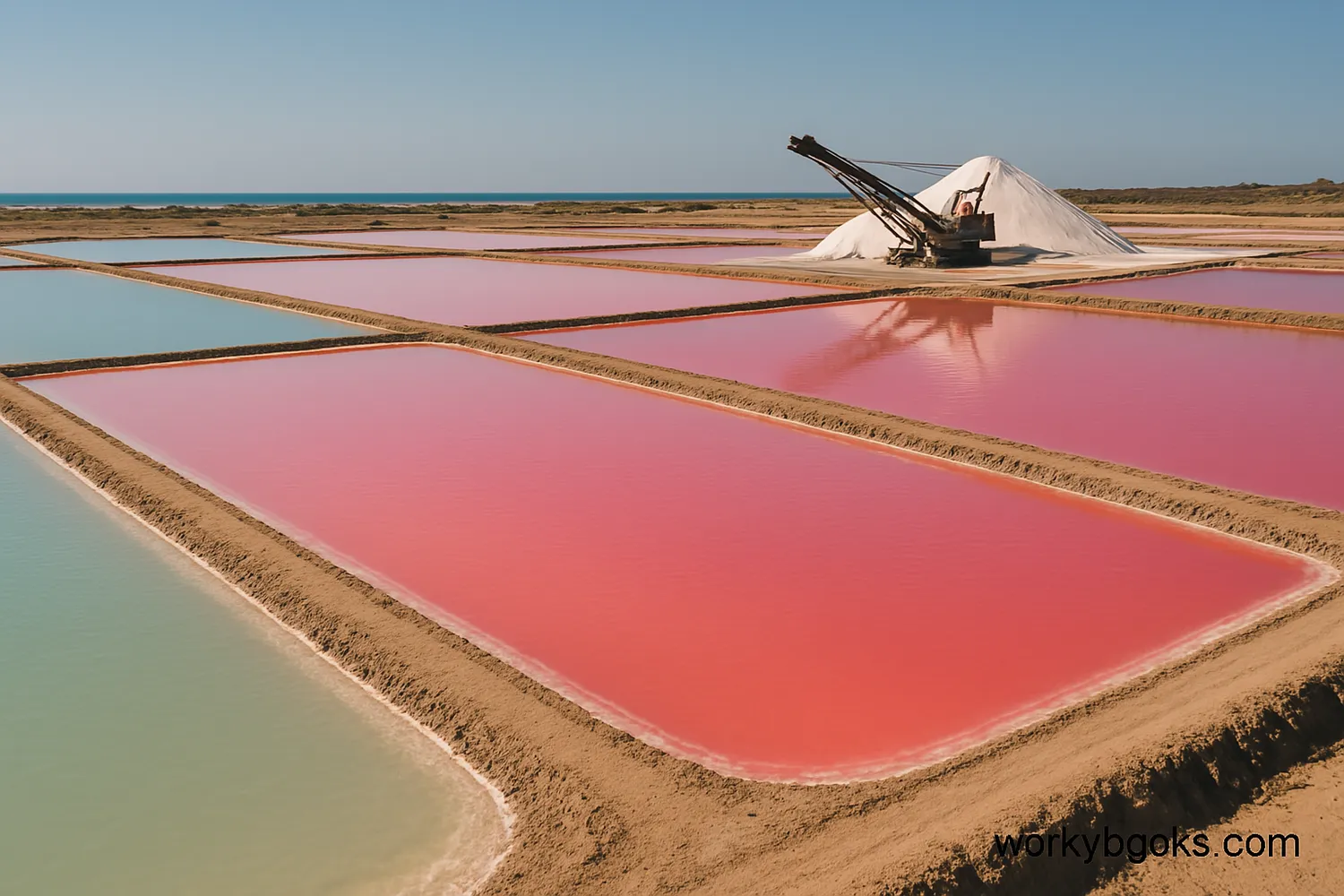
Salt evaporation ponds are used to produce valuable evaporite minerals like halite and gypsum through the natural power of solar energy.
Evaporative salts, or evaporites, are a class of sedimentary minerals and rocks formed by the precipitation of salts from water. This process occurs when a body of water, such as a lake or a shallow sea, becomes concentrated with dissolved minerals as the water evaporates. In arid or semi-arid climates where the rate of evaporation is higher than the rate of water inflow, the remaining water becomes supersaturated with salts, which then crystallize and settle out. Common examples of evaporative salts include halite (table salt), gypsum, and potash. These minerals are crucial to both natural systems and human society.
The formation of these salts happens in a specific order. As a body of water evaporates, the minerals with the lowest solubility, like calcite and gypsum, precipitate first. Once the water becomes even more concentrated, the more soluble salts, such as halite, begin to crystallize. Finally, the most soluble salts, including potassium and magnesium chlorides, precipitate out. This sequential process results in layered deposits of different evaporite minerals, which geologists can study to learn about Earth's past climates.
Evaporative salts have a wide variety of uses that impact our daily lives. The most well-known evaporite is halite, which is used for food preservation and seasoning, de-icing roads in winter, and as a raw material in the chemical industry to produce substances like chlorine and sodium hydroxide. Gypsum is another vital evaporite, primarily used in construction to make drywall and plaster. Additionally, potash, a potassium-rich salt, is a key ingredient in agricultural fertilizers, helping to nourish crops and increase food production. These minerals are vital for everything from construction to food security.
Fun Fact: The Great Salt Lake in Utah is a modern example of an evaporite basin. Its high salinity, which is several times saltier than the ocean, allows for the commercial harvesting of salt and other minerals through natural solar evaporation.
What is the primary process by which evaporative salts are formed?
Volcanic activityPrecipitation from supersaturated waterErosion of rock layersPressure and heat deep underground
What are evaporites?
Rocks formed by volcanic eruptionsSedimentary minerals from evaporated waterIgneous rocks with a crystalline structureMinerals found only in deep ocean trenches
In the formation of evaporative salts, which type of minerals precipitates first?
Highly soluble salts like potashHaliteMinerals with the lowest solubilityAll minerals at the same time
According to the passage, what is a key use of gypsum?
Food preservationDe-icing roadsManufacturing fertilizersMaking drywall and plaster
The sequential precipitation of different salts from evaporating water can be used by geologists to understand what?
The age of the EarthThe composition of ancient oceansPast climate conditionsThe movement of tectonic plates
Which of the following is NOT listed as a use for halite in the passage?
To explain the geological history of evaporites.To describe the chemical properties of different salts.To discuss the formation and diverse uses of evaporative salts.To highlight the economic importance of the Great Salt Lake.
If a company wants to produce a large amount of potash, they should look for a body of water that has undergone which process?
Volcanic activity to heat the waterComplete evaporation, leaving only the most soluble mineralsA constant, high inflow of fresh waterCrystallization of low-solubility salts, but not yet of halite
Perfect For:
👩🏫 Teachers
• Reading comprehension practice
• Auto-graded assessments
• Literacy skill development
👨👩👧👦 Parents
• Reading practice at home
• Comprehension improvement
• Educational reading time
🏠 Homeschoolers
• Reading curriculum support
• Independent reading practice
• Progress monitoring
Reading Features:
📖
Reading Passage
Engaging fiction or nonfiction text
❓
Comprehension Quiz
Auto-graded questions
📊
Instant Feedback
Immediate results and scoring
📄
Printable Version
Download for offline reading
🔊
Read Aloud
Voice-over with word highlighting
Reviews & Ratings
No reviews yet. Be the first to share your experience!
Related Content
Physical Properties of Matter
This comprehensive reading passage introduces grades 6-8 students to the concept of physical properties of matter, perfe...
MS-PS1-1
Chemical Properties of Matter
This engaging middle school science passage explores the chemical properties of matter, focusing on how these properties...
MS-PS1-2
Changes in Matter
This engaging science passage introduces Grade 4-5 students to the concept of how matter can change, meeting NGSS standa...
Matter States Word Sort
This classification activity helps students understand how particles are arranged in different states of matter. Student...
5-PS1-1
Matter States Word Sort
This interactive word sort focuses on helping students understand the different states of matter through real-world exam...
PS1.A
Is Evaporation a Physical Change
"This reading passage is designed for middle school students to explore the concept of evaporation and its classificatio...
What Are Physical Changes?
This engaging Grade 4-5 science passage introduces students to the concept of physical changes in matter, aligning with ...
Properties of Addition
This worksheet on the properties of addition will help students to practice this skill. All of the properties are define...
3.OA.B.5
Particle Model of Matter
This comprehensive science reading passage for grades 6-8 explores the particle model of matter, aligning with NGSS stan...
MS-PS1-1MS-PS1-4
Particle Movement Sort
This classification activity helps students understand particle movement in different materials. Students categorize sub...
5-PS1-1
Sorting Materials by Properties
In the 'Sorting Materials by Properties' activity, students sort various materials into categories such as 'Hard and Rig...
Kinetic Theory of Matter
This middle school science reading passage introduces students to the kinetic theory of matter, aligning with NGSS MS-PS...
MS-PS1-4
Properties of Addition— Commutative
This worksheet is perfect for practicing the commutative property. Students will practice this property as well as their...
1.OA.B.3-3
The Nature of Science
This passage explores the nature of science for middle school students, aligning with NGSS standards MS-ETS1-4, MS-PS1-1...
MS-ETS1-4MS-PS1-1MS-LS1-1
Science Vocabulary
This worksheet on domain-specific words will help students learn some science vocabulary. Students will be asked to matc...
L.3.6L.3.4.A
The Melting Point of Substances
This middle school science reading passage, titled 'The Melting Point of Substances', explores the physical property kno...
5-PS1MS-PS1-4RI.6.3RI.7.1
Properties of Communication Tools
The 'Properties of Communication Tools' word sort activity is crafted for first-grade students to meet NGSS 1-PS4-4 stan...
Temperature Effects Sort
This classification activity helps students understand how temperature affects matter. Students categorize various chang...
5-PS1-2
Simple Machines Science Report
This science writing task requires students to clearly explain how three simple machines work using precise domain-speci...
W.5.4
The States of Matter: Solid
Discover the differences between solids, liquids and gases by exploring how their particles are arranged and move. This ...