This learning resource is available in interactive and printable formats. The interactive worksheet can be played online and assigned to students. The Printable PDF version can be downloaded and printed for completion by hand.
"This science passage for middle school students (grades 6-8) explores the fundamental physical science concept of evaporation. Aligned with NGSS standards, the reading details how a liquid substance changes into a gas below its boiling point, a process crucial to the Earth's water cycle. The passage explains the role of kinetic energy and molecular motion in evaporation, distinguishing it from boiling. It provides relatable, real-world examples, such as sweat cooling the body and wet clothes drying. Factors affecting the rate of evaporation, like temperature and surface area, are also discussed. This resource is designed to enhance student understanding of physical science concepts through a direct, informative style suitable for self-study and classroom use. The content supports key NGSS physical science standards related to matter and its interactions."
CONTENT PREVIEW
Expand content preview
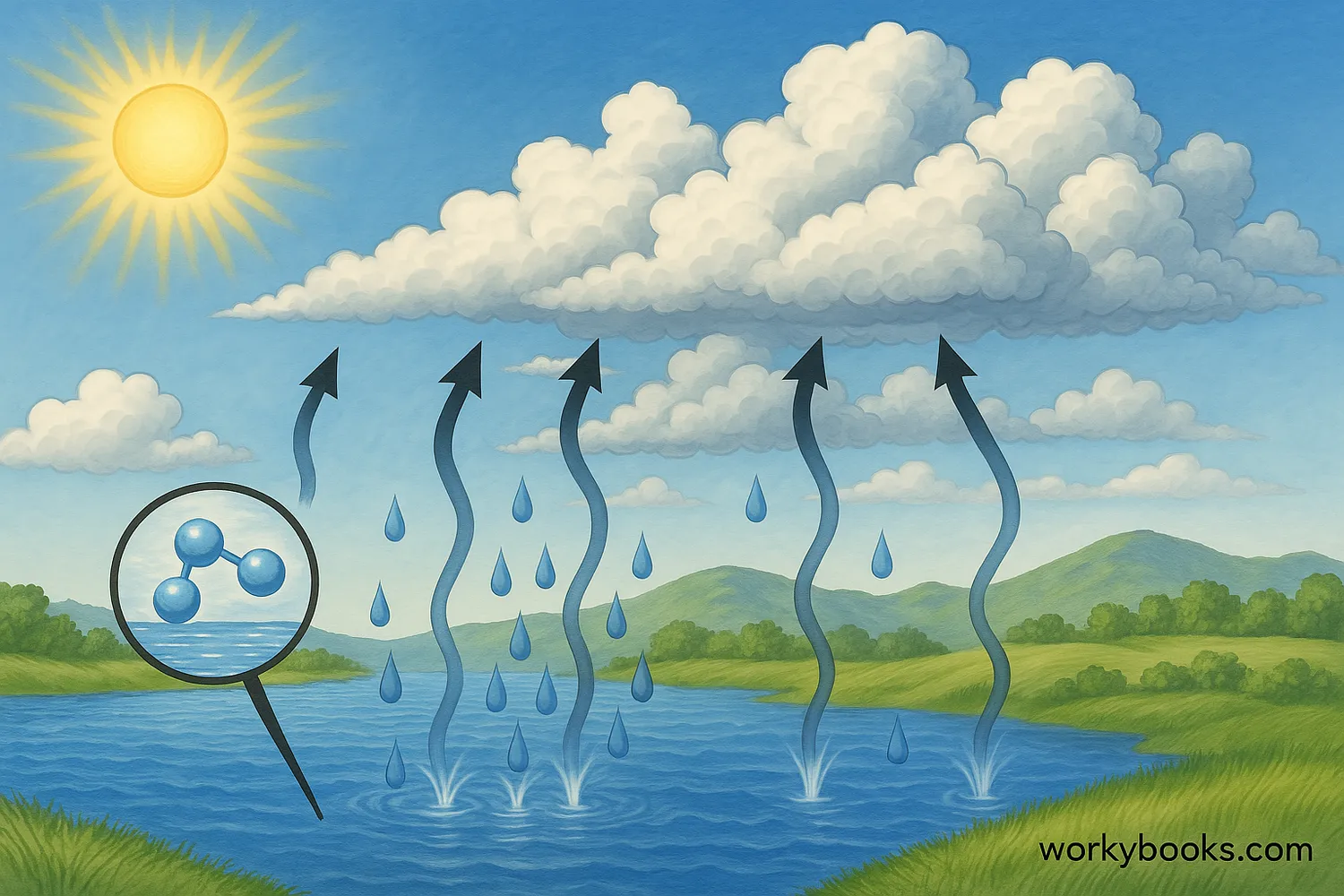
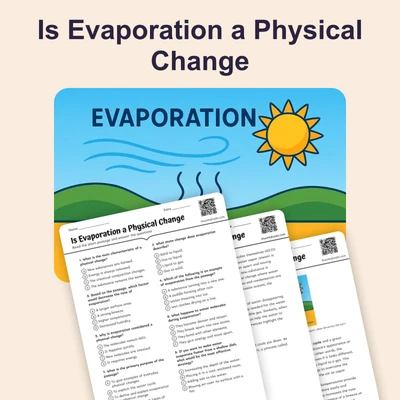
Evaporation as a key part of the water cycle, showing water molecules rising from a liquid surface.
Evaporation is a fundamental process in which a substance changes from a liquid to a gaseous state. This phase change occurs at the surface of a liquid, below its boiling point. The water cycle provides a perfect example: water from oceans, lakes, and rivers absorbs energy, causing it to change into a gas known as water vapor, which then rises into the atmosphere. This continuous movement of water is essential for Earth’s climate and ecosystems. Understanding evaporation helps explain many everyday phenomena and is a cornerstone of physical science.
All molecules in a liquid are constantly in motion, but some move faster than others. The molecules at the surface of a liquid are in a position to escape. When these surface molecules absorb enough kinetic energy (energy of motion) from their surroundings, they overcome the forces of attraction holding them together. Once they have enough energy to break free, they transition into a gaseous state and disperse into the air. This process is different from boiling, which occurs when a liquid is heated to a specific temperature and vapor forms throughout the entire liquid, not just at the surface.
Evaporation is responsible for many of the changes we observe daily. For instance, when wet clothes are hung outside, the water molecules on the fabric’s surface absorb energy from the sun and the surrounding air, eventually turning into water vapor and drying the clothes. Similarly, a puddle on the sidewalk disappears after a rainy day as the liquid water slowly evaporates. The human body also uses evaporation as a cooling mechanism. When we sweat, the sweat on our skin absorbs body heat to evaporate, which effectively cools us down.
The rate of evaporation is influenced by several factors, including temperature, surface area, and humidity. Higher temperatures increase molecular energy, speeding up the process. A larger surface area exposes more liquid molecules to the air, increasing the rate of evaporation. In contrast, high humidity slows evaporation because the air is already saturated with water vapor and cannot hold much more.
Fun Fact: Evaporation is used in large-scale solar evaporation ponds to produce salt. Seawater is funneled into shallow ponds, where the sun evaporates the water, leaving behind the salt crystals.
What is the main idea of the passage?
The difference between evaporation and boiling.The process and importance of evaporation.How humidity affects the water cycle.The use of evaporation in producing salt.
According to the passage, what state of matter is water vapor?
LiquidGasSolidPlasma
Evaporation differs from boiling primarily because evaporation occurs:
only on very hot days.at the boiling point of the liquid.at the surface of the liquid.throughout the entire liquid.
Which of the following is not mentioned as a factor that influences the rate of evaporation?
TemperatureSurface areaWind speedHumidity
How does sweating help to cool the human body?
It adds moisture to the skin.Sweat absorbs body heat to evaporate.The liquid sweat cools the skin directly.It increases the body’s kinetic energy.
A student places two identical cups of water in a room. One cup is in a sunny spot, and the other is in a shaded spot. Based on the passage, what is the most likely outcome?
The water in the shaded cup will evaporate faster.Both cups will evaporate at the same rate.The water in the sunny cup will evaporate faster.Neither cup will experience evaporation.
In the context of the passage, what is kinetic energy?
The energy of a substance in a gaseous state.The energy of attraction between molecules.The energy a molecule has to break free.The energy of motion.
Why does a puddle on the sidewalk eventually disappear on a warm, sunny day?
The water soaks into the sidewalk.The sun's light destroys the water molecules.The water freezes and sublimates.The water molecules evaporate into the air.
Perfect For:
👩🏫 Teachers
• Reading comprehension practice
• Auto-graded assessments
• Literacy skill development
👨👩👧👦 Parents
• Reading practice at home
• Comprehension improvement
• Educational reading time
🏠 Homeschoolers
• Reading curriculum support
• Independent reading practice
• Progress monitoring
Reading Features:
📖
Reading Passage
Engaging fiction or nonfiction text
❓
Comprehension Quiz
Auto-graded questions
📊
Instant Feedback
Immediate results and scoring
📄
Printable Version
Download for offline reading
🔊
Read Aloud
Voice-over with word highlighting
Reviews & Ratings
No reviews yet. Be the first to share your experience!
Related Content
Physical Properties of Matter
This comprehensive reading passage introduces grades 6-8 students to the concept of physical properties of matter, perfe...
MS-PS1-1
Chemical Properties of Matter
This engaging middle school science passage explores the chemical properties of matter, focusing on how these properties...
MS-PS1-2
Changes in Matter
This engaging science passage introduces Grade 4-5 students to the concept of how matter can change, meeting NGSS standa...
Matter States Word Sort
This classification activity helps students understand how particles are arranged in different states of matter. Student...
5-PS1-1
Is Evaporation a Physical Change
"This reading passage is designed for middle school students to explore the concept of evaporation and its classificatio...
Matter States Word Sort
This interactive word sort focuses on helping students understand the different states of matter through real-world exam...
PS1.A
What Are Physical Changes?
This engaging Grade 4-5 science passage introduces students to the concept of physical changes in matter, aligning with ...
Properties of Addition
This worksheet on the properties of addition will help students to practice this skill. All of the properties are define...
3.OA.B.5
Particle Model of Matter
This comprehensive science reading passage for grades 6-8 explores the particle model of matter, aligning with NGSS stan...
MS-PS1-1MS-PS1-4
Particle Movement Sort
This classification activity helps students understand particle movement in different materials. Students categorize sub...
5-PS1-1
Kinetic Theory of Matter
This middle school science reading passage introduces students to the kinetic theory of matter, aligning with NGSS MS-PS...
MS-PS1-4
Sorting Materials by Properties
In the 'Sorting Materials by Properties' activity, students sort various materials into categories such as 'Hard and Rig...
Properties of Addition— Commutative
This worksheet is perfect for practicing the commutative property. Students will practice this property as well as their...
1.OA.B.3-3
The Nature of Science
This passage explores the nature of science for middle school students, aligning with NGSS standards MS-ETS1-4, MS-PS1-1...
MS-ETS1-4MS-PS1-1MS-LS1-1
Science Vocabulary
This worksheet on domain-specific words will help students learn some science vocabulary. Students will be asked to matc...
L.3.6L.3.4.A
The Melting Point of Substances
This middle school science reading passage, titled 'The Melting Point of Substances', explores the physical property kno...
5-PS1MS-PS1-4RI.6.3RI.7.1
Properties of Communication Tools
The 'Properties of Communication Tools' word sort activity is crafted for first-grade students to meet NGSS 1-PS4-4 stan...
Simple Machines Science Report
This science writing task requires students to clearly explain how three simple machines work using precise domain-speci...
W.5.4
Physical Changes: Evaporation
This middle school science passage examines the process of evaporation, a fundamental physical change where a liquid tur...
MS-PS1-4
The Nature of Life Science
This passage, aligned with NGSS MS-LS1-1, introduces students in grades 6-8 to the foundational concepts of life science...