Japan Surrenders: World War II Ends
Interactive passage with audio narration, comprehension questions, and printable PDF.
By completing this purchase you agree to our Terms of Use and Privacy Policy. Your subscription renews automatically until you cancel. You can cancel anytime from your account settings. All sales are final and non-refundable. Digital content is available for download in your account immediately upon purchase.
What's included
Japan Surrenders: World War II Ends preview and details
About this printable Japan Surrenders: World War II Ends reading passage (Grades 6-8)
Sample passage and quiz from Japan Surrenders: World War II Ends
Reading passage and comprehension quiz preview
Japan Surrenders 1945
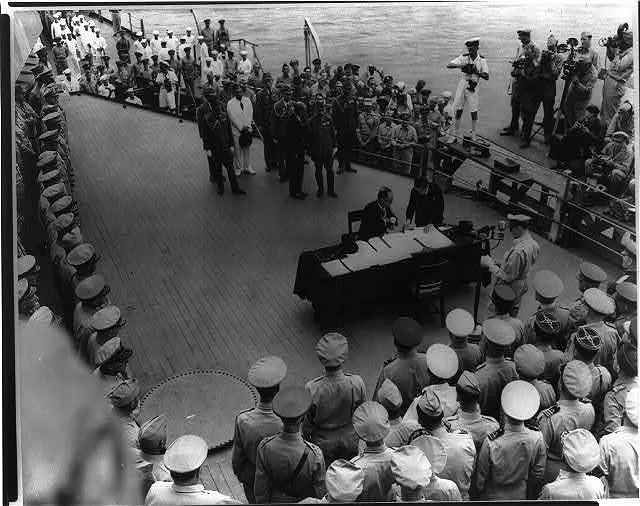
Source: Library of Congress - United States. Navy
On August 15, 1945, Japan announced its surrender to the Allied powers, bringing World War II to a close. This moment marked the end of six years of devastating global conflict. The decision to surrender did not happen suddenly; it was the result of a series of events, both military and diplomatic, that forced Japan to accept defeat. The world would never be the same after this victory for the Allies.
The road to Japan’s surrender began with mounting losses in the Pacific. By 1945, Allied forces had captured key islands and cut off Japan’s resources. The United States used a new and destructive weapon—the atomic bomb—on the cities of Hiroshima and Nagasaki in early August. These bombings, combined with the Soviet Union’s declaration of war on Japan, created overwhelming pressure. Facing destruction and isolation, Japanese leaders realized their only option was to seek an armistice, or agreement to stop fighting.
Japan’s surrender was formally signed on September 2, 1945, aboard the USS Missouri in Tokyo Bay. Representatives from the United States, the Soviet Union, China, and other Allied nations attended the ceremony. The event was broadcast worldwide, symbolizing the official end of World War II. The surrender document made it clear that Japan had to accept the Allies’ terms and begin a difficult period of rebuilding.
The consequences of Japan’s surrender were far-reaching. The war’s end launched the postwar era, which brought both hope and challenges. The United States occupied Japan, introducing new political and economic reforms. Globally, the war’s outcome shifted the balance of power. The United States and the Soviet Union emerged as superpowers, leading to new tensions known as the Cold War. The use of atomic bombs also began the atomic age, changing how nations thought about war and peace.
The end of World War II required nations to reconsider their relationships and create new international organizations, such as the United Nations. These efforts aimed to prevent future conflicts and promote global cooperation. However, many countries faced difficult recovery processes, rebuilding cities and lives lost in the war. For Japan, the postwar period was marked by transformation, as it shifted from a militaristic government to a peaceful democracy.
The Allied victory in World War II and Japan’s surrender changed the world in lasting ways. The events of 1945 continue to influence international relations and remind us of the devastating costs of war, as well as the importance of peace.
Interesting Fact: The Japanese word for surrender, "mokusatsu," was misunderstood by the Allies when first used, leading to confusion and further tension before Japan’s official announcement.
Comprehension quiz (8 questions)
1. When did Japan announce its surrender?
2. What weapon was used on Hiroshima?
3. Where was Japan’s surrender signed?
4. Why did Japan surrender?
5. What did the atomic bombings cause?
6. What started after WWII?
7. The atomic age began after WWII. True or False?
8. What does 'armistice' mean?
Common Core standards for Japan Surrenders: World War II Ends
Explain events, procedures, ideas, or concepts in a historical, scientific, or technical text, including what happened and why, based on specific information in the text.
Determine the meaning of general academic and domain-specific words or phrases in a text relevant to a grade 4 topic or subject area.
Write informative/explanatory texts to examine a topic and convey ideas and information clearly.
Perfect for the way you teach
- Build comprehension skills
- Auto-graded quiz
- Differentiated reading
- Read together at home
- Improve fluency
- Quiet reading time
- Reading curriculum support
- Independent practice
- Track Lexile growth