New Deal Programs: Relief Recovery Reform
Interactive passage with audio narration, comprehension questions, and printable PDF.
By completing this purchase you agree to our Terms of Use and Privacy Policy. Your subscription renews automatically until you cancel. You can cancel anytime from your account settings. All sales are final and non-refundable. Digital content is available for download in your account immediately upon purchase.
What's included
New Deal Programs: Relief Recovery Reform preview and details
About this printable New Deal Programs: Relief Recovery Reform reading passage (Grades 6-8)
Sample passage and quiz from New Deal Programs: Relief Recovery Reform
Reading passage and comprehension quiz preview
New Deal Programs
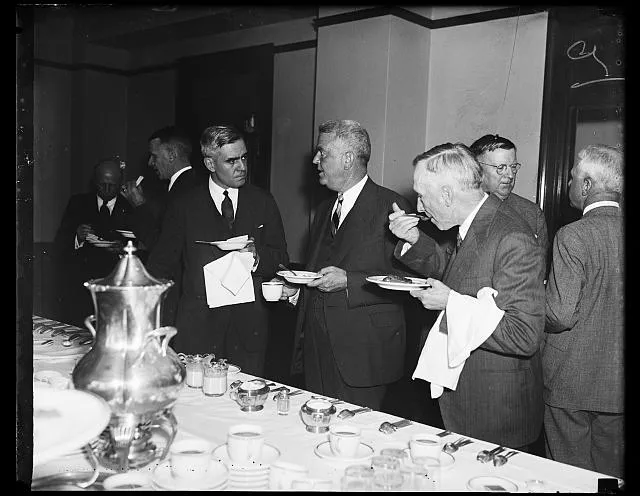
"Explaining New Deal. From the left, W. Dale Clark of Omaha; Lyman E. Wakefield, of Minneapolis, and Thomas R. Preston, Chattanooga, all directors of the U.S. Chamber of Commerce, photographed at the luncheon which interrupted the "explaining" of the New Deal by Chamber Directors. It was emphasized that the Directors were not "denouncing" the New Deal, merely "explaining"" by Harris & Ewing / Library of Congress.
The Great Depression was a severe economic crisis in the United States during the 1930s. Millions of Americans lost their jobs, homes, and savings as businesses failed and banks closed. To address these urgent problems, President Franklin D. Roosevelt launched a series of federal initiatives known as the New Deal. The New Deal included a variety of federal programs designed to provide relief to those suffering, encourage economic recovery, and introduce lasting reforms to prevent future crises.
One of the first challenges was widespread unemployment. The government responded by creating work programs such as the Civilian Conservation Corps (CCC) and the Works Progress Administration (WPA). The CCC hired young men to plant trees, build parks, and prevent soil erosion. Meanwhile, the WPA funded artists, writers, and construction workers to build schools, roads, and public buildings. These programs not only provided jobs but also improved the nation's infrastructure.
In addition to creating jobs, New Deal programs aimed to deliver direct relief to struggling Americans. The Federal Emergency Relief Administration (FERA) supplied money and food to families in need. This approach marked a shift in the role of government, as the federal government took greater responsibility for the welfare of its citizens. Some people supported these programs, believing they offered hope and stability. Others criticized them for expanding government power and increasing national debt.
The New Deal also sought to reform the American economy to prevent another depression. For example, the Social Security Act established a safety net for the elderly, unemployed, and disabled. The government also created regulations for banks and the stock market, aiming to protect people's savings and restore public confidence in the financial system. These reforms helped shape the relationship between the government and the economy for decades to come.
Despite many successes, the New Deal faced criticism and legal challenges. Some business leaders and politicians argued that the programs interfered with free enterprise. The Supreme Court even ruled some programs unconstitutional, forcing Roosevelt to adjust his approach. Nevertheless, the New Deal made a lasting impact on American society by demonstrating that the federal government could play an active role in addressing economic and social problems.
Most historians agree that the New Deal did not fully end the Great Depression, but it provided relief to millions and changed expectations about government responsibility. The legacy of the New Deal can still be seen in programs like Social Security and in the ongoing debates over the proper role of government in economic life.
Interesting Fact: The Civilian Conservation Corps, one of the most popular New Deal programs, planted over three billion trees across the United States, helping to restore forests and prevent soil erosion.
Comprehension quiz (8 questions)
1. Who created the New Deal?
2. What was the main goal of the CCC?
3. Which law created payments for the elderly?
4. Why did some people criticize the New Deal?
5. How did the WPA help Americans?
6. What was one result of New Deal reforms?
7. The New Deal programs fully ended the Great Depression.
8. What does "relief" mean in the passage?
Common Core standards for New Deal Programs: Relief Recovery Reform
Explain events, procedures, ideas, or concepts in a historical, scientific, or technical text, including what happened and why, based on specific information in the text.
Determine the meaning of general academic and domain-specific words or phrases in a text relevant to a grade 4 topic or subject area.
Write informative/explanatory texts to examine a topic and convey ideas and information clearly.
Perfect for the way you teach
- Build comprehension skills
- Auto-graded quiz
- Differentiated reading
- Read together at home
- Improve fluency
- Quiet reading time
- Reading curriculum support
- Independent practice
- Track Lexile growth