Progressive Movement Goals and Reforms
Interactive passage with audio narration, comprehension questions, and printable PDF.
By completing this purchase you agree to our Terms of Use and Privacy Policy. Your subscription renews automatically until you cancel. You can cancel anytime from your account settings. All sales are final and non-refundable. Digital content is available for download in your account immediately upon purchase.
What's included
Progressive Movement Goals and Reforms preview and details
About this printable Progressive Movement Goals and Reforms reading passage (Grades 6-8)
Sample passage and quiz from Progressive Movement Goals and Reforms
Reading passage and comprehension quiz preview
Progressive Movement Goals
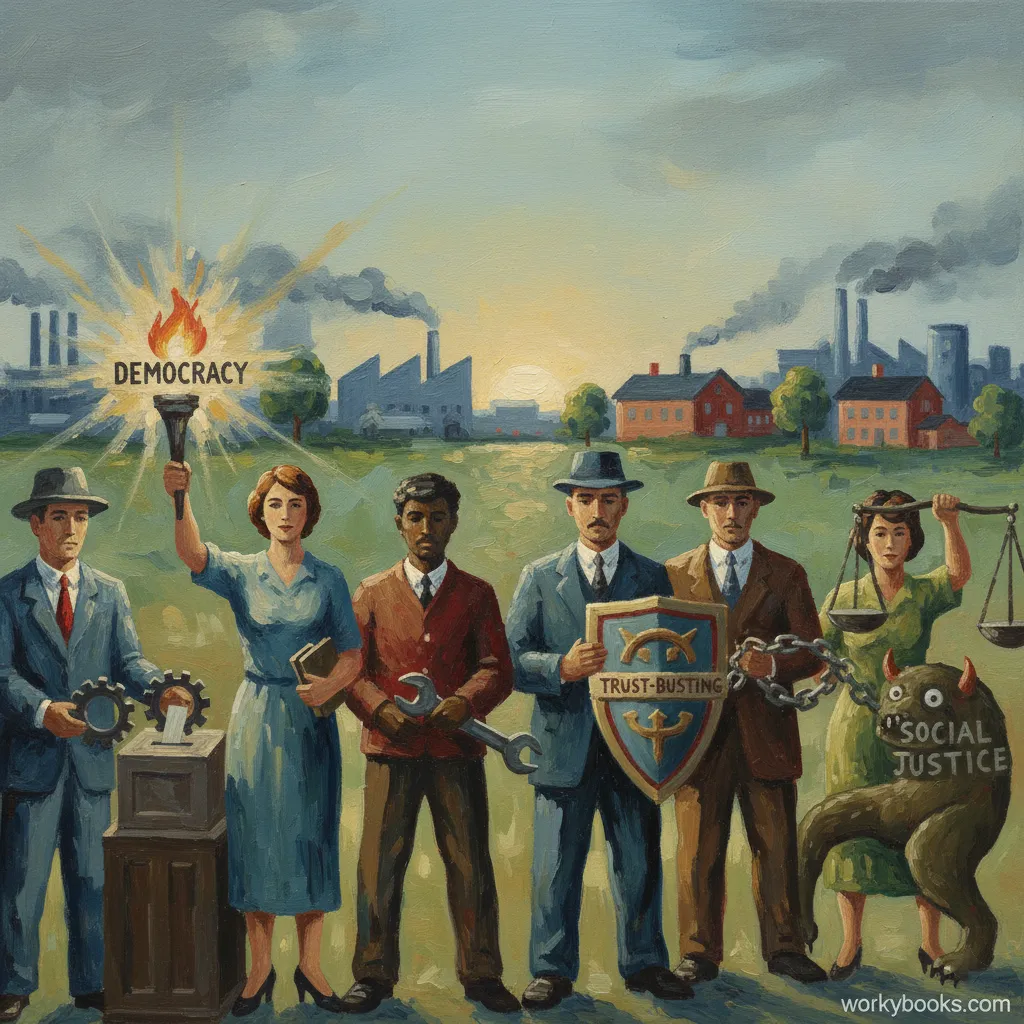
The Progressive Movement in the United States began in the late 1800s and continued into the early 1900s. During this period, rapid industrialization and urbanization led to significant social and economic changes. As factories and cities grew, many Americans faced new problems, including unsafe working conditions, political corruption, and unfair business practices. The main goal of the Progressive Movement was to address these problems and create a better society.
Progressive reformers believed that government should play a stronger role in regulating the economy and protecting people’s rights. They fought against monopolies, which are companies that control an entire industry and can set unfair prices. Reformers argued that monopolies hurt consumers and limited competition, so they supported laws to break up these powerful companies. Another key goal was to end corruption in politics. Progressive leaders pushed for reforms like secret ballots and direct election of senators to make government more accountable to citizens.
Social justice was also a central concern for Progressives. Many reformers worked to improve living conditions in crowded city neighborhoods. They supported the development of settlement houses, where immigrants and the poor could receive education, job training, and health care. Progressives advocated for child labor laws to protect young workers and pushed for better labor unions to help workers negotiate safer conditions and fair wages. They believed that society should take responsibility for the well-being of its most vulnerable members.
Women played a vital role in the Progressive Movement. Organizations led by women fought for suffrage, or the right to vote. After years of activism, the 19th Amendment was added to the Constitution in 1920, granting women the right to participate fully in American democracy. Women reformers also campaigned for laws to protect children and improve public health.
One of the most effective strategies Progressives used was investigative journalism, often called "muckraking." Muckrakers exposed problems such as unsafe food processing, dishonest politicians, and harsh factory conditions. Their reports led to new laws, including the Pure Food and Drug Act and the Meat Inspection Act, which aimed to protect consumers and ensure safer products.
Despite their successes, Progressives faced challenges. Not all groups benefited equally from reforms, and some changes were slow to reach African Americans, Native Americans, and other minorities. Debates over how much government should intervene in society continued. Nevertheless, the Progressive Era brought important changes that shaped modern America, including more democratic government, stronger protections for workers, and a greater focus on social justice.
Interesting Fact: The term "muckraker" was first used by President Theodore Roosevelt, who both criticized and praised journalists who uncovered wrongdoing during the Progressive Era.
Comprehension quiz (8 questions)
1. When did the Progressive Movement begin?
2. What did the 19th Amendment achieve?
3. Who were muckrakers?
4. Why did reformers oppose monopolies?
5. How did Progressives help workers?
6. Which group did not benefit equally?
7. The Progressive Movement ended in 1950. True or false?
8. What does 'suffrage' mean?
Common Core standards for Progressive Movement Goals and Reforms
Explain events, procedures, ideas, or concepts in a historical, scientific, or technical text, including what happened and why, based on specific information in the text.
Determine the meaning of general academic and domain-specific words or phrases in a text relevant to a grade 4 topic or subject area.
Write informative/explanatory texts to examine a topic and convey ideas and information clearly.
Perfect for the way you teach
- Build comprehension skills
- Auto-graded quiz
- Differentiated reading
- Read together at home
- Improve fluency
- Quiet reading time
- Reading curriculum support
- Independent practice
- Track Lexile growth