Rosie the Riveter: Women in Factories
Interactive passage with audio narration, comprehension questions, and printable PDF.
By completing this purchase you agree to our Terms of Use and Privacy Policy. Your subscription renews automatically until you cancel. You can cancel anytime from your account settings. All sales are final and non-refundable. Digital content is available for download in your account immediately upon purchase.
What's included
Rosie the Riveter: Women in Factories preview and details
About this printable Rosie the Riveter: Women in Factories reading passage (Grades 6-8)
Sample passage and quiz from Rosie the Riveter: Women in Factories
Reading passage and comprehension quiz preview
Rosie the Riveter
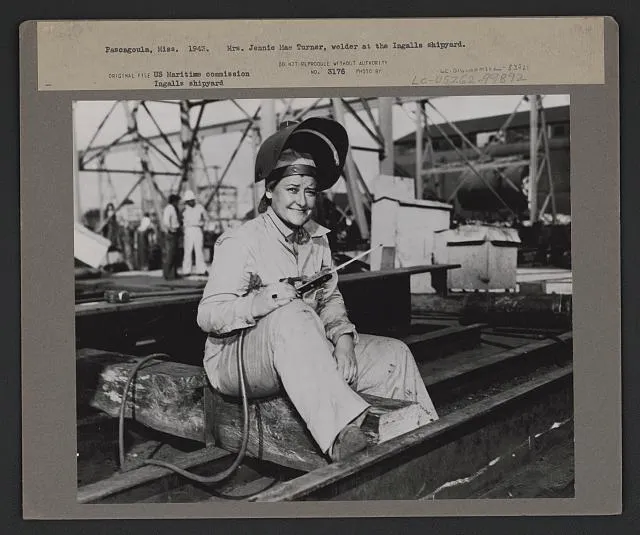
Source: Library of Congress - Library of Congress
During World War II, the United States faced a serious problem: millions of men left their jobs to fight overseas, leaving many manufacturing plants and factories without enough workers. To solve this, the government encouraged women to join the workforce in roles traditionally filled by men. One of the most powerful images of this movement was Rosie the Riveter, a symbol of women’s strength, skill, and determination. Rosie was not a real person, but her image inspired millions of women to step up and fill vital positions in the war effort.
Before the war, most American women worked at home or in jobs such as teaching, nursing, or domestic service. However, the demands of the war led to a dramatic shift. Women began working in shipyards, airplane factories, and ammunition plants. This shift not only changed the composition of the workforce but also challenged traditional gender roles. As they proved their ability to perform difficult and skilled tasks, women gained new respect and opportunities in American society.
The transition was not always easy. Many men doubted women’s abilities, and some employers paid women less than men for the same work. Despite these obstacles, women persevered. The government ran propaganda campaigns using posters and songs to encourage female participation. Training programs were established so women could learn to operate complex machines and understand safety procedures. Women proved themselves by building planes, tanks, and ships at incredible speeds and high quality.
The contribution of these women was critical to the Allied victory. Factories with female workers produced enormous quantities of supplies and equipment for soldiers overseas. Their hard work demonstrated that women were just as capable as men in industrial settings. By the end of the war, women made up nearly one-third of the total workforce in the United States, with over six million women holding factory jobs.
After the war ended, many women were expected to return to traditional roles at home. However, their experiences during the war sparked changes in attitudes about women’s rights and abilities. The legacy of Rosie the Riveter paved the way for future movements toward equality in the workplace and greater participation of women in all types of careers.
Interesting Fact: During World War II, over 310,000 women worked in the U.S. aircraft industry alone, making up 65% of its workforce at the time.
Comprehension quiz (8 questions)
1. What did Rosie the Riveter symbolize?
2. How did women's roles change during WWII?
3. What percentage of aircraft factory workers were women?
4. Why did the government encourage women to work?
5. What was a challenge women faced in factories?
6. How did women's work affect the war effort?
7. Women proved they could do skilled jobs. True or false?
8. What does 'workforce' mean?
Common Core standards for Rosie the Riveter: Women in Factories
Explain events, procedures, ideas, or concepts in a historical, scientific, or technical text, including what happened and why, based on specific information in the text.
Determine the meaning of general academic and domain-specific words or phrases in a text relevant to a grade 4 topic or subject area.
Write informative/explanatory texts to examine a topic and convey ideas and information clearly.
Perfect for the way you teach
- Build comprehension skills
- Auto-graded quiz
- Differentiated reading
- Read together at home
- Improve fluency
- Quiet reading time
- Reading curriculum support
- Independent practice
- Track Lexile growth