This learning resource is available in interactive and printable formats. The interactive worksheet can be played online and assigned to students. The Printable PDF version can be downloaded and printed for completion by hand.
This passage, aligned with NGSS standards MS-LS1-4 and MS-LS1-5, explores the complex and fascinating world of animal behavior as it relates to survival. Students will discover the differences between innate behaviors, such as reflexes, migration, and hibernation, and learned behaviors, including hunting techniques and tool use. The text explains how internal and external cues trigger behaviors and how natural selection shapes these responses over generations. Rich examples—such as bird migration, salmon spawning, and camouflage—help students connect scientific concepts to real-world situations. The passage integrates academic vocabulary, highlights cause-and-effect relationships, and encourages scientific thinking about adaptation and survival. Glossary, quizzes, writing prompts, graphic organizers, and Spanish translations are included for accessibility. Audio integration supports diverse learners. This resource is ideal for middle school classrooms and supports inquiry into how organisms adapt their behaviors for survival.
CONTENT PREVIEW
Expand content preview
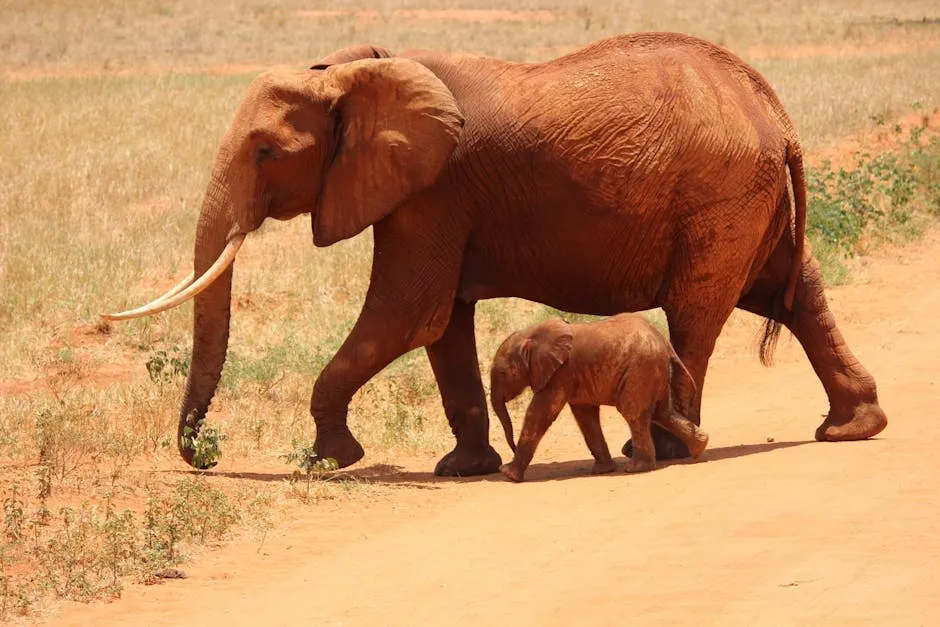
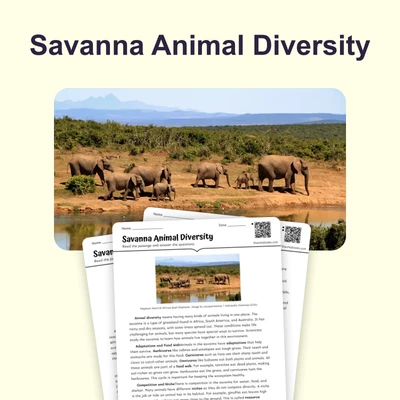
Adult African elephant and calf walking side by side in the sunny savanna. by Pixabay
Animal behavior is essential for survival in the natural world. Every day, animals must find food, avoid predators, and adapt to environmental changes. Some behaviors are present at birth, while others are learned through experience. Understanding how and why animals behave in certain ways reveals the complex systems that help them survive and thrive.
Innate vs. Learned Behaviors Many animals rely on innate behaviors, which are instincts present from birth. For example, salmon instinctively swim upstream to spawn, and birds migrate thousands of miles each year without being taught. These behaviors are triggered by cues such as changing daylight or temperature. In contrast, learned behaviors develop through experience. Young lions practice hunting by playing with siblings, and some birds learn to use tools to reach food. Learned behaviors are shaped by trial and error and can be passed from one generation to the next through observation.
Behaviors That Improve Survival Survival often depends on the ability to respond to both internal and external cues. Internal cues like hunger or hormone levels signal when it’s time to search for food or find shelter. External cues such as changes in seasons or daylight can trigger major behaviors like migration or hibernation. For example, bears enter hibernation to conserve energy during winter when food is scarce. Some animals, like chameleons, use camouflage to blend in with their environment, reducing the risk of being eaten. Behaviors like these increase an animal’s chances of survival and reproduction.
Natural Selection and Adaptation Over generations, behaviors that improve survival become more common in populations because of natural selection. For instance, if a certain migration route helps birds avoid predators, those birds are more likely to survive and produce offspring with the same instinct. Scientists observe these patterns by tracking animal movements and comparing behaviors within and between species. Quantitative data, such as the fact that about 90% of Arctic terns migrate from the Arctic to the Antarctic each year, help researchers understand the role of behavior in survival.
Animal behaviors are not just fascinating to observe; they are crucial for the survival of species. By studying these behaviors, scientists gain insights into how life adapts and evolves over time, connecting individual actions to the broader principles of biology and ecology.
Interesting Fact: Monarch butterflies migrate up to 3,000 miles each year, even though no single butterfly makes the round trip—each generation continues the journey!
What is an innate behavior?
A behavior present at birth that does not need to be learned.A behavior learned through experience.A behavior only seen in humans.A behavior that changes every year.
Which of the following is an example of a learned behavior?
Salmon swimming upstream to spawn.Birds migrating when seasons change.A lion cub learning to hunt by playing.Bears hibernating in winter.
According to the passage, what triggers hibernation in bears?
Migration routes.External cues like cold weather and less food.Learning from other bears.Daylight increasing in summer.
What is the main purpose of camouflage in animals?
To attract mates.To blend in and avoid predators.To find more food.To migrate farther.
What does the word 'internal cues' mean as used in the passage?
Signals from inside the animal’s body, like hunger.Signals from the environment.Behaviors learned from parents.Behaviors that animals do not use anymore.
In the context of the passage, what does 'natural selection' mean?
When animals choose their own food.The process where helpful traits become more common over generations.A type of animal migration.A learned behavior passed between generations.
Why do scientists collect quantitative data about animal behavior?
To compare animal behaviors and understand survival strategies.To teach animals new behaviors.To make animals migrate.To increase the number of predators.
If a bird species changes its migration route to avoid new predators, what is this an example of?
An innate behavior only.Natural selection allowing adaptation.A behavior with no effect on survival.An internal cue only.
True or False: All animal behaviors are learned.
TrueFalse
True or False: Monarch butterflies complete their migration in a single generation.
TrueFalse
Perfect For:
👩🏫 Teachers
• Reading comprehension practice
• Auto-graded assessments
• Literacy skill development
👨👩👧👦 Parents
• Reading practice at home
• Comprehension improvement
• Educational reading time
🏠 Homeschoolers
• Reading curriculum support
• Independent reading practice
• Progress monitoring
Reading Features:
📖
Reading Passage
Engaging fiction or nonfiction text
❓
Comprehension Quiz
Auto-graded questions
📊
Instant Feedback
Immediate results and scoring
📄
Printable Version
Download for offline reading
🔊
Read Aloud
Voice-over with word highlighting
Reviews & Ratings
No reviews yet. Be the first to share your experience!
Related Content
Venus Flytrap Facts
This passage explains where Venus flytraps live in North Carolina bogs, how their snap traps work, and their unique way ...
MS-LS1-4RI.6.3RI.7.3RI.8.8
Pitcher Plants: Reproduction Facts
This passage describes tropical and North American pitcher plants, their liquid-filled traps, and how they get nutrients...
MS-LS1-4RI.6.3RI.7.3RI.8.8
What Is the Floor of an Aquatic Biome Called?
This NGSS-aligned science reading passage explains the benthic zone, which is the floor of an aquatic biome such as ocea...
MS-LS1-4
Echidna Puggle
This interactive science reading passage, titled "Echidna Life: From Egg to Puggle," delves into the fascinating reprodu...
MS-LS1-4
Seed Dispersal
This middle school science passage examines the fascinating process of seed dispersal and the diverse strategies plants ...
MS-LS1-4
Cell Division: Mitosis
This comprehensive science passage for middle school students explores the key concept of mitosis, the division of the n...
MS-LS1-4
Desert Birds
This informational passage for grades 6-8 examines how desert birds survive and thrive in some of the harshest environme...
MS-LS2-1MS-LS2-2MS-LS1-4
Asexual vs Sexual Reproduction
This NGSS-aligned passage for grades 6-8 explores sexual and asexual reproduction, comparing their underlying mechanisms...
MS-LS1-4MS-LS3-2
Reproductive System
This passage provides a comprehensive overview of the human reproductive system for middle school students, aligning wit...
MS-LS1-3MS-LS1-4
Fertilization and Early Development
This passage explores the scientific process of fertilization and early human development, aligning with NGSS standards ...
MS-LS1-4MS-LS3-2
Cytokinesis and Cell Growth
This middle school science reading passage explores the essential biological process of cytokinesis, the division of a c...
MS-LS1-4
Plant Reproduction
This comprehensive passage for grades 6-8 explores the fascinating world of plant reproduction, aligning with NGSS stand...
MS-LS1-4MS-LS3-2
Mammal Migration
This comprehensive passage on mammal migration, designed for grades 6-8 and aligned with NGSS standards MS-LS2-2 and MS-...
MS-LS2-2MS-LS1-4
How Animals Navigate
This engaging science passage for grades 6-8 examines the fascinating world of navigation strategies. Aligned with NGSS ...
MS-LS1-4MS-ESS3-3MS-ETS1-1
Growth and Development of Organisms
This middle school science passage, aligned with NGSS standards MS-LS1-4 and MS-LS1-5, provides an in-depth look at the ...
MS-LS1-4MS-LS1-5
What Is a Tropical Savanna?
This NGSS-aligned science passage for grades 6-8 explores the rich animal diversity of the savanna ecosystem. Students w...
MS-LS2-1MS-LS2-2MS-LS2-4MS-LS1-4
The Cell Cycle
This middle school science reading passage introduces the cell cycle as the life of a cell from formation to division. A...
MS-LS1-4
Reproductive Success
This middle school science passage explores the essential concepts of reproductive success and adaptation in plants and ...
MS-LS1-4MS-LS4-4
The Fascinating Dumbo Octopus: Deep-Sea Wonder
Aligned to NGSS, this passage explores Dumbo octopus adaptations like ear-like fins for swimming at 3,000-13,000 ft dept...