The Intertropical Convergence Zone (ITCZ): Earth's Weather Belt — Reading Comprehension
Rate this
Present
Present in classroom. No work saved
Assign
Classroom with student accounts, Track progress
Quick Play
No student accounts, assign with a link
Grades
5
6
7
8
Standards
MS-ESS2-5
MS-ESS2-4
RI.6.7
PRINT+DIGITAL RESOURCE
This learning resource is available in interactive and printable formats. The interactive worksheet can be played online and assigned to students. The Printable PDF version can be downloaded and printed for completion by hand.
This science passage explains the Intertropical Convergence Zone (ITCZ), a key equatorial weather system. Covering NGSS MS-ESS2-5 (weather systems) and MS-ESS2-4 (water cycle), it details how converging trade winds create low-pressure conditions with heavy rainfall and thunderstorms. The text describes seasonal migration patterns, the doldrums phenomenon, and connections to monsoon systems. Examples include tropical rainforest climates and sailing challenges.
CONTENT PREVIEW
Expand content preview
The Intertropical Convergence Zone (ITCZ): Earth’s Weather Belt
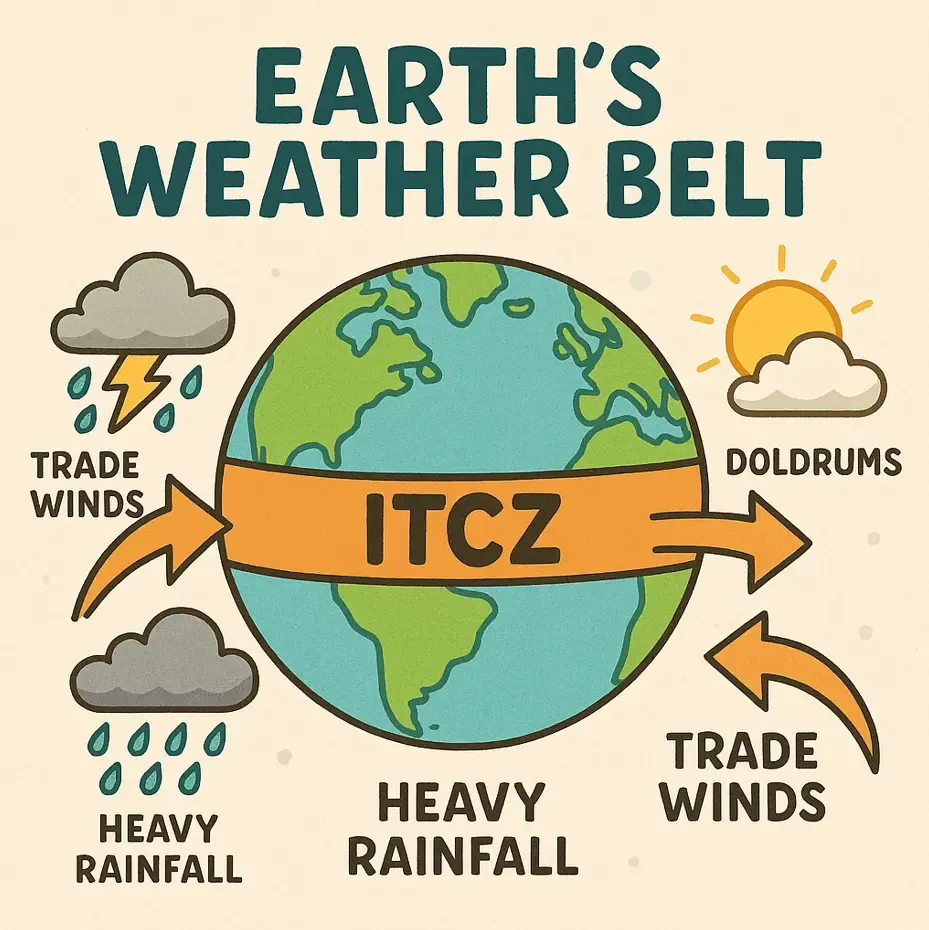
The Intertropical Convergence Zone (ITCZ) is a band of low pressure near the equator where trade winds from the Northern and Southern Hemispheres meet. This zone is known for its heavy rainfall, thunderstorms, and calm winds, making it a key driver of tropical weather patterns.
Characteristics of the ITCZ
Seasonal Movement – The ITCZ shifts north and south with the Sun’s position, following the thermal equator. It moves toward the warmer hemisphere during summer.
Heavy Rainfall – Warm, moist air rises in this zone, creating constant cloud formation and frequent downpours, supporting tropical rainforests.
Doldrums – Near the ITCZ, surface winds are often weak, a region sailors historically called the "doldrums" due to stalled sailing ships.
Thunderstorm Activity – The collision of trade winds triggers strong convection, leading to persistent thunderstorms.
Variable Width – The ITCZ can be narrow (over oceans) or broad (over continents like Africa and South America).
The ITCZ influences monsoon systems and tropical cyclones. Over land, its movement affects wet and dry seasons, while over oceans, it helps distribute heat globally. Farmers in tropical regions rely on its rains for agriculture, while meteorologists track it to predict extreme weather.
Understanding the ITCZ is crucial for climate studies, as shifts due to climate change can alter rainfall patterns, affecting ecosystems and human livelihoods.
Fun Fact: The Intertropical Convergence Zone (ITCZ) shifts its position so dramatically with the seasons that sailors for centuries nicknamed it "the doldrums" due to its calm winds that could strand sailing ships for weeks!
What is the ITCZ?
A high-pressure desert zoneA low-pressure belt near the equatorA polar wind currentA mid-latitude storm system
Why does the ITCZ cause heavy rainfall?
Cold air sinking rapidlyWarm, moist air rising and coolingConstant high-pressure systemsOcean currents evaporating saltwater
What are "doldrums" in the ITCZ?
Strong hurricanesWeak or calm windsFrozen ocean waterSandstorms
How does the ITCZ move seasonally?
Toward the cooler hemisphereToward the warmer hemisphereRandomly without patternOnly over oceans
Which weather feature is common in the ITCZ?
BlizzardsThunderstormsTornadoesDroughts
How does the ITCZ affect monsoons?
It blocks monsoon rainsIt shifts monsoon wind patternsIt has no effectIt creates permanent drought
Why is the ITCZ wider over continents?
Due to mountain rangesBecause of faster windsFrom intense heating and convectionOcean currents narrow it
How might climate change affect the ITCZ?
Stop all rainfall permanentlyShift its position and alter rain patternsTurn it into a high-pressure zoneFreeze the equatorial region
Perfect For:
👩🏫 Teachers
• Reading comprehension practice
• Auto-graded assessments
• Literacy skill development
👨👩👧👦 Parents
• Reading practice at home
• Comprehension improvement
• Educational reading time
🏠 Homeschoolers
• Reading curriculum support
• Independent reading practice
• Progress monitoring
Reading Features:
📖
Reading Passage
Engaging fiction or nonfiction text
❓
Comprehension Quiz
Auto-graded questions
📊
Instant Feedback
Immediate results and scoring
📄
Printable Version
Download for offline reading
🔊
Read Aloud
Voice-over with word highlighting
Reviews & Ratings
No reviews yet. Be the first to share your experience!
Related Content
Saving Snow Leopards
Snow leopards face many threats today. People are building roads and farms in their mountain homes. Some hunt them for f...
MS-ESS3.CRI.6.7RI.7.8RI.8.9
What Is a Polar Vortex?
This NGSS-aligned science passage explains the polar vortex, a swirling mass of cold air that stays near Earth’s poles. ...
MS-ESS2-5
What Is the Antarctic Polar Vortex?
This NGSS-aligned science reading passage introduces middle school students to the Antarctic polar vortex—a swirling mas...
MS-ESS2-5
How Does Sleet Form?
This NGSS-aligned science passage explains how sleet forms in the atmosphere. Sleet begins as snow high in the clouds, m...
MS-ESS2-5
What Causes the Temperature to Decrease with Height in the Troposphere?
This NGSS-aligned middle school science passage explains why temperature decreases with height in the troposphere. Stude...
MS-ESS2-5
What Type of Cloud Is Associated with Hail?
This NGSS-aligned science reading passage for middle school explains that cumulonimbus clouds are the main cloud type re...
MS-ESS2-4
Raining Frogs
This engaging science passage aligned to NGSS standard MS-ESS2-5 explores the unusual but real weather phenomenon known ...
MS-ESS2-5
Earth's Spheres
This middle school science passage introduces students to Earth's four major spheres: the geosphere, hydrosphere, atmosp...
MS-ESS2-4MS-ESS2-6
Hurricanes and Tropical Cyclones
This in-depth passage for grades 6-8 covers hurricanes and tropical cyclones, aligning with NGSS standards MS-ESS3-2 and...
MS-ESS3-2MS-ESS2-5
Tornadoes
This informational science passage for grades 6-8 explores the science of tornadoes, aligning with NGSS standards MS-ESS...
MS-ESS3-2MS-ESS2-5
Surface Water: Rivers, Lakes, and Wetlands
This engaging middle school science passage explores the dynamic world of surface water, focusing on the complex systems...
MS-ESS2-4
Groundwater
This middle school science passage explores the essential topic of groundwater, aligned to NGSS standards MS-ESS2-4 and ...
MS-ESS2-4MS-ESS3-1
Distribution of Water on Earth
This middle school science reading passage explores the distribution of water on Earth, aligned with NGSS standards MS-E...
MS-ESS2-4MS-ESS3-1
Weather Factors
This comprehensive passage introduces middle school students to the main variables that determine weather: temperature, ...
MS-ESS2-5
Water in Ecosystems
This engaging passage for grades 6-8 explores the essential role of water in ecosystems, tracing its movement through va...
MS-LS2-3MS-ESS2-4
Air Pressure
This middle school science passage explores the concept of air pressure, aligning with NGSS standard MS-ESS2-5. Students...
MS-ESS2-5
The Ozone Layer
This engaging NGSS-aligned passage explores the science and importance of the ozone layer for middle school students (gr...
MS-ESS2-4MS-ESS3-3
Wind
This comprehensive science passage introduces middle school students to the mechanisms of wind formation, focusing on ai...
MS-ESS2-5MS-ESS2-6
Clouds and Precipitation
This comprehensive science passage for grades 6-8 explores the mechanisms of cloud formation and the various forms of pr...