What Causes the Temperature to Decrease with Height in the Troposphere? — Reading Comprehension
Rate this
Present
Present in classroom. No work saved
Assign
Classroom with student accounts, Track progress
Quick Play
No student accounts, assign with a link
Grades
3
4
5
6
7
Standards
MS-ESS2-5
PRINT+DIGITAL RESOURCE
This learning resource is available in interactive and printable formats. The interactive worksheet can be played online and assigned to students. The Printable PDF version can be downloaded and printed for completion by hand.
This NGSS-aligned middle school science passage explains why temperature decreases with height in the troposphere. Students learn that the Earth’s surface is the main source of heat, and as altitude increases, the distance from this heat source grows. The passage introduces the concept of adiabatic cooling, where rising air expands and cools due to lower air pressure. It also explains the lapse rate and how these processes lead to colder temperatures at higher elevations. Real-world examples like mountaintop temperatures and airplane altitudes support student understanding. This passage supports NGSS Earth and Atmospheric Science standards and builds key science vocabulary.
CONTENT PREVIEW
Expand content preview
The troposphere is the lowest layer of Earth's atmosphere, where all weather happens. It extends from the ground up to about 6 to 12 miles (10 to 20 kilometers), depending on your location. One of the most important features of the troposphere is that the temperature decreases with height. But why does this happen?
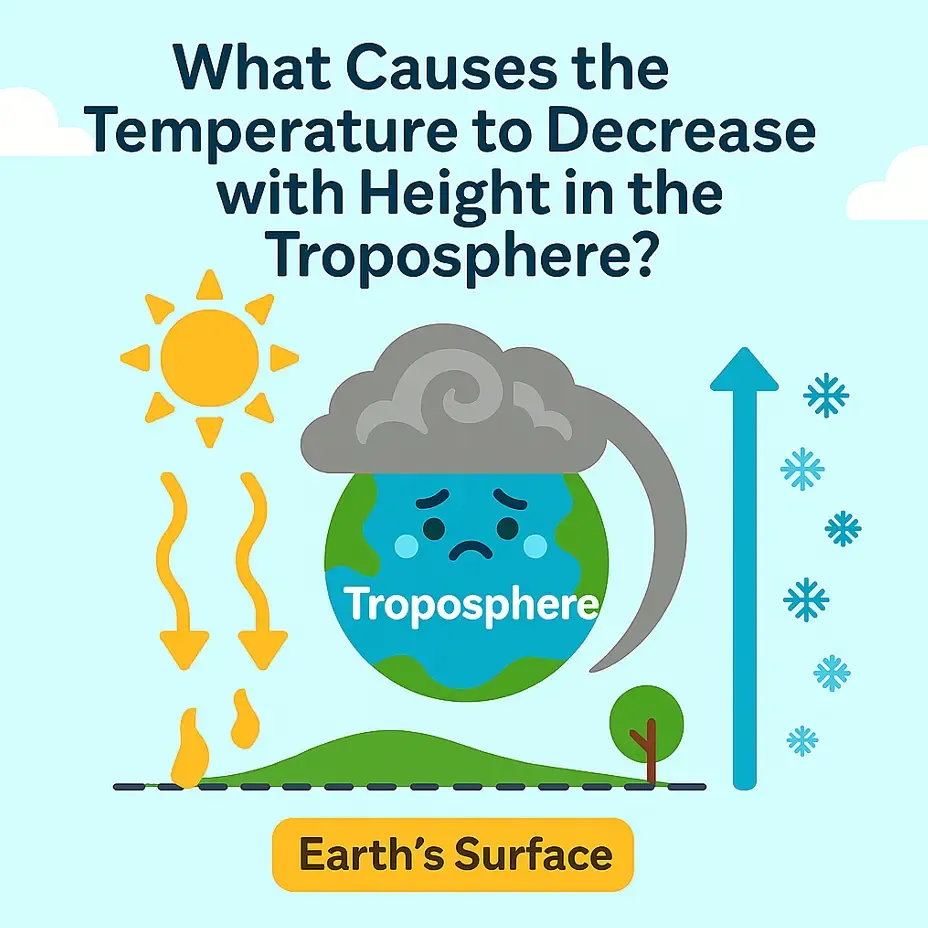
The key reason is that the Earth’s surface is the main source of heat in the troposphere. The Sun warms the ground, and then the ground warms the air just above it. As you go higher up in the troposphere, you move farther from that heat source. This means the air becomes cooler the higher you go.
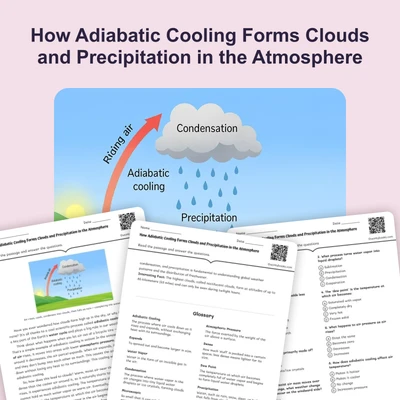
Another reason is air pressure. As you rise in the atmosphere, air pressure decreases. With lower pressure, rising air expands, and as it expands, it cools. This process is called adiabatic cooling. That’s why mountain tops are often much colder than valleys, even though they are the same distance from the Sun.
This decrease in temperature with altitude is known as the lapse rate. On average, the temperature drops about 6.5°C for every kilometer you go up in the troposphere.
Fun Fact: Even though airplanes fly high in the sky, they need heated cabins because outside temperatures at cruising altitudes can drop to –50°C (–58°F)!
What is the troposphere?
A layer of ocean waterThe highest part of the atmosphereThe lowest layer of the atmosphere where weather occursA part of the Earth’s core
What happens to temperature as you go higher in the troposphere?
It stays the sameIt increasesIt decreasesIt becomes hotter at night
Why does the air near Earth’s surface get warmer?
It is warmed by the cloudsThe ground absorbs sunlight and warms the airThe wind cools the surfaceRain makes the air warm
What happens to air pressure as altitude increases?
It increasesIt stays the sameIt decreasesIt freezes
What happens to rising air in the troposphere?
It condenses and heats upIt expands and coolsIt sinks and warmsIt stays at the same temperature
What is the name for the rate at which temperature drops with height?
Wind speedCloud baseLapse rateJet stream
What is the main idea of the passage?
The Sun directly heats the air at high altitudesTemperature increases with height in the troposphereTemperature decreases with height in the troposphere due to surface heating and expanding airAll parts of the atmosphere have the same temperature
Why are mountaintops colder than valleys?
Mountains are closer to spaceThe air is thicker up highThe air expands and cools as it risesSunlight skips over mountains
Perfect For:
👩🏫 Teachers
• Reading comprehension practice
• Auto-graded assessments
• Literacy skill development
👨👩👧👦 Parents
• Reading practice at home
• Comprehension improvement
• Educational reading time
🏠 Homeschoolers
• Reading curriculum support
• Independent reading practice
• Progress monitoring
Reading Features:
📖
Reading Passage
Engaging fiction or nonfiction text
❓
Comprehension Quiz
Auto-graded questions
📊
Instant Feedback
Immediate results and scoring
📄
Printable Version
Download for offline reading
🔊
Read Aloud
Voice-over with word highlighting
Reviews & Ratings
No reviews yet. Be the first to share your experience!
Related Content
The Intertropical Convergence Zone (ITCZ): Earth's Weather Belt
This science passage explains the Intertropical Convergence Zone (ITCZ), a key equatorial weather system. Covering NGSS ...
MS-ESS2-5MS-ESS2-4RI.6.7
What Is a Polar Vortex?
This NGSS-aligned science passage explains the polar vortex, a swirling mass of cold air that stays near Earth’s poles. ...
MS-ESS2-5
What Is the Antarctic Polar Vortex?
This NGSS-aligned science reading passage introduces middle school students to the Antarctic polar vortex—a swirling mas...
MS-ESS2-5
How Does Sleet Form?
This NGSS-aligned science passage explains how sleet forms in the atmosphere. Sleet begins as snow high in the clouds, m...
MS-ESS2-5
Raining Frogs
This engaging science passage aligned to NGSS standard MS-ESS2-5 explores the unusual but real weather phenomenon known ...
MS-ESS2-5
Hurricanes and Tropical Cyclones
This in-depth passage for grades 6-8 covers hurricanes and tropical cyclones, aligning with NGSS standards MS-ESS3-2 and...
MS-ESS3-2MS-ESS2-5
Tornadoes
This informational science passage for grades 6-8 explores the science of tornadoes, aligning with NGSS standards MS-ESS...
MS-ESS3-2MS-ESS2-5
Weather Factors
This comprehensive passage introduces middle school students to the main variables that determine weather: temperature, ...
MS-ESS2-5
Air Pressure
This middle school science passage explores the concept of air pressure, aligning with NGSS standard MS-ESS2-5. Students...
MS-ESS2-5
Wind
This comprehensive science passage introduces middle school students to the mechanisms of wind formation, focusing on ai...
MS-ESS2-5MS-ESS2-6
Clouds and Precipitation
This comprehensive science passage for grades 6-8 explores the mechanisms of cloud formation and the various forms of pr...
MS-ESS2-5
Air Masses
This passage provides a comprehensive explanation of air masses, their formation, classification, and their critical rol...
MS-ESS2-5
Weather Maps and Forecasting
This comprehensive middle school science passage explores how weather maps and forecasting work, directly aligning with ...
MS-ESS2-5MS-ESS3-2
Weather Fronts
This passage for grades 6-8 explores the science of weather fronts, aligned to NGSS standard MS-ESS2-5. Students will le...