This learning resource is available in interactive and printable formats. The interactive worksheet can be played online and assigned to students. The Printable PDF version can be downloaded and printed for completion by hand.
This NGSS-aligned science passage explains the polar vortex, a swirling mass of cold air that stays near Earth’s poles. Students learn how it strengthens in winter and is held in place by the jet stream. When the jet stream weakens, part of the cold vortex can shift south, causing extreme cold snaps and snow in places far from the poles. The passage also covers how scientists use satellites and weather balloons to study this pattern. With clear vocabulary and real-world examples, this passage supports reading comprehension and Earth and Space Science standards about weather, climate, and atmospheric systems.
CONTENT PREVIEW
Expand content preview
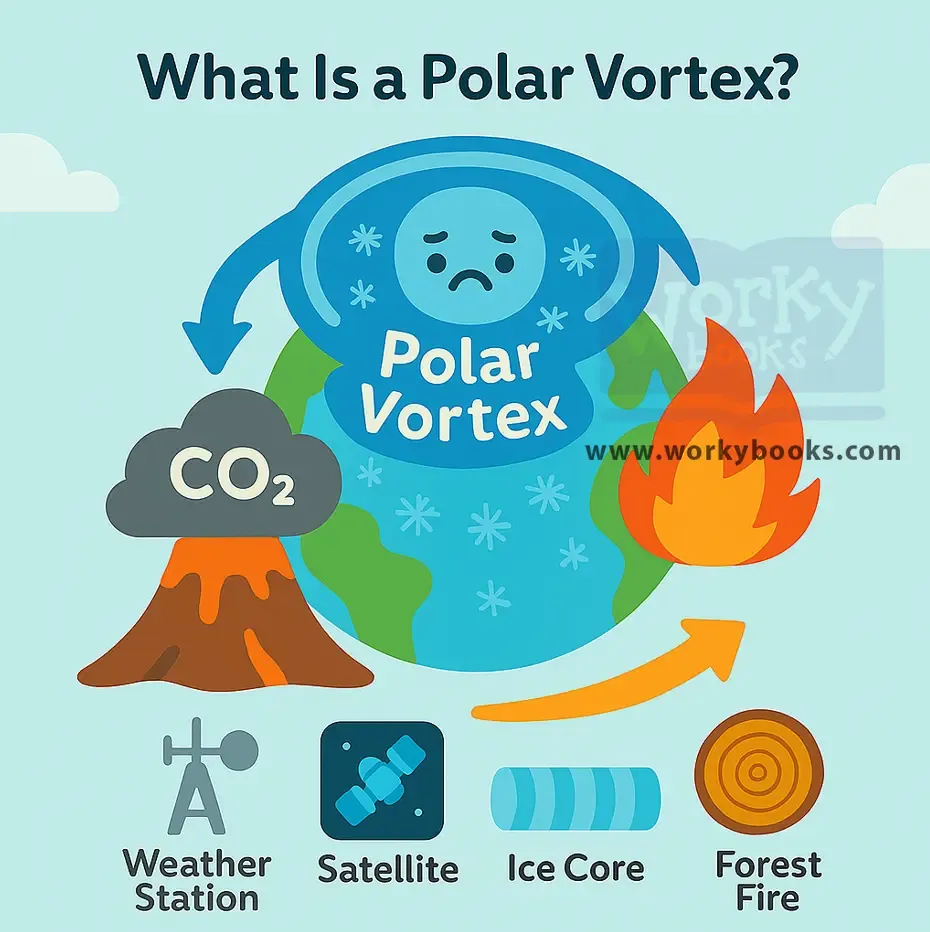
A polar vortex is a large area of swirling cold air that sits over the Earth’s poles—the North Pole and the South Pole. This air is always present, but it becomes stronger in the winter months. The term “vortex” means a spinning motion, like a whirlpool, and in this case, it refers to a spinning mass of cold air high in the stratosphere.
Normally, the polar vortex stays near the poles and is held in place by strong winds called the jet stream. But sometimes, the jet stream weakens or becomes wavy, allowing part of the cold air to break off and move south. When this happens, areas like the United States, Europe, or Asia can experience extremely cold weather.
A polar vortex is not a storm or a snowstorm itself, but it can lead to dangerous cold snaps, snow, and icy conditions. These changes can affect travel, cause school closures, and even lead to power outages.
Scientists monitor the polar vortex using weather balloons and satellites. Understanding it helps meteorologists predict extreme winter weather and prepare people for sudden temperature drops.
Fun Fact: In 2019, a split in the polar vortex brought temperatures as low as –50°F (–45°C) to parts of the U.S.!
What is a polar vortex?
A snowstorm near the polesA spinning mass of cold air over the polesA fast-moving ocean currentA thunderstorm in the Arctic
Where does the polar vortex usually stay?
Near the equatorIn the middle of continentsClose to the polesOver the oceans
The polar vortex disappearsWarm air moves to the polesCold air moves south, causing freezing weatherVolcanoes erupt
When is the polar vortex the strongest?
During summerDuring springDuring fallDuring winter
What tools do scientists use to study the polar vortex?
Maps and magnetsWeather balloons and satellitesShips and submarinesCompasses and thermometers
What is the main idea of the passage?
The North Pole is meltingPolar vortexes are the cause of all snowA polar vortex is a swirling cold air mass that can bring extreme winter weatherAll cold air comes from space
What kind of weather can a polar vortex cause?
Hot and sunny daysEarthquakesCold snaps and snowstormsRainy seasons
Perfect For:
👩🏫 Teachers
• Reading comprehension practice
• Auto-graded assessments
• Literacy skill development
👨👩👧👦 Parents
• Reading practice at home
• Comprehension improvement
• Educational reading time
🏠 Homeschoolers
• Reading curriculum support
• Independent reading practice
• Progress monitoring
Reading Features:
📖
Reading Passage
Engaging fiction or nonfiction text
❓
Comprehension Quiz
Auto-graded questions
📊
Instant Feedback
Immediate results and scoring
📄
Printable Version
Download for offline reading
🔊
Read Aloud
Voice-over with word highlighting
Reviews & Ratings
No reviews yet. Be the first to share your experience!
Related Content
The Intertropical Convergence Zone (ITCZ): Earth's Weather Belt
This science passage explains the Intertropical Convergence Zone (ITCZ), a key equatorial weather system. Covering NGSS ...
MS-ESS2-5MS-ESS2-4RI.6.7
What Is the Antarctic Polar Vortex?
This NGSS-aligned science reading passage introduces middle school students to the Antarctic polar vortex—a swirling mas...
MS-ESS2-5
How Does Sleet Form?
This NGSS-aligned science passage explains how sleet forms in the atmosphere. Sleet begins as snow high in the clouds, m...
MS-ESS2-5
What Causes the Temperature to Decrease with Height in the Troposphere?
This NGSS-aligned middle school science passage explains why temperature decreases with height in the troposphere. Stude...
MS-ESS2-5
Raining Frogs
This engaging science passage aligned to NGSS standard MS-ESS2-5 explores the unusual but real weather phenomenon known ...
MS-ESS2-5
Hurricanes and Tropical Cyclones
This in-depth passage for grades 6-8 covers hurricanes and tropical cyclones, aligning with NGSS standards MS-ESS3-2 and...
MS-ESS3-2MS-ESS2-5
Tornadoes
This informational science passage for grades 6-8 explores the science of tornadoes, aligning with NGSS standards MS-ESS...
MS-ESS3-2MS-ESS2-5
Weather Factors
This comprehensive passage introduces middle school students to the main variables that determine weather: temperature, ...
MS-ESS2-5
Air Pressure
This middle school science passage explores the concept of air pressure, aligning with NGSS standard MS-ESS2-5. Students...
MS-ESS2-5
Wind
This comprehensive science passage introduces middle school students to the mechanisms of wind formation, focusing on ai...
MS-ESS2-5MS-ESS2-6
Clouds and Precipitation
This comprehensive science passage for grades 6-8 explores the mechanisms of cloud formation and the various forms of pr...
MS-ESS2-5
Air Masses
This passage provides a comprehensive explanation of air masses, their formation, classification, and their critical rol...
MS-ESS2-5
Weather Maps and Forecasting
This comprehensive middle school science passage explores how weather maps and forecasting work, directly aligning with ...
MS-ESS2-5MS-ESS3-2
Weather Fronts
This passage for grades 6-8 explores the science of weather fronts, aligned to NGSS standard MS-ESS2-5. Students will le...