Theodore Roosevelt Square Deal: Progressive Policies
Interactive passage with audio narration, comprehension questions, and printable PDF.
By completing this purchase you agree to our Terms of Use and Privacy Policy. Your subscription renews automatically until you cancel. You can cancel anytime from your account settings. All sales are final and non-refundable. Digital content is available for download in your account immediately upon purchase.
What's included
Theodore Roosevelt Square Deal: Progressive Policies preview and details
About this printable Theodore Roosevelt Square Deal: Progressive Policies reading passage (Grades 6-8)
Sample passage and quiz from Theodore Roosevelt Square Deal: Progressive Policies
Reading passage and comprehension quiz preview
Theodore Roosevelt's Square Deal
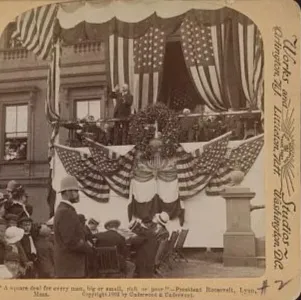
""A square deal for every man, big or small, rich or poor" - President Roosevelt, Lynn, Mass." by Underwood & Underwood / Library of Congress.
Theodore Roosevelt became President of the United States in 1901 after the assassination of William McKinley. He inherited a nation facing rapid industrial growth, which brought both progress and serious problems. Factories were expanding, cities were growing, and the economy was booming. However, this period of change also led to inequality, dangerous working conditions, and environmental destruction. Roosevelt recognized these issues and believed the government should play a role in ensuring fairness for all Americans.
To address these challenges, Roosevelt introduced his program called the Square Deal. The Square Deal focused on three main ideas: controlling corporations, protecting consumers, and conserving natural resources. Roosevelt argued that everyone—business owners, workers, and the public—deserved a "square deal," or fair treatment. He used his presidential power to take on powerful companies called trusts, which often limited competition and hurt consumers. Roosevelt became known as a "trustbuster" because he used the law to break up large corporations that acted unfairly.
One famous example of Roosevelt’s intervention was the 1902 coal strike. Thousands of coal miners went on strike for better pay and safer conditions. Instead of siding with business owners, Roosevelt invited both sides to the White House to negotiate. This was the first time a president acted as a mediator between labor and management, showing Roosevelt’s commitment to fairness and setting a new standard for government involvement.
Another major part of the Square Deal was conservation. Roosevelt was alarmed by the rapid loss of forests and wildlife due to industrial expansion. He worked to set aside millions of acres of land as national parks and forests, and created agencies like the U.S. Forest Service. These actions were designed to protect natural resources for future generations, not just for immediate economic gain.
The Square Deal also led to important laws for consumer protection. The Pure Food and Drug Act and the Meat Inspection Act were passed to ensure that food and medicines were safe for Americans. These laws gave the federal government more regulatory power to inspect businesses and enforce standards.
Roosevelt’s reforms were not without controversy. Some business leaders argued that government intervention would hurt the economy. Others believed Roosevelt did not do enough to help workers or address racial inequality. Despite these conflicts, the Square Deal marked a turning point by expanding the government’s responsibility to protect public interests. Roosevelt’s actions inspired future reformers and shaped the Progressive Era—a time when Americans demanded greater justice and accountability from their leaders.
Interesting Fact: Roosevelt was the first president to win a Nobel Peace Prize. He received it in 1906 for helping end the Russo-Japanese War—showing his belief in negotiation and fairness, both at home and abroad.
Comprehension quiz (8 questions)
1. When did Roosevelt become President?
2. What was the Square Deal?
3. Who did Roosevelt mediate for in 1902?
4. Why did Roosevelt break up trusts?
5. How did the Square Deal help nature?
6. What was one effect of Roosevelt's reforms?
7. Roosevelt won a Nobel Peace Prize. True or false?
8. What does conservation mean?
Common Core standards for Theodore Roosevelt Square Deal: Progressive Policies
Explain events, procedures, ideas, or concepts in a historical, scientific, or technical text, including what happened and why, based on specific information in the text.
Determine the meaning of general academic and domain-specific words or phrases in a text relevant to a grade 4 topic or subject area.
Write informative/explanatory texts to examine a topic and convey ideas and information clearly.
Perfect for the way you teach
- Build comprehension skills
- Auto-graded quiz
- Differentiated reading
- Read together at home
- Improve fluency
- Quiet reading time
- Reading curriculum support
- Independent practice
- Track Lexile growth