Tracing Energy Back to the Sun
Interactive passage with audio narration, comprehension questions, and printable PDF.
By completing this purchase you agree to our Terms of Use and Privacy Policy. Your subscription renews automatically until you cancel. You can cancel anytime from your account settings. All sales are final and non-refundable. Digital content is available for download in your account immediately upon purchase.
What's included
Tracing Energy Back to the Sun preview and details
About this printable Tracing Energy Back to the Sun science reading passage, NGSS-aligned (Grades 4-6)
Sample passage and quiz from Tracing Energy Back to the Sun
Reading passage and comprehension quiz preview
Tracing Energy Back to the Sun
Energy is the ability to do work or cause change. All living things need energy to grow, move, and survive. Every bite of food you eat contains energy, but where does that energy come from? If you trace it back far enough, all food energy comes from the sun.
Plants are the starting point for almost all food energy on Earth. Through a process called photosynthesis, plants capture light energy from the sun and use it to make food. Photosynthesis means "putting together with light." During this process, plants use sunlight, water, and carbon dioxide from the air to create sugars. These sugars store the sun's energy in a form that living things can use. The green parts of plants, especially the leaves, contain a substance called chlorophyll that captures sunlight and makes photosynthesis possible.
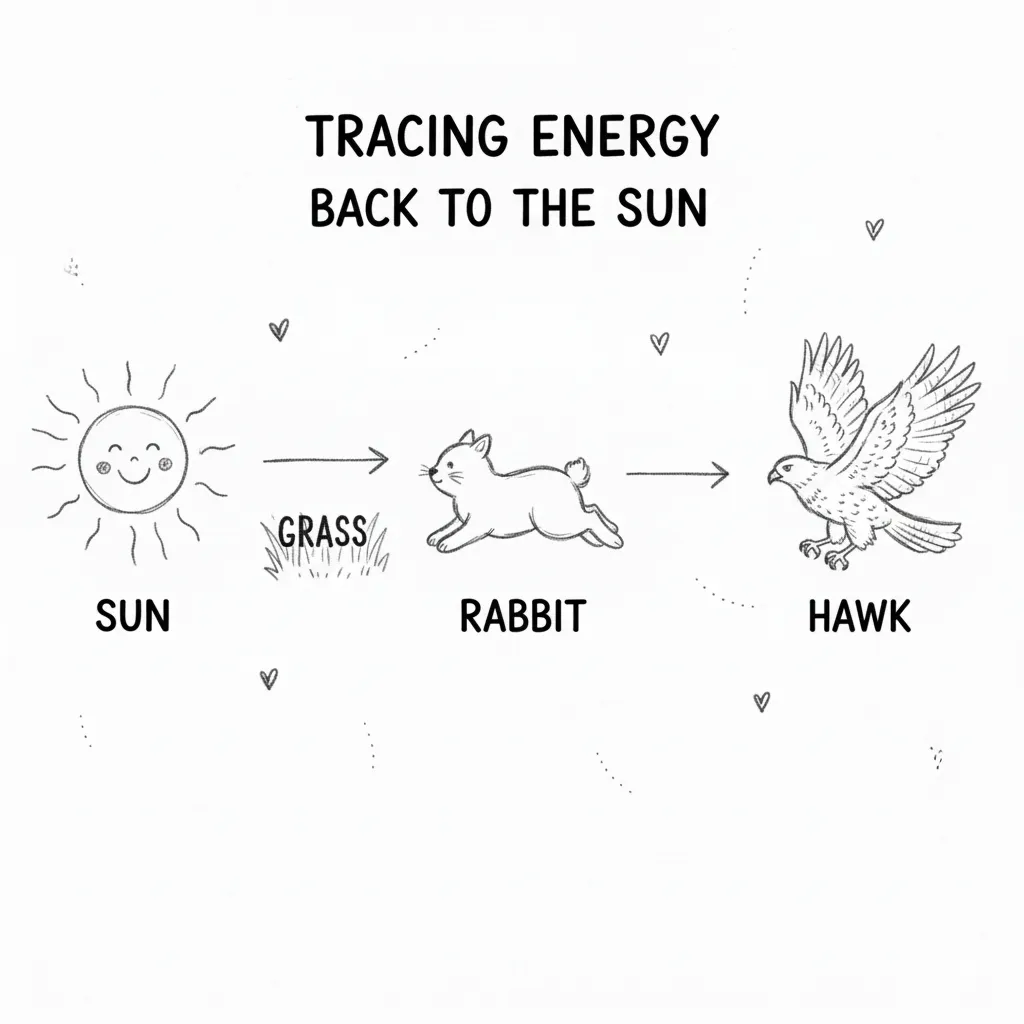
When an animal eats a plant, energy transfer occurs. Energy transfer means energy moves from one thing to another. For example, when a rabbit eats grass, the energy stored in the grass moves into the rabbit's body. The rabbit uses this energy to hop, breathe, and stay warm. Some of the energy helps the rabbit grow bigger and stronger.
The energy chain continues when another animal eats the plant-eater. If a hawk catches and eats the rabbit, energy transfers again. The energy that was in the grass moved to the rabbit, and now it moves to the hawk. At each step, we can trace the energy backward: the hawk got energy from the rabbit, the rabbit got energy from the grass, and the grass got energy from the sun.
This pattern creates what scientists call a food chain. A food chain shows how energy moves from one living thing to another. Every food chain starts with the sun. Even when you eat a hamburger, you can trace that energy back to the sun. The cow ate grass or grain, and those plants captured sunlight. Without the sun's energy, there would be no plants, and without plants, there would be no food for animals or people.
Scientists use arrows to show energy flow in food chains. The arrows point from the energy source to the organism that receives the energy. For example: Sun → Grass → Rabbit → Hawk. The arrows show that energy flows from the sun to grass, from grass to rabbit, and from rabbit to hawk.
Interesting Fact: The sun provides more energy to Earth in one hour than all the people on the planet use in an entire year! Plants capture only about 1% of the sun's energy that reaches Earth, but that's still enough to power almost all life on our planet.
Comprehension quiz (8 questions)
1. What do plants use to make food?
2. What does photosynthesis mean?
3. Where does all food energy start?
4. Why do animals eat plants?
5. What happens in energy transfer?
6. How do scientists show energy flow?
7. All food chains begin with the sun.
8. What is chlorophyll?
Perfect for the way you teach
- Build comprehension skills
- Auto-graded quiz
- Differentiated reading
- Read together at home
- Improve fluency
- Quiet reading time
- Reading curriculum support
- Independent practice
- Track Lexile growth