War Bonds: Financing World War II
Interactive passage with audio narration, comprehension questions, and printable PDF.
By completing this purchase you agree to our Terms of Use and Privacy Policy. Your subscription renews automatically until you cancel. You can cancel anytime from your account settings. All sales are final and non-refundable. Digital content is available for download in your account immediately upon purchase.
What's included
War Bonds: Financing World War II preview and details
About this printable War Bonds: Financing World War II reading passage (Grades 6-8)
Sample passage and quiz from War Bonds: Financing World War II
Reading passage and comprehension quiz preview
War Bonds
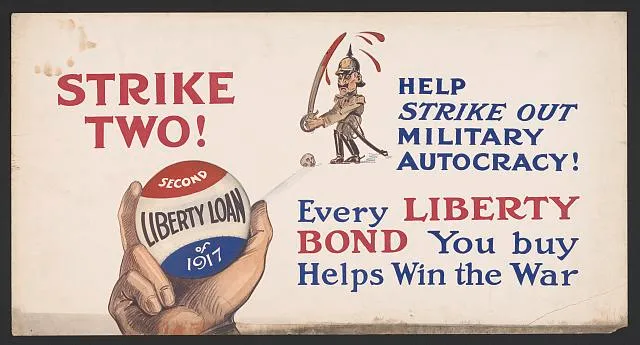
"Strike two! Help strike out military autocracy! Every Liberty Bond you buy helps win the war." / Library of Congress.
During World War II, the United States government faced the enormous challenge of paying for an expensive global conflict. The cost of purchasing weapons, building ships, feeding soldiers, and supporting allies was far more than what taxes alone could provide. To solve this problem, the government turned to the American public for help by selling bonds, which are certificates people buy as a type of investment. The money raised from these bonds was used to fund the war effort, and in return, buyers were promised their money back with interest after a set number of years.
To encourage people to buy bonds, the government organized nationwide campaigns known as bond drives. Famous movie stars, athletes, and politicians appeared at rallies, on radio shows, and in posters. Their message was clear: buying bonds was not just smart financing—it was an act of patriotism. Citizens from all walks of life, including children, bought bonds to show their support for the troops. Even schools and community clubs joined together to purchase bonds, making the campaign a true national effort.
The bond drives were successful because they appealed to both emotions and logic. Posters and speeches explained that every bond bought meant more tanks, planes, and supplies for soldiers overseas. At the same time, the government explained that bonds were a safe way to save money for the future. After ten years, a $25 war bond would be worth $37.50, making it a wise financial decision as well as a way to help win the war.
However, not everyone was able to buy bonds easily. Some Americans faced economic hardships left over from the Great Depression. For these families, buying a bond could mean giving up money needed for daily needs. To address this, the government allowed people to buy stamps for as little as ten cents, which they could collect until they had enough for a full bond. This innovative approach made participation possible for nearly everyone, regardless of income.
Historians agree that the war bond program did more than raise money. It united the nation and gave people a sense of agency during a time of uncertainty. The act of buying a bond became a symbol of unity and shared purpose. It demonstrated how ordinary citizens could have a direct impact on the outcome of a global event.
Although war bonds did not pay for the entire cost of World War II, they provided billions of dollars that helped the United States maintain its military operations. More importantly, the program showed how financial tools and public support can work together to solve enormous challenges. The legacy of war bonds continued to influence American finance and society for decades after the war ended.
Interesting Fact: More than 85 million Americans purchased war bonds during World War II, making it one of the largest public participation campaigns in U.S. history.
Comprehension quiz (8 questions)
1. What are war bonds?
2. Who was asked to buy bonds?
3. What made bonds appealing?
4. Why did some people buy stamps instead?
5. What is patriotism?
6. How did bond drives unite Americans?
7. War bonds were only for the wealthy. True or false?
8. What does the word 'investment' mean?
Common Core standards for War Bonds: Financing World War II
Explain events, procedures, ideas, or concepts in a historical, scientific, or technical text, including what happened and why, based on specific information in the text.
Determine the meaning of general academic and domain-specific words or phrases in a text relevant to a grade 4 topic or subject area.
Write informative/explanatory texts to examine a topic and convey ideas and information clearly.
Perfect for the way you teach
- Build comprehension skills
- Auto-graded quiz
- Differentiated reading
- Read together at home
- Improve fluency
- Quiet reading time
- Reading curriculum support
- Independent practice
- Track Lexile growth