This learning resource is available in interactive and printable formats. The interactive worksheet can be played online and assigned to students. The Printable PDF version can be downloaded and printed for completion by hand.
This comprehensive Grade 4 physical science reading passage introduces students to the fundamental parts of a wave, aligned with NGSS standard 4-PS4-1. Students explore the crest (highest point), trough (lowest point), amplitude (wave height), and wavelength (distance between crests) through clear explanations and relatable examples. The passage uses age-appropriate language and includes audio integration to support diverse learners. Activities include multiple-choice comprehension questions, writing prompts, and graphic organizers that help students practice identifying and describing wave features. This foundational knowledge prepares students for deeper investigations into wave behavior, energy transfer, and the properties of sound and light. Perfect for elementary science classrooms, the passage builds vocabulary and conceptual understanding essential for NGSS Disciplinary Core Idea PS4.A: Wave Properties.
CONTENT PREVIEW
Expand content preview
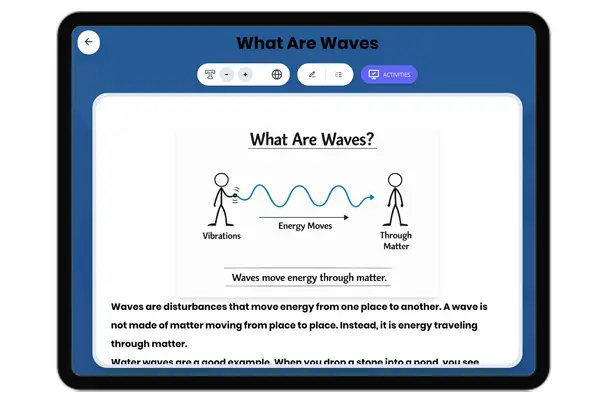
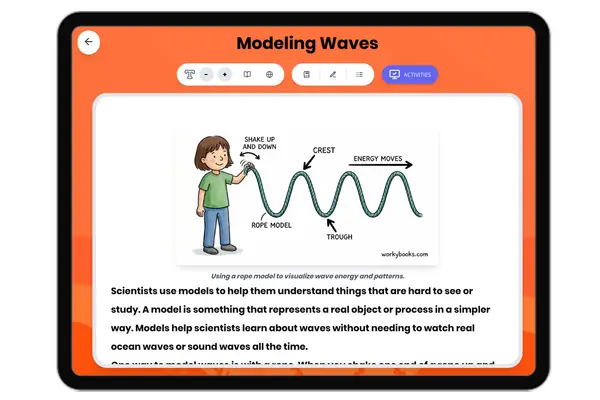
A wave is a pattern of motion that carries energy from one place to another. Waves move through water, air, and many other materials. Understanding the parts of a wave helps scientists describe how waves behave and how they transfer energy.
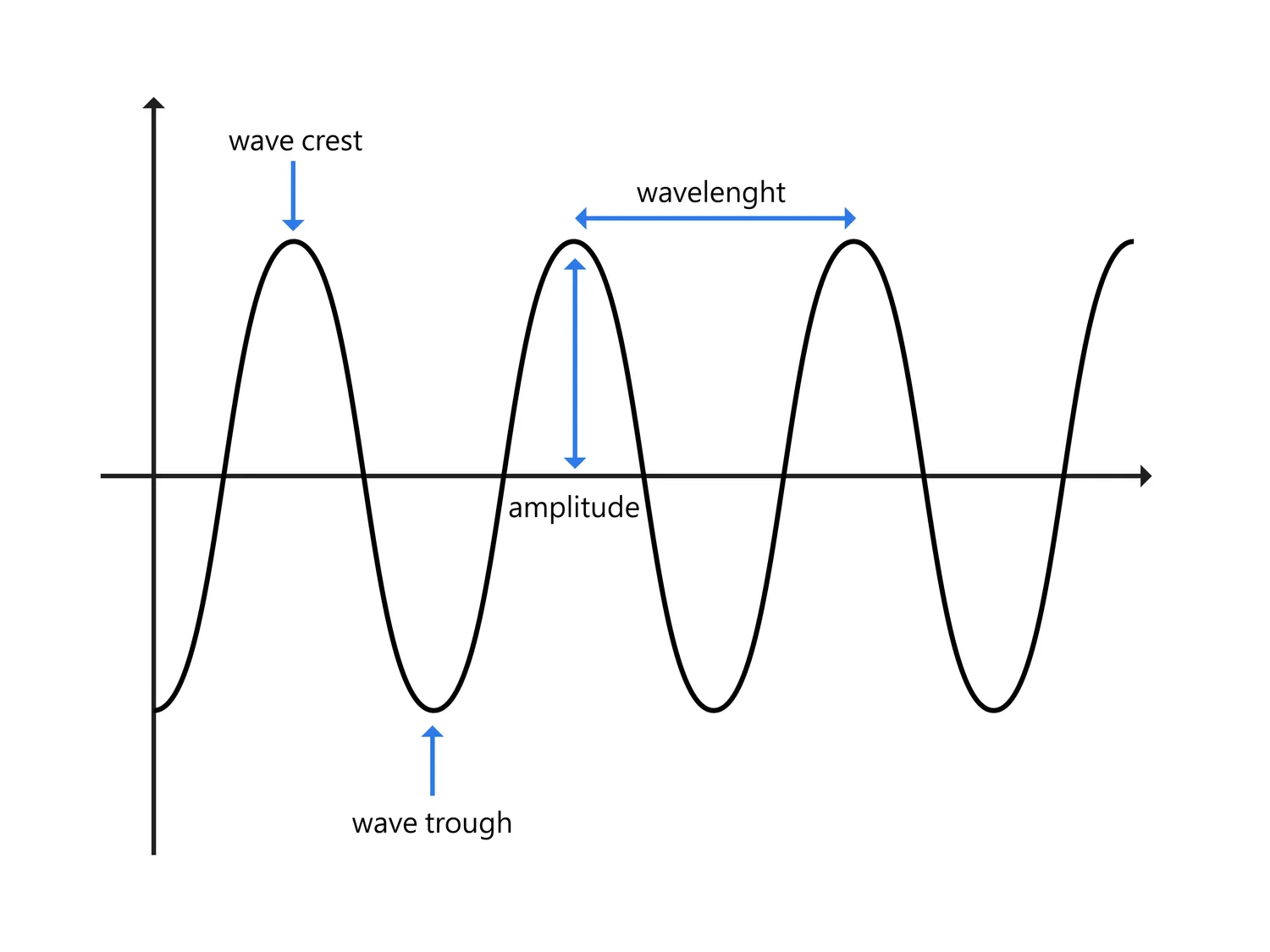
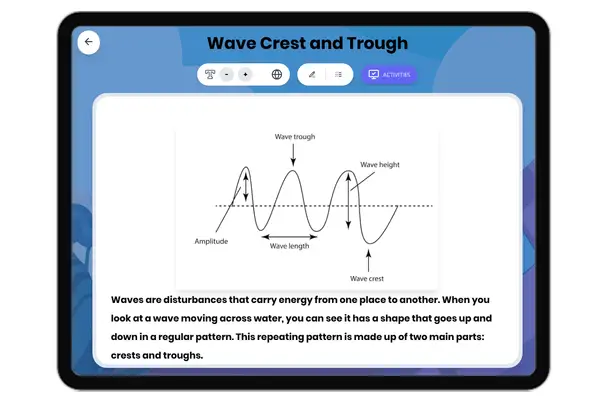
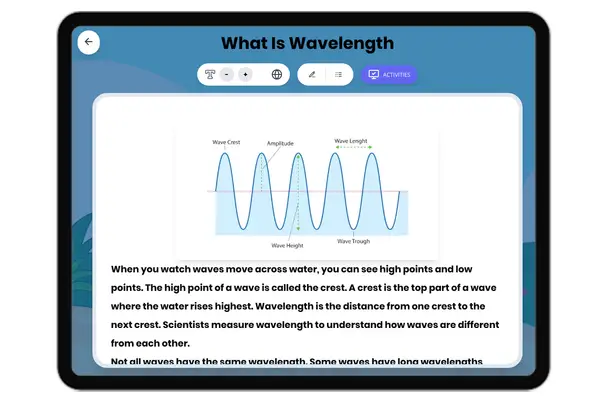
Every wave has specific parts that we can identify and measure. The crest is the highest point of a wave. If you watch ocean waves, the crest is the top of the wave before it crashes down. The trough is the lowest point of a wave, like the dip between two ocean waves. These two parts help us see the shape of a wave.
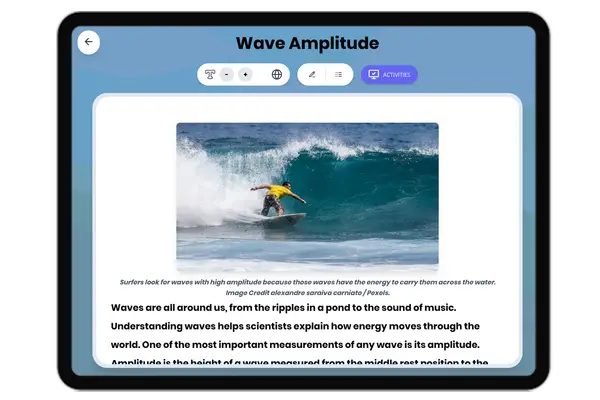
The amplitude is the height of a wave, measured from the middle line to the crest. A wave with greater amplitude carries more energy. Think of jumping rope—when you swing the rope higher, you create waves with greater amplitude. The wavelength is the distance from one crest to the next crest, or from one trough to the next trough. Wavelength tells us how long each wave pattern is.
Scientists use these four parts to describe all kinds of waves, including sound waves, light waves, and water waves. By measuring the crest, trough, amplitude, and wavelength, we can understand how waves carry energy and information through our world.
What is the highest point of a wave?
CrestTroughAmplitudeWavelength
What is the lowest point of a wave?
CrestWavelengthTroughAmplitude
How do you measure wave amplitude?
From crest to troughFrom middle line to crestFrom crest to crestFrom trough to trough
What does wavelength measure?
How tall the wave isHow fast the wave movesDistance from crest to crestThe lowest wave point
Which wave carries more energy?
Wave with greater amplitudeWave with smaller amplitudeWave with shorter wavelengthWave with longer wavelength
Scientists use wave parts to describe what?
Only water wavesOnly sound wavesAll kinds of wavesOnly light waves
Waves carry energy from place to place.
TrueFalse
What does the word 'amplitude' mean?
The distance between wave crestsThe height of a waveThe lowest wave pointThe speed of a wave
Perfect For:
👩🏫 Teachers
• Reading comprehension practice
• Auto-graded assessments
• Literacy skill development
👨👩👧👦 Parents
• Reading practice at home
• Comprehension improvement
• Educational reading time
🏠 Homeschoolers
• Reading curriculum support
• Independent reading practice
• Progress monitoring
Reading Features:
📖
Reading Passage
Engaging fiction or nonfiction text
❓
Comprehension Quiz
Auto-graded questions
📊
Instant Feedback
Immediate results and scoring
📄
Printable Version
Download for offline reading
🔊
Read Aloud
Voice-over with word highlighting
Reviews & Ratings
No reviews yet. Be the first to share your experience!
Related Content
What Is Wave Amplitude
This engaging 250-word reading passage introduces fourth-grade students to the concept of wave amplitude as outlined in ...
NGSS 4-PS4-1
Wave Crests and Troughs
This engaging 250-word passage introduces Grade 4-5 students to the fundamental parts of transverse waves: crests and tr...
NGSS 4-PS4-1
Circular Wave Patterns
This engaging 250-word science passage introduces Grade 4-5 students to circular wave patterns and how they behave in na...
NGSS 4-PS4-1
How Waves Move Objects
This engaging 250-word reading passage introduces fourth-grade students to the fundamental concept of how waves move obj...
NGSS 4-PS4-1
Straight Wave Pattern
This engaging reading passage introduces fourth-grade students to the concept of straight wave patterns as outlined in N...
NGSS 4-PS4-1
What Is Wavelength
This 250-word reading passage introduces fourth-grade students to the concept of wavelength as outlined in NGSS standard...
NGSS 4-PS4-1
What Are Waves
This comprehensive reading passage on waves is specifically designed for Grade 4 students and aligns with NGSS standard ...