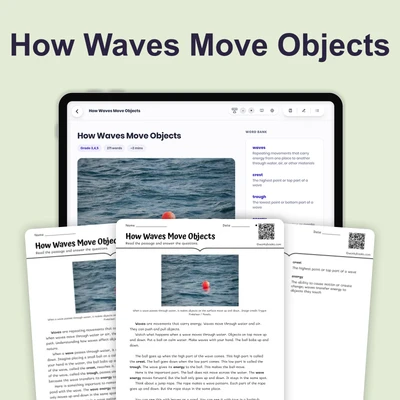
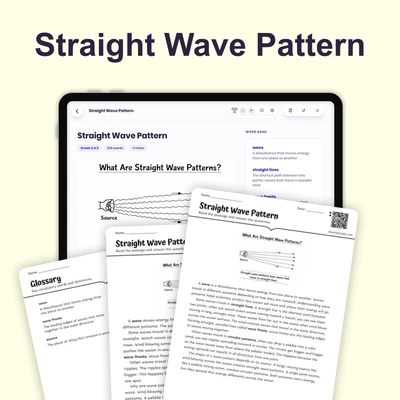
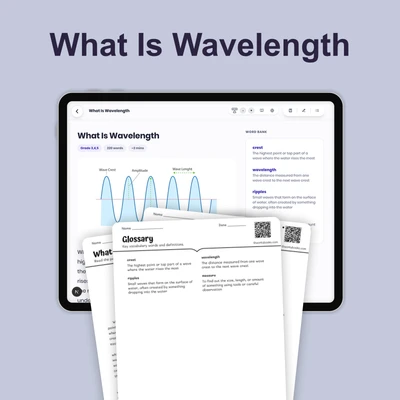
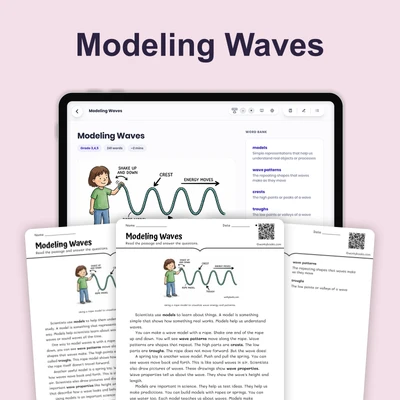
This learning resource is available in interactive and printable formats. The interactive worksheet can be played online and assigned to students. The Printable PDF version can be downloaded and printed for completion by hand.
This comprehensive reading passage on waves is specifically designed for Grade 4 students and aligns with NGSS standard 4-PS4-1. Students explore the fundamental concept that waves are disturbances that transfer energy from one place to another without moving matter. Using water waves as the primary example, the passage helps students understand the difference between wave motion and water motion. The resource includes audio-integrated reading support, making content accessible to all learners. Students discover how waves carry energy through various materials and why understanding waves matters in everyday life. The passage is accompanied by multiple activities including comprehension questions, writing prompts, and graphic organizers that reinforce key vocabulary such as wave, energy, disturbance, and motion. Spanish translations are provided for both the standard and simplified versions, supporting English language learners. This foundational understanding of wave behavior prepares students for deeper exploration of light and sound waves in subsequent lessons.
CONTENT PREVIEW
Expand content preview
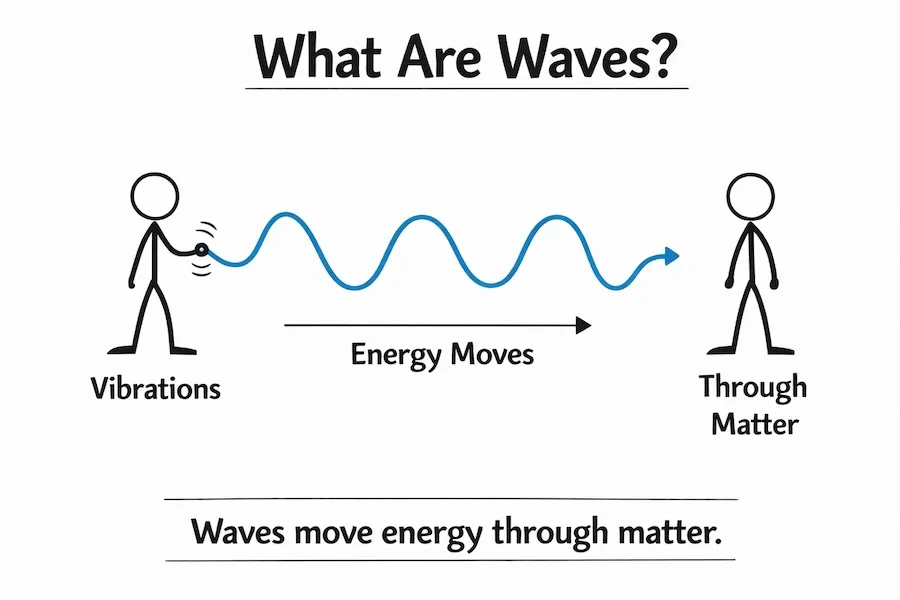
Waves are disturbances that move energy from one place to another. A wave is not made of matter moving from place to place. Instead, it is energy traveling through matter.
Water waves are a good example. When you drop a stone into a pond, you see waves move outward in circles. The water itself does not travel across the pond. If you watch a leaf floating on the water, you will see it bob up and down as the wave passes. The leaf moves up and down, but it stays in about the same spot. This shows that the water moves up and down while the wave moves forward.
Waves carry energy, not matter. The energy from the stone hitting the water travels outward through the water. This is called wave motion. The water particles move up and down or back and forth, but they do not move along with the wave.
Understanding waves helps us explain many things we observe. Ocean waves carry energy from wind across great distances. Sound travels as waves through air. Light reaches Earth as waves from the Sun. All these waves have one thing in common: they move energy from one location to another without moving the material itself.
What do waves move from place to place?
EnergyWaterMatterStones
How does a floating leaf move?
It travels across the pondIt moves up and downIt sinks to the bottomIt moves sideways only
What creates waves in a pond?
A leaf floatingWater moving forwardA stone hitting the waterThe wind stopping
Why doesn't water travel across the pond?
Water is too heavy to moveOnly energy moves, not matterThe pond is too smallWaves block the water
How do water particles move in waves?
They travel with the waveThey stay completely stillThey move up and downThey disappear and reappear
What do ocean waves and sound have?
They both need waterThey both carry energyThey both move matterThey both come from stones
Waves carry matter from place to place.
TrueFalse
What is wave motion?
Water traveling across a pondEnergy traveling through matterStones sinking in waterLeaves floating on water
Perfect For:
👩🏫 Teachers
• Reading comprehension practice
• Auto-graded assessments
• Literacy skill development
👨👩👧👦 Parents
• Reading practice at home
• Comprehension improvement
• Educational reading time
🏠 Homeschoolers
• Reading curriculum support
• Independent reading practice
• Progress monitoring
Reading Features:
📖
Reading Passage
Engaging fiction or nonfiction text
❓
Comprehension Quiz
Auto-graded questions
📊
Instant Feedback
Immediate results and scoring
📄
Printable Version
Download for offline reading
🔊
Read Aloud
Voice-over with word highlighting
Reviews & Ratings
No reviews yet. Be the first to share your experience!
Related Content
What Is Wave Amplitude
This engaging 250-word reading passage introduces fourth-grade students to the concept of wave amplitude as outlined in ...
NGSS 4-PS4-1
Wave Crests and Troughs
This engaging 250-word passage introduces Grade 4-5 students to the fundamental parts of transverse waves: crests and tr...
NGSS 4-PS4-1
Circular Wave Patterns
This engaging 250-word science passage introduces Grade 4-5 students to circular wave patterns and how they behave in na...
NGSS 4-PS4-1
What Are Parts of a Wave
This comprehensive Grade 4 physical science reading passage introduces students to the fundamental parts of a wave, alig...
NGSS 4-PS4-1
How Waves Move Objects
This engaging 250-word reading passage introduces fourth-grade students to the fundamental concept of how waves move obj...
NGSS 4-PS4-1
Straight Wave Pattern
This engaging reading passage introduces fourth-grade students to the concept of straight wave patterns as outlined in N...
NGSS 4-PS4-1
What Is Wavelength
This 250-word reading passage introduces fourth-grade students to the concept of wavelength as outlined in NGSS standard...