This learning resource is available in interactive and printable formats. The interactive worksheet can be played online and assigned to students. The Printable PDF version can be downloaded and printed for completion by hand.
This 250-word reading passage introduces fourth-grade students to the concept of wavelength as outlined in NGSS standard 4-PS4-1 and the PS4.A Disciplinary Core Ideas. Students learn that wavelength is the distance from one wave crest to the next crest, and that different waves have different wavelengths. The passage uses water waves as concrete, visual examples that fourth graders can easily understand and relate to their own experiences at pools, lakes, or oceans. The content builds foundational understanding of wave properties without assuming prior knowledge beyond third-grade standards. Audio-integrated features support diverse learners by providing multiple ways to access the content. The passage includes bolded vocabulary terms with immediate definitions, real-world examples, and age-appropriate language. Accompanying activities include comprehension questions, writing prompts, and graphic organizers that reinforce the core concepts. This resource helps teachers introduce wave properties in an accessible way that prepares students for hands-on investigations and deeper discussions about how waves transfer energy and information in our world.
CONTENT PREVIEW
Expand content preview
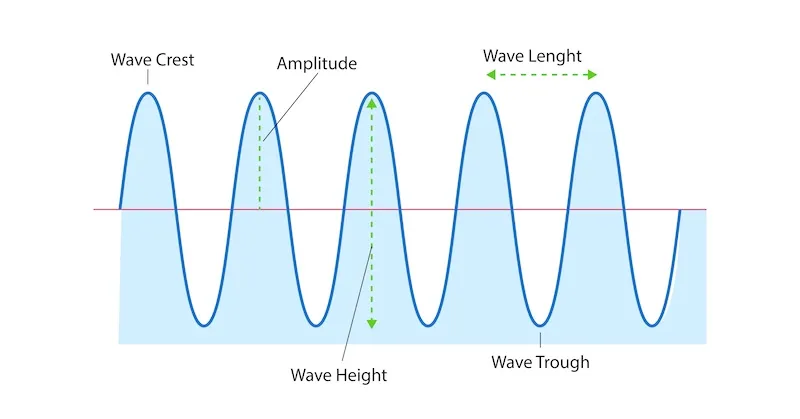
When you watch waves move across water, you can see high points and low points. The high point of a wave is called the crest. A crest is the top part of a wave where the water rises highest. Wavelength is the distance from one crest to the next crest. Scientists measure wavelength to understand how waves are different from each other.
Not all waves have the same wavelength. Some waves have long wavelengths, which means the crests are far apart. Imagine standing at a lake on a calm day. The waves might be gentle and spread out, with lots of space between each crest. These waves have long wavelengths. Other waves have short wavelengths, which means the crests are close together. Think about dropping a pebble in a puddle. The ripples that form have crests very close to each other. These ripples have short wavelengths.
Understanding wavelength helps us describe and compare different types of waves. When you look at ocean waves, you might notice that some days the waves are big and far apart, while other days they are small and close together. The distance between the crests—the wavelength—is one important way waves can be different. Whether in a bathtub, a swimming pool, or the ocean, all water waves have wavelengths that we can observe and measure.
What is the crest of a wave?
The highest point of the waveThe lowest point of the waveThe middle of the waveThe bottom of the wave
How do scientists measure wavelength?
From the bottom to the topFrom one crest to the next crestFrom the shore to the oceanFrom the water to the air
What do waves with long wavelengths have?
Crests that are close togetherCrests that are far apartNo crests at allVery tall crests only
Why would wavelength help compare different waves?
It shows wave color differencesIt measures water temperatureIt shows distance between crestsIt counts how many waves exist
What happens when you drop a pebble?
Ripples form with short wavelengthsRipples form with long wavelengthsNo waves form at allOnly one big wave forms
Which example shows waves with short wavelengths?
Gentle waves on a calm lakeWaves spread far apartRipples in a puddleBig ocean waves far apart
All water waves have wavelengths we can measure.
TrueFalse
What does wavelength measure?
How tall a wave isDistance between crestsHow fast waves moveThe color of water
Perfect For:
👩🏫 Teachers
• Reading comprehension practice
• Auto-graded assessments
• Literacy skill development
👨👩👧👦 Parents
• Reading practice at home
• Comprehension improvement
• Educational reading time
🏠 Homeschoolers
• Reading curriculum support
• Independent reading practice
• Progress monitoring
Reading Features:
📖
Reading Passage
Engaging fiction or nonfiction text
❓
Comprehension Quiz
Auto-graded questions
📊
Instant Feedback
Immediate results and scoring
📄
Printable Version
Download for offline reading
🔊
Read Aloud
Voice-over with word highlighting
Reviews & Ratings
No reviews yet. Be the first to share your experience!
Related Content
What Is Wave Amplitude
This engaging 250-word reading passage introduces fourth-grade students to the concept of wave amplitude as outlined in ...
NGSS 4-PS4-1
Wave Crests and Troughs
This engaging 250-word passage introduces Grade 4-5 students to the fundamental parts of transverse waves: crests and tr...
NGSS 4-PS4-1
Circular Wave Patterns
This engaging 250-word science passage introduces Grade 4-5 students to circular wave patterns and how they behave in na...
NGSS 4-PS4-1
What Are Parts of a Wave
This comprehensive Grade 4 physical science reading passage introduces students to the fundamental parts of a wave, alig...
NGSS 4-PS4-1
How Waves Move Objects
This engaging 250-word reading passage introduces fourth-grade students to the fundamental concept of how waves move obj...
NGSS 4-PS4-1
Straight Wave Pattern
This engaging reading passage introduces fourth-grade students to the concept of straight wave patterns as outlined in N...
NGSS 4-PS4-1
What Are Waves
This comprehensive reading passage on waves is specifically designed for Grade 4 students and aligns with NGSS standard ...