This learning resource is available in interactive and printable formats. The interactive worksheet can be played online and assigned to students. The Printable PDF version can be downloaded and printed for completion by hand.
This middle school science reading passage introduces students to the kinetic theory of matter, aligning with NGSS MS-PS1-4. Students will learn how all matter is made of constantly moving particles, how temperature reflects average kinetic energy, and why adding heat causes particles to move faster. The passage uses real-world examples like perfume diffusion and food coloring in water to illustrate these concepts, showing the connections between particle motion and observable phenomena. It also integrates scientific thinking, explaining how scientists use evidence to understand these processes. Designed for grades 6-8, the resource includes a glossary, Spanish translations, simplified versions for accessibility, comprehension quizzes, writing prompts, and graphic organizers. Audio integration supports diverse learners. This comprehensive resource helps students deepen their understanding of physical science concepts and prepares them for further study in chemistry and physics.
CONTENT PREVIEW
Expand content preview
The five postulates of KMT
The kinetic theory of matter describes how all substances are made of extremely small particles, such as atoms or molecules, that are always in motion. This theory helps explain why materials behave differently under various conditions. For example, when perfume is sprayed in one corner of a room, its scent eventually spreads throughout the entire space. Scientists use the kinetic theory to understand the causes behind this and similar everyday phenomena.
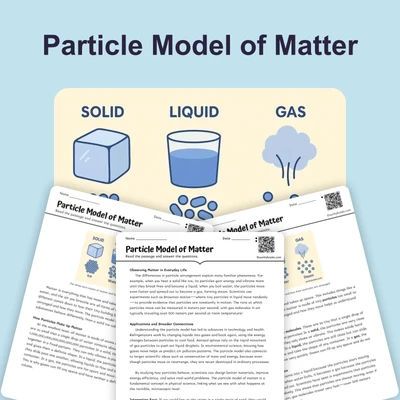
Particle Motion and Temperature Particles in solids, liquids, and gases are never completely still. In solids, particles vibrate in place and are closely packed. In liquids, they move more freely but still remain close together. In gases, particles move rapidly and are far apart. The speed at which particles move is related to temperature. Temperature measures the average kinetic energy of particles. When you add heat to a substance, the particles move faster because they gain energy. For instance, if you place a drop of food coloring in hot water, the color spreads quickly. This happens because the hotter water particles move faster, helping the coloring to disperse rapidly. In cold water, the movement is much slower.
Diffusion and Real-World Examples One important process explained by the kinetic theory is diffusion. Diffusion is the movement of particles from an area of high concentration to an area of low concentration. In the case of perfume, the scent particles move through the air until they are evenly spread out. This happens because air particles and perfume particles are always bumping into each other and moving around. The rate of diffusion increases with temperature because particles have more energy and move faster. This is also why food coloring spreads more quickly in warm water than in cold water. Scientists have measured that diffusion can be up to twice as fast in hot water compared to cold, depending on the temperature difference.
Broader Implications and Scientific Connections The kinetic theory not only explains diffusion but also other changes, such as melting, evaporation, and condensation. When heat is added to ice, the particles vibrate so much that they break free from their fixed positions, turning into liquid water. The theory connects to larger scientific principles, like the laws of thermodynamics, which describe how energy moves and changes in systems. Understanding kinetic theory has led to advances in technology, from refrigerators to air conditioning, and helps people make sense of everyday observations, such as why heating a room makes the air feel less dense.
In summary, the kinetic theory of matter provides a powerful explanation for why matter changes and moves. It shows the connection between energy, temperature, and the behavior of particles in different states. This theory is a foundation for many scientific discoveries and real-world technologies.
Interesting Fact: At absolute zero (−273.15°C), particles have their lowest possible energy, but they never stop moving completely!
What does the kinetic theory of matter explain?
How all matter is made of tiny, moving particlesWhy only liquids can moveHow energy is created from nothingWhy solids never change shape
Which state of matter has particles that vibrate in place and are tightly packed?
SolidsLiquidsGasesPlasmas
What is diffusion?
When particles move from high to low concentrationWhen particles stop movingWhen solids melt into liquidsWhen energy is lost
What happens to particle motion when heat is added to a substance?
Particles move fasterParticles stop movingParticles get biggerParticles shrink
What does temperature measure, according to the passage?
The average kinetic energy of particlesHow heavy the particles areThe size of the particlesThe color of the particles
Based on the passage, why does food coloring spread faster in hot water than cold?
Because hot water particles move fasterBecause hot water is heavierBecause cold water particles are largerBecause hot water is red
Why do scientists think diffusion happens faster at higher temperatures?
Particles have more energy and move fasterParticles are biggerParticles are more colorfulParticles lose energy
Which process is NOT explained by the kinetic theory according to the passage?
PhotosynthesisMeltingEvaporationCondensation
True or False: Particles in a solid are completely still and never move.
TrueFalse
True or False: At absolute zero, particles have their lowest energy but do not stop moving.
TrueFalse
Perfect For:
👩🏫 Teachers
• Reading comprehension practice
• Auto-graded assessments
• Literacy skill development
👨👩👧👦 Parents
• Reading practice at home
• Comprehension improvement
• Educational reading time
🏠 Homeschoolers
• Reading curriculum support
• Independent reading practice
• Progress monitoring
Reading Features:
📖
Reading Passage
Engaging fiction or nonfiction text
❓
Comprehension Quiz
Auto-graded questions
📊
Instant Feedback
Immediate results and scoring
📄
Printable Version
Download for offline reading
🔊
Read Aloud
Voice-over with word highlighting
Reviews & Ratings
No reviews yet. Be the first to share your experience!
Related Content
The Melting Point of Aluminum
This science reading passage, 'The Melting Point of Aluminum,' introduces middle school students to the physical propert...
5-PS1MS-PS1-4RI.6.3RI.7.1
The Melting Point of Copper
This reading passage, 'The Melting Point of Copper,' introduces middle school students to an important physical property...
5-PS1MS-PS1-4RI.6.3RI.7.1
The Melting Point of Substances
This middle school science reading passage, titled 'The Melting Point of Substances', explores the physical property kno...
5-PS1MS-PS1-4RI.6.3RI.7.1
The Boiling Point of Water
This passage, 'The Boiling Point of Water,' introduces students to the physical property of boiling point through one of...
5-PS1MS-PS1-4RI.6.3RI.7.1
The Melting Point of Steel
This engaging science passage, 'The Melting Point of Steel,' explains a key physical property of steel—its melting point...
5-PS1MS-PS1-4RI.6.3RI.7.1
Is Sublimation Endothermic or Exothermic?
This NGSS-aligned science passage for middle school explains the thermodynamic nature of sublimation, showing how a soli...
MS-PS1-4HS-PS1
How Many Valence Electrons Does Oxygen Have?
This NGSS-aligned science reading passage teaches middle school students about the number of valence electrons in oxygen...
MS-PS1-2MS-PS1-4
How Many Valence Electrons Does Chlorine Have?
This NGSS-aligned science reading passage explains how many valence electrons chlorine has and why that makes it such a ...
MS-PS1-2MS-PS1-4
What Is Vapor Pressure?
This NGSS-aligned science passage explains the concept of vapor pressure in an age-appropriate, engaging way for middle ...
MS-PS1-4MS-LS1-2
What is Freezing Point Depression
This passage, 'Freezing Point Depression,' introduces students to the physical science concept of how adding substances ...
5-PS1MS-PS1-4RI.6.3RI.7.1
Solids, Liquids, and Gases
This comprehensive middle school science passage explains the scientific concepts behind the three common states of matt...
MS-PS1-4
Behavior of Gases
This comprehensive reading passage explores the behavior of gases for middle school students, aligned with NGSS standard...
MS-PS1-4
Evaporation as Physical Change
This middle school science passage examines the process of evaporation, a fundamental physical change where a liquid tur...
MS-PS1-4
Physical Changes: Condensation
This middle school science passage explores the process of condensation, the physical change where a gas becomes a liqui...
MS-PS1-4
Sublimation as Physical Change
This educational passage for grades 6-8 explores the science of sublimation—a physical change where a solid transforms d...
MS-PS1-4
Physical Changes: Deposition
This middle school science passage explores the concept of deposition, a type of physical change where matter transition...
MS-PS1-4
Scientific Investigations
This passage, aligned with NGSS standards for grades 6-8, introduces students to the process of scientific investigation...
MS-ETS1-1MS-ETS1-2MS-ETS1-3MS-ETS1-4
Scientific Theories
This reading passage for grades 6-8 introduces students to the concept of scientific theories, emphasizing that these ar...
MS-PS1-1MS-PS1-4MS-PS3-4SCIENCE AND ENGINEERING PRACTICES
Particle Model of Matter
This comprehensive science reading passage for grades 6-8 explores the particle model of matter, aligning with NGSS stan...