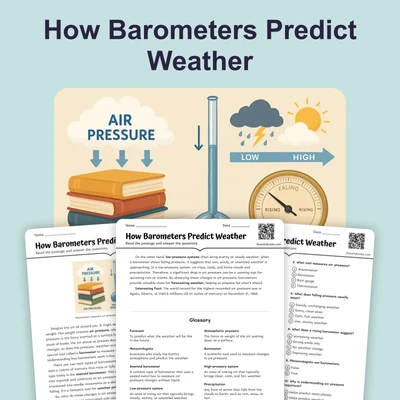
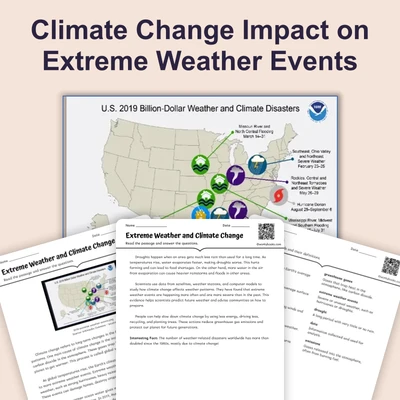
"This comprehensive reading passage, titled ""What is a Barometer?"", is designed for middle school students and aligns with NGSS standard MS-ESS2-5. It provides a detailed explanation of barometers, defining atmospheric pressure and its significance. The passage explores the two main types of barometers—mercury and aneroid—explaining their distinct mechanisms of action. Real-world applications, such as their use in weather forecasting, as altimeters in aviation, and in modern technology like smartphones, are highlighted to connect the concept to students' daily lives. Key vocabulary terms like 'atmospheric pressure' and 'altimeter' are bolded for emphasis. The content aims to be engaging and factual, promoting a deeper understanding of how these instruments help us understand our environment and predict weather patterns. The passage is suitable for self-study or classroom use to support a unit on Earth and space sciences."
Written by Workybooks TeamPublished by Workybooks
Preview
Sample passage and quiz content
CONTENT PREVIEW
Expand content preview
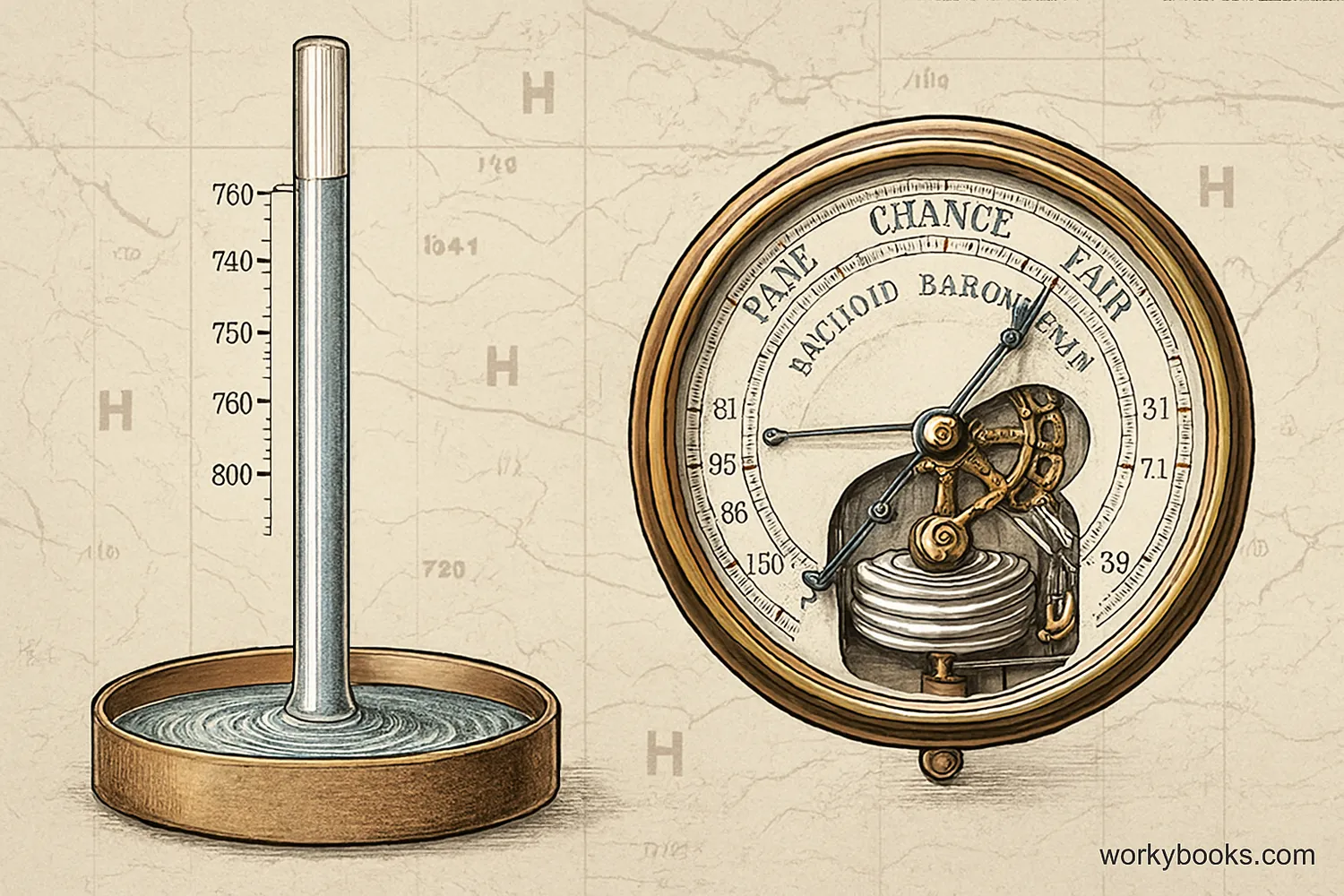
A visual comparison of a mercury barometer and an aneroid barometer, the two main types of instruments used to measure atmospheric pressure.
A barometer is a scientific instrument used to measure atmospheric pressure, which is the force exerted by the weight of the air above the Earth's surface. Think of the atmosphere as a vast ocean of air. Just as the pressure increases the deeper you dive into water, atmospheric pressure changes depending on your altitude and the weather. This pressure is an important factor for meteorologists and scientists to predict weather patterns. Changes in barometric pressure can signal an approaching weather system, making the barometer a valuable tool.
There are two primary types of barometers: mercury and aneroid. A mercury barometer is a simple yet accurate device. It consists of a glass tube with a sealed top, placed upside down in a small pool of mercury. The atmospheric pressure pushes down on the mercury in the pool, forcing some of the liquid metal up into the tube. The height of the mercury column in the tube is a direct measurement of the air pressure. A high column indicates high pressure, and a low column indicates low pressure.
The second type, an aneroid barometer, is more common today because it is smaller, safer, and does not use toxic mercury. The word "aneroid" means "without fluid." Inside this type of barometer is a small, sealed, flexible metal box called an aneroid capsule. When the atmospheric pressure increases, it squeezes the capsule, causing it to compress slightly. When the pressure decreases, the capsule expands. This tiny movement is amplified by a system of levers and springs, which moves a needle on a dial, providing a pressure reading.
Barometers have many real-world applications beyond simple weather forecasting. Pilots use them as altimeters—instruments that measure altitude. As a plane climbs higher, the air pressure decreases, and the altimeter translates this pressure drop into a measurement of height above sea level. Many smartphones and fitness trackers also contain tiny digital barometers to measure altitude changes for activities like hiking or climbing stairs. By monitoring the changes in air pressure, barometers give us valuable clues about our environment.
Fun Fact: The first barometer was invented in 1643 by Italian physicist Evangelista Torricelli, a student of Galileo.
How does a mercury barometer measure air pressure?
By using an aneroid capsuleBy measuring the expansion of a metal boxBy the height of a mercury column in a tubeBy monitoring changes in electrical resistance
What does "aneroid" mean?
With fluidWithout fluidWithout pressureWith high pressure
What is a possible consequence of a rapid drop in barometric pressure?
An approaching stormClear, sunny weatherA decrease in wind speedRising temperatures
Which of the following is an example of an aneroid barometer's use in daily life?
A car's speedometerA home thermometerA fitness tracker measuring altitudeA kitchen scale
Why are aneroid barometers more common than mercury barometers today?
They are more accurateThey are filled with waterThey are smaller and safer to useThey do not require calibration
Based on the passage, what is the best explanation for how an altimeter works?
It measures the force of gravity.It uses a barometer to measure altitude based on air pressure.It measures the speed of an aircraft.It calculates height using a GPS signal.
If a barometer reading is steadily increasing, what weather condition would a meteorologist likely predict?
An approaching cold frontAn approaching storm systemFair and stable weatherRapidly falling temperatures
Who it's for
Perfect for the way you teach
Teachers
Build comprehension skills
Auto-graded quiz
Differentiated reading
Parents
Read together at home
Improve fluency
Quiet reading time
Homeschoolers
Reading curriculum support
Independent practice
Track Lexile growth
Topics
barometeratmospheric pressureair pressureweather forecastinganeroid barometermercury barometeraltimeterMS-ESS2-5NGSSmiddle school science
Reviews & Ratings
No reviews yet. Be the first to share your experience!
More reading you might love
20 more
Climate and weather activity
This worksheet is perfect for understanding the differences between climate and weather. Students will read the phrases ...
Climate and Weather — Distinguishing Characterstics
This worksheet highlights the differences between climate and weather. The chart format makes comparing and contrasting ...
Comparing Weather and Climate Texts
This reading comprehension worksheet has 5th graders read two informational texts about Weather and Climate. Students th...
RI.5.9
Tools and Technology in Earth Science
This middle school science reading passage explores the wide range of tools and technologies used in Earth science, from...
MS-ESS2-2MS-ESS3-2MS-ETS1-1MS-PS4-3
What Is Space Weather and How Does It Affect the Earth?
This NGSS-aligned science passage for middle school explains what space weather is and how it affects Earth. Students le...
MS-ESS2-2
What Is Earth Science?
This engaging middle school science passage introduces students to the field of Earth science, aligning with NGSS standa...
MS-ESS1MS-ESS2MS-ESS3SEP
Extreme Weather and Climate Change
This Grade 6-8 science passage, aligned to NGSS standards, explores the impact of climate change on extreme weather even...
What Is The Difference Between Climate Model And Weather Model?
This reading passage delves into the fundamental differences between weather models and climate models, explaining their...
Scientific Inquiry in Earth Science
This passage explores scientific inquiry in Earth science for grades 6-8, aligned with NGSS standards MS-ESS1-4, MS-ESS2...
MS-ESS1-4MS-ESS2-1MS-ESS3-5SEP
How Earth Science Fields Work Together
This engaging 650-word informational passage explores how the four branches of Earth science—geology, oceanography, mete...
MS-ESS2-1
Mountains, Elevation, and Climate
This engaging middle school science passage explores the fascinating relationship between mountains, elevation, and clim...
MS-ESS2-6
How is Climate Different from Weather?
This passage distinguishes climate from weather for young readers. It defines climate as the usual weather patterns over...
RI.3.1RI.4.14.ESS2.D
Earth's Major Climate Zones Explained
This engaging science passage for grades 6-8 explains Earth's major climate zones, including tropical, temperate, and po...
Weather vs. Climate
This comprehensive passage for grades 6-8 explores the difference between weather and climate, aligning with NGSS standa...
MS-ESS2-6
Climate Through Earth's History
This engaging passage for grades 6-8 explores how Earth's climate has naturally changed over millions of years, highligh...
MS-ESS1-4MS-ESS2-6
Air Masses and Weather
This audio-integrated passage, "Air Masses and Weather," is designed for 6th-grade students to understand how the moveme...
How Earth Science Shapes Our World
This comprehensive 600-word reading passage introduces middle school students to Earth science and its practical applica...
MS-ESS3-1
Oceans and Climate Patterns
This passage explores the critical role of the oceans and water in shaping Earth's climate, aligned to NGSS standard MS-...
MS-ESS2-6
Polar Bears and Climate
This informational text on polar bears is a great way to practice reading comprehension. Students will read the passage ...
RI.4.1W.4.72-LS4-1RF.4.4
Earth: Our Home in Space
This engaging Grade 4-5 science passage, aligned to NGSS, introduces students to Earth's special place in the solar syst...