How Does Weather Radar Work
Interactive passage with audio narration, comprehension questions, and printable PDF.
By completing this purchase you agree to our Terms of Use and Privacy Policy. Your subscription renews automatically until you cancel. You can cancel anytime from your account settings. All sales are final and non-refundable. Digital content is available for download in your account immediately upon purchase.
What's included
How Does Weather Radar Work preview and details
About this printable How Does Weather Radar Work science reading passage, NGSS-aligned (Grades 5-8)
Sample passage and quiz from How Does Weather Radar Work
Reading passage and comprehension quiz preview
How Does Weather Radar Work
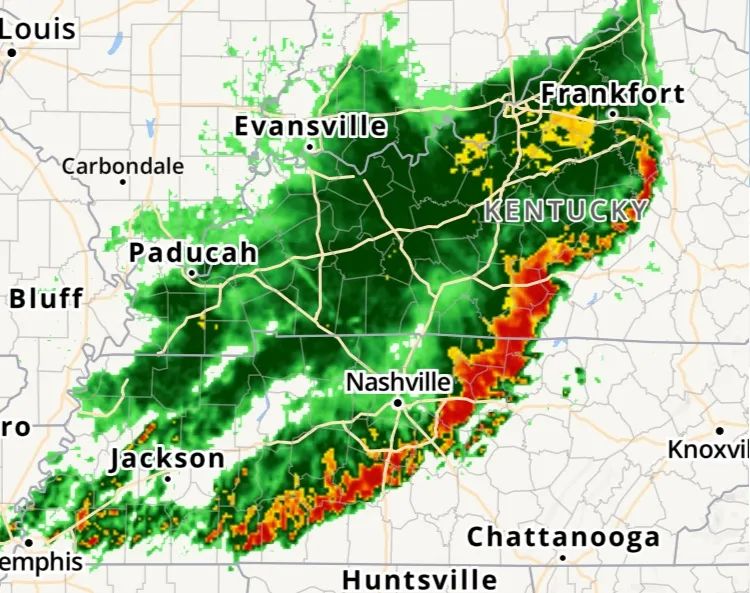
"Thunderstorm line in Tennessee on weather radar" by TNmitchy / Wikimedia Commons
Weather radar helps meteorologists track storms and predict dangerous weather conditions. Radar stands for "Radio Detection and Ranging." The system works by sending out radio waves that travel through the air until they hit objects like raindrops or snowflakes. When radio waves strike precipitation, they bounce back to the radar station. Scientists analyze these return signals to determine where precipitation is falling and how heavy it is.
Doppler radar provides even more information than basic weather radar systems. This technology uses the Doppler effect, which detects changes in the frequency of returning radio waves. When precipitation moves toward the radar, the return signal has a higher frequency. When precipitation moves away, the frequency decreases. This change allows meteorologists to measure wind speed and direction inside storms. Doppler radar can detect rotation within thunderstorms, which often indicates tornado formation.
The United States uses a network called NEXRAD, which stands for Next Generation Radar. This system includes over 160 Doppler radar stations positioned across the country. Each radar station sends out pulses of radio waves thousands of times per second. The pulses travel outward in a circular pattern, scanning the sky at different angles. When the radio waves encounter precipitation, some energy bounces back to the receiving antenna. Computers process this data and create colorful images showing precipitation location and intensity. Meteorologists use these images to track storm movement and issue weather warnings.
NEXRAD radars can detect tornado rotation early enough to provide 10 to 15 minutes of advance warning to communities. This early detection has saved thousands of lives since the system became operational in the 1990s. Weather radar cannot see through mountains or around the curve of Earth, so multiple radar stations work together to provide complete coverage. The data from all stations combines to give meteorologists a comprehensive view of weather patterns across large regions.
Interesting Fact: Weather radar can detect more than just rain and snow. It can also track swarms of insects, flocks of migrating birds, and even clouds of dust during severe windstorms.
Comprehension quiz (10 questions)
1. What does the acronym RADAR stand for?
2. How does weather radar detect precipitation?
3. What does the Doppler effect allow meteorologists to measure?
4. In the passage, the word 'frequency' most closely means:
5. What does 'precipitation' refer to in the context of weather radar?
6. Why is detecting rotation inside thunderstorms important?
7. How much advance warning can NEXRAD radars provide for tornadoes?
8. Why do multiple radar stations need to work together?
9. True or False: Weather radar can only detect rain and snow.
10. True or False: The NEXRAD system became operational in the 1990s.
Perfect for the way you teach
- Build comprehension skills
- Auto-graded quiz
- Differentiated reading
- Read together at home
- Improve fluency
- Quiet reading time
- Reading curriculum support
- Independent practice
- Track Lexile growth